
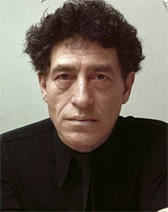
Alberto Giacometti
Swiss sculptor and painter known for his elongated human figures, including Walking Man, Standing Woman, and Man Pointing. His work developed through Cubism and Surrealism before he established his distinctive postwar sculptural style.
Born on October 10, 1901
Died on January 11, 1966
Age at death: 65
Profession: Painter, Sculptor
Place of Birth: Borgonovo, Stampa, Graubünden, Switzerland
Place of Death: Chur, Switzerland
Alberto Giacometti (October 10, 1901 – January 11, 1966) was a Swiss sculptor, painter, draftsman, and printmaker. His work incorporated elements of Cubism, Surrealism, and Expressionism, although it cannot be adequately classified within a single artistic movement. He is particularly known for the elongated, slender human figures he began producing in the second half of the 1940s. His sculptures, including Walking Man, Man Pointing, and Standing Woman, explored the human figure through variations in scale, proportion, and spatial relationships. He spent most of his professional life in Paris and worked closely with his brother Diego Giacometti, who assisted him with sculpture and furniture design.
Early Life and Family Background
Alberto Giacometti was born on October 10, 1901, in Borgonovo, near Stampa, in the Italian-speaking Bregaglia Valley of the canton of Graubünden, Switzerland. He was the eldest of four children born to painter Giovanni Giacometti and Annetta Stampa. His younger siblings were Diego Giacometti, Ottilia Giacometti, and Bruno Giacometti.
His father was associated with Swiss Post-Impressionism and introduced Alberto to painting and drawing at an early age. Growing up among his father's paintings and the mountainous landscapes of the Bregaglia Valley, he began making drawings, paintings, and sculptures during childhood.
In 1913, he painted an early oil composition commonly known as Apples on a Table. The following year, he made a sculpted portrait of his brother Diego, titled Head of Diego.
Family members frequently served as his models, particularly Diego, who later became his assistant and lifelong collaborator. His early artistic interests also included the works of Albrecht Dürer, Rembrandt, and Jan van Eyck.
Education and Artistic Influences
From 1915 to 1919, Alberto Giacometti attended the Evangelical School in Schiers, Switzerland. He studied literature, history, and natural sciences and developed an interest in political events, including the Russian Revolution of 1917.
His literary interests included German Romanticism and writers such as Johann Wolfgang von Goethe and Friedrich Hölderlin.
In 1919, he began studying painting, drawing, and sculpture in Geneva. The following year, he traveled to Italy, where he examined Renaissance painting and sculpture.
During visits to Venice, Padua, Florence, and Rome, he studied works by Giotto di Bondone, Tintoretto, Gentile Bellini, and Giovanni Bellini. He was also interested in Byzantine mosaics, Baroque architecture, and ancient Roman sculpture.
His encounters with Egyptian art, particularly sculpted heads and standing figures, became another influence on his approach to representing the human body.
Move to Paris and Early Sculptures
In January 1922, Alberto Giacometti moved to Paris to continue his artistic education. He studied sculpture with Antoine Bourdelle, a former associate of Auguste Rodin, at the Académie de la Grande Chaumière.
During the 1920s, he encountered Cubism and the work of sculptors including Alexander Archipenko, Henri Laurens, Jean Arp, and Jacques Lipchitz. He also studied African, Oceanian, and ancient Mexican sculpture.
Gradually moving away from direct representation, he developed simplified human forms and sculptural compositions based on memory and imagination.
Among his works from this period were The Couple (1926) and Spoon Woman (1927), in which the human figure was reduced to geometric and symbolic forms.
In 1926, he established a studio at 46 Rue Hippolyte-Maindron in Paris. The small workshop remained his principal working space for the rest of his life, apart from periods spent away during World War II.
He exhibited at the Salon des Tuileries and began developing relationships with Parisian artists, writers, and gallery owners.
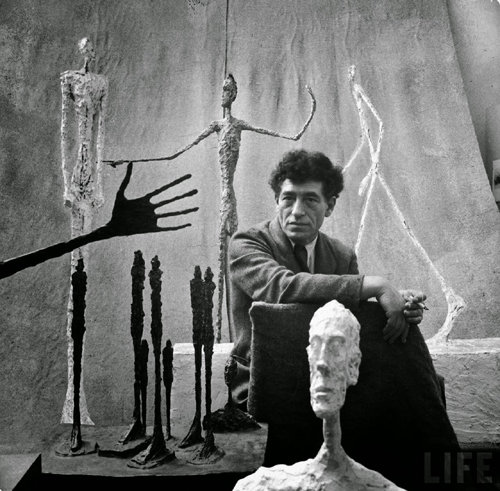
Examples of Alberto Giacometti's sculptures.
Surrealism and Experimental Sculpture
During the late 1920s, Alberto Giacometti became associated with artists and writers including Joan Miró, Max Ernst, Pablo Picasso, and Louis Aragon. He also met André Breton and Salvador Dalí, becoming involved with the Surrealist movement around 1930.
In 1929, he entered into an agreement with gallery owner Pierre Loeb, who exhibited his sculptural objects.
Giacometti's Surrealist works explored movement, sexual symbolism, dreams, and unexpected relationships between objects. They included Suspended Ball (1930–1931), The Palace at 4 a.m. (1932), The Cage, No More Play (1932), and The Invisible Object (1934–1935).
His first solo exhibition took place at the Galerie Pierre Colle in Paris in 1932. In 1934, he held his first American solo exhibition at the Julien Levy Gallery in New York.
During this period, he also designed decorative objects, lighting, and furniture with his brother Diego. He worked with interior designer Jean-Michel Frank and created jewelry designs for fashion designer Elsa Schiaparelli. These commissions provided income alongside his independent artistic work.
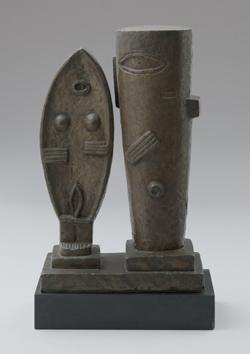
The Couple (Le Couple), 1926.
Break with Surrealism and Return to the Human Figure
In 1935, Alberto Giacometti returned to working directly from models. His renewed interest in observation and the representation of the human head contributed to his separation from the Surrealist group.
He concentrated on sculpted heads and busts, frequently using Diego and other acquaintances as models. Despite repeated attempts, he found it difficult to reconcile the apparent size of a person with the way that person appeared from a distance.
His sculptures gradually became smaller. During the late 1930s and early 1940s, he sometimes produced human figures only a few centimeters tall.
He maintained friendships with painters including Balthus, André Derain, Pierre Tal Coat, and Francis Gruber. He also became acquainted with philosophers Jean-Paul Sartre and Simone de Beauvoir.
Although he continued painting and sculpting, he largely withdrew from exhibiting his new work between 1935 and 1947.
World War II and Years in Geneva
Following the German occupation of France during World War II, Alberto Giacometti remained in Paris for a period before traveling to Switzerland in 1942.
He lived in Geneva until 1945, continuing to produce small sculptures and drawings. During these years, he became associated with publisher Albert Skira and contributed to artistic and literary activities.
In Geneva, he met Annette Arm, who later became his wife and one of his principal models.
He returned to Paris in 1945 and resumed work in the studio that Diego had maintained during his absence.
Postwar Sculptures and Elongated Figures
From 1946 onward, Alberto Giacometti began producing the elongated human figures for which he became internationally known. His standing women, walking men, and portrait busts were characterized by narrow bodies, textured surfaces, and pronounced relationships between figures and the space around them.
Works such as Man Pointing (1947), Walking Man (1947), and City Square (1948) developed from his continuing examination of the human body and the perception of distance.
The figures were often modeled in plaster or clay before being cast in bronze. Their rough surfaces preserved evidence of his repeated additions and removals of material.
In 1948, his first major solo exhibition after the war took place at the Pierre Matisse Gallery in New York. Jean-Paul Sartre wrote an essay titled The Search for the Absolute for the exhibition catalogue.
During the late 1940s and 1950s, Giacometti continued alternating between sculpture, painting, and drawing. His portraits frequently included his brother Diego, his wife Annette, and individuals from his Parisian circle.
Portraits, Literary Collaborations and Major Commissions
In the 1950s, Alberto Giacometti produced numerous portraits based on prolonged observation. Among his subjects were Jean Genet, Isaku Yanaihara, James Lord, and David Sylvester.
Yanaihara, a Japanese philosopher, posed for Giacometti during several visits to Paris between 1956 and 1961. The resulting paintings and sculptures formed part of the artist's continuing investigation into the human face.
Giacometti also developed a friendship with playwright Samuel Beckett. He designed the single tree used in Beckett's production of Waiting for Godot at the Théâtre de l'Odéon in Paris in 1961.
In 1959, he was invited to submit a proposal for monumental sculptures at the Chase Manhattan Bank Plaza in New York. He developed standing female figures, walking men, and a large head for the project. Although the commission was never completed as planned, the models contributed to his large-scale sculptural work.
He also began preparing lithographs and drawings for Paris Without End, a book portraying streets, interiors, and scenes from Paris. The volume was published posthumously in 1969.
International Exhibitions and Awards
Alberto Giacometti received increasing international recognition during the 1950s and 1960s. Retrospective exhibitions of his work were organized in London and New York in 1955.
In 1956, he represented France at the Venice Biennale, presenting a group of female figures known as Women of Venice.
In 1961, he received the sculpture prize at the Carnegie International in Pittsburgh. The following year, he won the Grand Prize for Sculpture at the Venice Biennale.
In January 1964, he received the Guggenheim International Award for Painting. That July, he attended the inauguration of the Fondation Maeght in Saint-Paul-de-Vence, where a courtyard and gallery were dedicated to his work. Joan Miró was among the other artists associated with the foundation's opening.
Major retrospective exhibitions followed in 1965 at the Tate Gallery in London, the Museum of Modern Art in New York, and the Louisiana Museum of Modern Art in Denmark.
He also received the Grand Prix National des Arts from the French government in 1965.
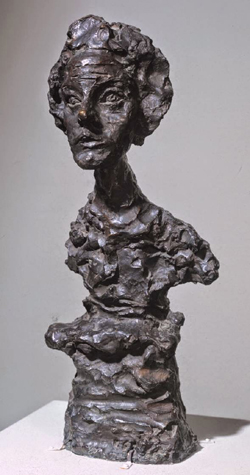
Bust of Annette, one of Giacometti's recurring portrait subjects.
Artistic Style
The work of Alberto Giacometti developed through several distinct approaches. His sculptures of the 1920s incorporated Cubist simplification and influences from ancient and non-European art. During the early 1930s, his objects and sculptural compositions became associated with Surrealism.
After 1935, he returned to direct observation and repeatedly examined the proportions and appearance of the human figure.
His postwar elongated figures have also been discussed in relation to existentialist philosophy, particularly through his friendship with Jean-Paul Sartre. Giacometti himself continued to emphasize the difficulty of accurately representing what he saw.
He worked in sculpture, oil painting, drawing, and printmaking, frequently returning to the same subjects over many years.
Marriage and Personal Life
Alberto Giacometti met Annette Arm in Geneva during World War II. She moved to Paris in 1946, and the couple married in 1949.
Annette became one of his principal models, appearing in numerous paintings, drawings, and sculptures. The couple had no children.
His younger brother Diego Giacometti remained an important collaborator throughout his career, assisting with the preparation and casting of sculptures and developing his own work as a furniture designer.
Giacometti also maintained close relationships with members of the Parisian artistic and literary community. During the final years of his life, a young woman known as Caroline became another frequent portrait subject.
Death
Alberto Giacometti died on January 11, 1966, at the cantonal hospital in Chur, Switzerland, at the age of 64. He had undergone surgery for stomach cancer in 1963 and experienced declining health during his final years. His death was attributed to cardiac exhaustion.
He was buried on January 15, 1966, in the cemetery of San Giorgio near Borgonovo, close to his birthplace.
After his death, Annette Giacometti worked to document, authenticate, and protect his artistic estate. She died on September 19, 1993.
Selected Works
1913 – Apples on a Table (Oil painting)
1914 – Head of Diego (Sculpture)
1926 – The Couple (Sculpture)
1927 – Spoon Woman (Sculpture)
1930–1931 – Suspended Ball (Sculpture)
1932 – The Palace at 4 a.m. (Sculpture)
1932 – No More Play (Sculpture)
1932 – Woman with Her Throat Cut (Sculpture)
1934–1935 – The Invisible Object (Sculpture)
1947 – Man Pointing (Sculpture)
1947 – Walking Man (Sculpture)
1948 – City Square (Sculpture)
1950 – The Chariot (Sculpture)
1956 – Women of Venice (Sculpture series)
1960 – Walking Man I (Sculpture)
1960 – Walking Man II (Sculpture)
1962 – Annette VIII (Sculpture)
1969 – Paris Without End (Illustrated book, published posthumously)
Selected Awards and Honors
1961 – First Prize for Sculpture, Carnegie International, Pittsburgh
1962 – Grand Prize for Sculpture, Venice Biennale
1964 – Guggenheim International Award for Painting
1965 – Grand Prix National des Arts, France
Source: Biyografiler.com
Frequently asked questions about Alberto Giacometti
Who is Alberto Giacometti?, Alberto Giacometti biography, Alberto Giacometti life story, Alberto Giacometti age, Alberto Giacometti facts, Alberto Giacometti birthplace, Alberto Giacometti photos, Alberto Giacometti videos, Alberto Giacometti career
Related Biographies

Lamine Yamal
Professional footballer

Kylian Mbappe
Professional footballer

Keanu Reeves
Actor

Erling Haaland
Professional footballer

Brad Pitt
Actor

Leonardo DiCaprio
Actor

Anton Dvorak
Composer

Antoine Lavoisier
Chemist

Antoine Bourdelle
Sculptor

Anthony van Dyck
Painter

Anthony Stewart Head
Actor, Singer

Antoni Gaudi
Architect

Gadi Eisenkot
Politician, Military Commander

Elizabeth Taylor
Actress

Susie Wiles
Political Consultant

Alberto Ascari
Formula 1 Driver

Michael Jordan
Professional Basketball Player

Ann-Margret
Actress, Singer