
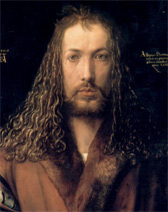
Albrecht Dürer
German Renaissance painter and printmaker known for his woodcuts, copper engravings, self-portraits, and studies of human proportions. His works include Melencolia I, Knight, Death and the Devil, Adam and Eve, and The Four Apostles.
Born on May 21, 1471
Died on April 6, 1528
Age at death: 57
Profession: Painter
Place of Birth: Nuremberg, Holy Roman Empire (present-day Germany)
Place of Death: Nuremberg, Holy Roman Empire (present-day Germany)
Albrecht Dürer (May 21, 1471 – April 6, 1528) was a German painter, engraver, draftsman, and art theorist associated with the Northern Renaissance. Born in Nuremberg, he developed techniques in woodcut printing and copper engraving while also producing religious paintings, portraits, landscapes, and theoretical writings. His travels to Italy brought him into contact with the artistic methods of the Italian Renaissance, particularly the study of perspective, anatomy, and proportion. Among his works are The Four Horsemen of the Apocalypse (1498), Adam and Eve (1504), Feast of the Rose Garlands (1506), Knight, Death and the Devil (1513), Saint Jerome in His Study (1514), and Melencolia I (1514). He also worked for Holy Roman Emperor Maximilian I and published treatises on geometry, fortification, and human proportions.
Early Life and Family Background
Albrecht Dürer was born on May 21, 1471, in Nuremberg, then a free imperial city within the Holy Roman Empire. His father, Albrecht Dürer the Elder, was a goldsmith who had emigrated from the Kingdom of Hungary. His mother, Barbara Holper, was the daughter of Nuremberg goldsmith Hieronymus Holper.
Dürer was one of eighteen children born to the couple, although only a small number survived to adulthood. His godfather was Anton Koberger, a Nuremberg printer and publisher.
As a young boy, he worked in his father's workshop, learning drawing, metalworking, and the use of engraving tools. His father initially intended him to become a goldsmith, but Dürer's interest in painting led to a change in his training.
In 1486, at the age of fifteen, he began an apprenticeship with Nuremberg painter and printmaker Michael Wolgemut.
Artistic Training and Early Career
Between 1486 and 1489, Albrecht Dürer trained in Wolgemut's workshop, where he studied painting, woodcut design, and book illustration.
Wolgemut's workshop produced religious paintings, altarpieces, and printed illustrations. It also contributed woodcuts to The Nuremberg Chronicle, published by Anton Koberger in 1493.
In 1490, shortly before beginning his travels as a journeyman, Dürer painted Portrait of Dürer's Father at 63, one of his earliest surviving oil paintings.
Between 1490 and 1494, he traveled through German-speaking territories, visiting artistic and publishing centers including Colmar, Basel, and Strasbourg.
In Colmar, he hoped to meet engraver Martin Schongauer, whose work he admired, but Schongauer had died in 1491, before Dürer's arrival.
While in Basel, Dürer worked on designs for woodcut illustrations. His early book illustration projects have been associated with editions of classical and medieval literature, including the comedies of Terence and the writings of Geoffroi de La Tour Landry, author of a medieval guide to the education of young women.
These years provided him with experience in the commercial production and distribution of printed images.
Marriage and First Journey to Italy
In July 1494, Albrecht Dürer returned to Nuremberg and married Agnes Frey, the daughter of a local craftsman, on July 7, 1494.
The marriage had been arranged through their families. The couple had no children.
Later that year, Dürer traveled to northern Italy, probably visiting Venice, Mantua, and Padua. During this journey, he studied Italian painting and encountered approaches to composition, perspective, and the representation of the human body that differed from those common in German workshops.
He studied the works of Italian artists including Andrea Mantegna and Giovanni Bellini.
After returning to Nuremberg in 1495, he established his own workshop and began producing paintings, engravings, and woodcuts for a growing market.
Woodcuts and the Apocalypse Series
During the late 1490s, Albrecht Dürer developed a series of woodcuts based on biblical subjects.
In 1498, he published Apocalypse, an illustrated edition of the Book of Revelation featuring fifteen major woodcuts.
Among its illustrations was The Four Horsemen of the Apocalypse, depicting the biblical riders associated with conquest, war, famine, and death.
Dürer used closely arranged lines, contrasting areas of light and darkness, and complex compositions to create detailed scenes within the limitations of woodblock printing.
He subsequently produced other religious print series, including The Large Passion, The Small Passion, and The Life of the Virgin.
His prints circulated through European publishing and commercial networks, reaching audiences beyond those who could purchase original paintings.
Second Journey to Italy
In 1505, Albrecht Dürer traveled to Italy for a second time and remained there until 1507.
He spent much of this period in Venice, where he encountered the paintings of Giovanni Bellini and the broader artistic environment of the Venetian Renaissance.
In 1506, he completed Feast of the Rose Garlands, an altarpiece commissioned for the German merchant community in Venice.
The painting combined religious figures, detailed portraiture, and the use of color associated with Venetian painting.
Dürer also traveled to Bologna, where he pursued his interest in mathematical perspective and geometric methods of representation.
His second Italian journey strengthened his engagement with the theoretical study of art, which became increasingly important in his later writings.
Painting, Portraiture and Religious Works
Albrecht Dürer produced numerous portraits and religious paintings throughout his career.
His self-portraits from 1493, 1498, and 1500 document changes in his artistic methods and his presentation of himself as a professional painter.
Among his other works were Adoration of the Magi (1504), Christ Among the Doctors (1506), Adam and Eve (1507), and The Adoration of the Trinity (1511).
He also produced portraits of patrons, scholars, and members of his family, including his father and mother.
In 1526, he completed The Four Apostles, two large painted panels depicting John the Apostle, Peter the Apostle, Mark the Evangelist, and Paul the Apostle. He presented the work to the city council of Nuremberg.
Major Engravings of 1513–1514
Between 1513 and 1514, Albrecht Dürer produced three copper engravings commonly discussed together as his master engravings: Knight, Death and the Devil, Saint Jerome in His Study, and Melencolia I.
Knight, Death and the Devil (1513) depicts an armored horseman traveling through a rocky landscape while accompanied by figures representing death and the devil.
Saint Jerome in His Study (1514) portrays the Christian scholar Jerome working in a carefully constructed interior illuminated by natural light.
Melencolia I (1514) depicts a winged figure surrounded by mathematical instruments, geometric forms, tools, and other objects. The engraving has been studied in relation to Renaissance ideas about melancholy, artistic creation, mathematics, and intellectual activity.
These works demonstrate Dürer's command of fine engraved lines, tonal variation, perspective, and symbolic composition.
Work for Emperor Maximilian I
From approximately 1512, Albrecht Dürer worked on artistic commissions associated with Holy Roman Emperor Maximilian I.
His projects included designs for imperial publications and monumental woodcut compositions.
Among these was The Triumphal Arch of Maximilian I, a large printed work assembled from numerous woodblocks.
In 1515, Dürer was awarded an annual imperial pension of 100 florins. His association with the imperial court continued until Maximilian's death in 1519.
During the same period, he exchanged drawings with Italian painter Raphael, whose work he admired.
Following the accession of Emperor Charles V, Dürer sought confirmation of his imperial pension.
Journey to the Netherlands
In July 1520, Albrecht Dürer traveled with his wife Agnes to the Low Countries, visiting cities including Antwerp, Brussels, Bruges, and Ghent.
He intended partly to obtain confirmation of his pension from Charles V, who had succeeded Maximilian I as Holy Roman Emperor.
During the journey, Dürer met artists, merchants, and scholars and examined works associated with the early Netherlandish painting tradition.
He visited churches, collections, and workshops, recording his experiences in a travel diary.
He also encountered works by Jan van Eyck and other Flemish painters.
In 1521, he returned to Nuremberg. During or shortly after the journey, he developed an illness that affected his health during the remaining years of his life.
Art Theory, Mathematics and Scientific Writing
Following his return to Nuremberg, Albrecht Dürer increasingly concentrated on artistic theory and the mathematical principles underlying representation.
He studied geometry, perspective, architecture, and the proportions of the human body.
In 1525, he published Underweysung der Messung (Instruction in Measurement), a treatise discussing geometric construction, perspective, and practical methods for artists and craftsmen.
In 1527, he published a work on fortification design titled Etliche Underricht zu Befestigung der Stett, Schloss und Flecken.
He also completed Vier Bücher von menschlicher Proportion (Four Books on Human Proportion), which examined mathematical approaches to human anatomy and figure drawing.
The latter work was published posthumously in 1528.
Final Years and Death
Albrecht Dürer spent his final years in Nuremberg, continuing to work on paintings, drawings, prints, and theoretical manuscripts.
He died on April 6, 1528, in Nuremberg, at the age of 56.
He was buried in St. John's Cemetery (Johannisfriedhof) in Nuremberg.
Selected Paintings
1490 – Portrait of Dürer's Father at 63
1493 – Self-Portrait at 22
1498 – Self-Portrait at 26
1500 – Self-Portrait at 28
1504 – Adoration of the Magi
1506 – Christ Among the Doctors
1506 – Feast of the Rose Garlands
1507 – Adam and Eve
1508 – Martyrdom of the Ten Thousand
1511 – The Adoration of the Trinity
1526 – The Four Apostles
Selected Engravings and Woodcuts
1498 – The Four Horsemen of the Apocalypse
1498 – The Great Whore of Babylon
1498 – The Sea Monster
1498–1499 – The Dream of the Doctor
1504 – Adam and Eve (Engraving)
1513 – Knight, Death and the Devil
1514 – Saint Jerome in His Study
1514 – Melencolia I
1515 – The Rhinoceros (Woodcut)
1515 – The Triumphal Arch of Maximilian I (Woodcut project)
Selected Publications
1498 – Apocalypse (Illustrated woodcut series)
1511 – The Large Passion (Published edition)
1511 – The Life of the Virgin (Published edition)
1511 – The Small Passion (Published edition)
1525 – Underweysung der Messung (Instruction in Measurement)
1527 – Etliche Underricht zu Befestigung der Stett, Schloss und Flecken (Treatise on Fortification)
1528 – Vier Bücher von menschlicher Proportion (Four Books on Human Proportion; published posthumously)
Source: Biyografiler.com
Frequently asked questions about Albrecht Dürer
Who is Albrecht Dürer?, Albrecht Dürer biography, Albrecht Dürer life story, Albrecht Dürer age, Albrecht Dürer facts, Albrecht Dürer birthplace, Albrecht Dürer photos, Albrecht Dürer videos, Albrecht Dürer career
Related Biographies

Lamine Yamal
Professional footballer

Kylian Mbappe
Professional footballer

Keanu Reeves
Actor

Erling Haaland
Professional footballer

Brad Pitt
Actor

Leonardo DiCaprio
Actor

Anton Dvorak
Composer

Antoine Lavoisier
Chemist

Antoine Bourdelle
Sculptor

Anthony van Dyck
Painter

Anthony Stewart Head
Actor, Singer

Antoni Gaudi
Architect

Susie Wiles
Political Consultant

Gadi Eisenkot
Politician, Military Commander

Elizabeth Taylor
Actress

Alberto Ascari
Formula 1 Driver

Michael Jordan
Professional Basketball Player
Antoine Bourdelle
Sculptor