
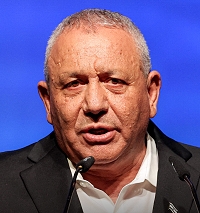
Gadi Eisenkot
Chief of the General Staff of the Israel Defense Forces (2015–2019), former National Unity Party lawmaker, and founder of the Yashar! Party.
Born on May 19, 1960
Age: 66
Profession: Politician, Military Commander
Place of Birth: Tiberias, Israel
Gadi Eisenkot, born on May 19, 1960, in Tiberias, Israel, is an Israeli politician and retired lieutenant general who served as the 21st Chief of the General Staff of the Israel Defense Forces (IDF) from February 2015 to January 2019. After a 41-year military career, he entered politics in 2022 as a member of the National Unity Party led by Benny Gantz. He served as a minister without portfolio and an observer in Israel's war cabinet during the Gaza war that began in October 2023. In September 2025, he founded the centrist Yashar! Party. His party won 21 seats in the October 27, 2026, parliamentary election. On November 7, 2026, Israeli President Isaac Herzog selected him to attempt to form a new government following the election, in which no political bloc secured a parliamentary majority.
Early Life and Education
Gadi Eisenkot was born on May 19, 1960, in Tiberias, Israel, to Meir Eisenkot and Esther Eisenkot, Jewish immigrants from Morocco who had settled in Israel during the 1950s. He was the second of four children. His family later moved to Eilat, a city on the Red Sea in southern Israel, where he spent much of his childhood.
He attended Goldwater High School in Eilat, where he studied maritime subjects. After completing his secondary education, he entered military service in 1978.
During his military career, Gadi Eisenkot pursued higher education alongside his professional responsibilities. He received a bachelor's degree in general history from Tel Aviv University and a master's degree in political science from the University of Haifa.
In 1997, he completed postgraduate studies in military strategy and security at the United States Army War College in Carlisle, Pennsylvania. His training covered military planning, strategic leadership, and national security.
Beginning of His Military Career
Gadi Eisenkot enlisted in the Israel Defense Forces on October 19, 1978. After briefly attending an Israeli Air Force pilot training course, he transferred to the Golani Brigade, one of the Israeli military's infantry formations.
He began his service in the brigade's 51st Battalion, initially serving as an infantry soldier before becoming a squad commander and officer. During the 1982 Lebanon War, he commanded an infantry company.
Over the following years, he held several command positions within the Golani Brigade. These included commanding an anti-tank company, serving as brigade operations officer, commanding the 13th Battalion, and becoming deputy commander of the brigade.
From 1997 to 1998, Gadi Eisenkot served as commander of the Golani Brigade. The appointment followed nearly two decades of military service in infantry and operational command positions.
Senior Military Appointments
Following his command of the Golani Brigade, Gadi Eisenkot held several senior appointments within the IDF. Between 1999 and 2001, he served as military secretary to senior Israeli government officials, working on matters involving military operations and national security.
From 2001 to 2003, he commanded the Amud HaEsh Division. He subsequently became commander of the Judea and Samaria Division, responsible for Israeli military operations in parts of the occupied West Bank, serving from 2003 to 2005.
Between 2005 and 2006, he headed the IDF Operations Directorate. In 2006, he was appointed head of the Northern Command, which oversees military activities along Israel's borders with Lebanon and Syria. He remained in that position until 2011.
His period as Northern Command commander included the 2006 Lebanon War between Israel and Hezbollah. He later became associated with the Israeli military's approach to using extensive firepower against areas from which Hezbollah operated, commonly discussed in connection with the Dahiya doctrine. The doctrine has attracted criticism over the risks it poses to civilians and civilian infrastructure.
From 2013 to 2014, Gadi Eisenkot served as Deputy Chief of the General Staff, the second-highest position in the Israeli military.
Chief of the General Staff of the Israel Defense Forces
On February 16, 2015, Gadi Eisenkot became the 21st Chief of the General Staff of the Israel Defense Forces, succeeding Benny Gantz. He held the rank of lieutenant general, known in Hebrew as Rav Aluf, the highest military rank in the IDF.
During his tenure, the Israeli military implemented the multiyear Gideon Plan, which addressed organizational restructuring, military readiness, personnel management, and the allocation of resources to operational units.
His period as chief of staff included Israeli military operations in Gaza, along the Lebanese border, and in Syria. The IDF also conducted Operation Good Neighbor, through which Israel provided humanitarian and medical assistance to Syrians near the border during the Syrian civil war.
In December 2018, the IDF launched Operation Northern Shield, an operation intended to locate and destroy tunnels crossing from Lebanon into Israeli territory that Israel attributed to Hezbollah. The operation continued into January 2019.
Gadi Eisenkot completed his term as Chief of the General Staff in January 2019. He retired after approximately 41 years of military service and was succeeded by Aviv Kochavi.
Entry into Politics and the National Unity Party
After leaving the military, Gadi Eisenkot became involved in Israeli political discussions. In 2022, he joined the National Unity Party, a political alliance led by former defense minister and fellow former IDF chief of staff Benny Gantz.
He entered the Knesset, Israel's parliament, following the November 2022 election. His political activities focused on national security, the functioning of state institutions, and relations between the military and civilian government.
The National Unity Party initially remained outside the government led by Prime Minister Benjamin Netanyahu, which took office in December 2022.
War Cabinet Role After October 7, 2023
On October 7, 2023, Hamas-led armed groups attacked southern Israel, killing approximately 1,200 people and taking about 250 hostages, according to Israeli figures. Israel subsequently launched a military campaign in the Gaza Strip, resulting in extensive destruction, displacement, and large numbers of Palestinian casualties.
Following the attacks, Gadi Eisenkot joined the emergency government formed by Benjamin Netanyahu and Benny Gantz. He served as a minister without portfolio and participated in the war cabinet as an observer without voting rights.
His responsibilities involved participation in discussions concerning military operations, the hostages held in Gaza, and Israel's wartime policies.
During 2024, disagreements developed between members of the emergency government over the management of the war, the return of hostages, and plans for governing Gaza after the fighting.
On June 9, 2024, Benny Gantz announced that the National Unity Party was leaving the emergency government. Gadi Eisenkot also resigned from his ministerial position and war cabinet role. He subsequently criticized the government's handling of wartime decisions and called for clearer strategic objectives.
Leaving National Unity and Founding Yashar!
On July 1, 2025, Gadi Eisenkot announced his departure from the National Unity Party led by Benny Gantz. He also resigned from the Knesset, with his departure taking effect in early July.
On September 16, 2025, he announced the establishment of a new political party called Yashar! with Eisenkot, commonly known as Yashar!. The Hebrew name Yashar means "straight" or "upright" and refers to the party's emphasis on integrity in government.
The party's declared platform included strengthening national security, introducing broader military or national service obligations, improving public education, reducing social inequalities, and maintaining Israel's character as a Jewish and democratic state.
Among the individuals associated with the new political organization were former military officers, public officials, and figures from business and civil society.
2026 Parliamentary Election
In July 2026, Gadi Eisenkot formally announced his candidacy for prime minister ahead of the parliamentary election scheduled for October. He presented his party as an alternative to the government of Benjamin Netanyahu.
The Yashar! Party submitted its candidate list for the election to the 26th Knesset. The list included former Shin Bet director Yoram Cohen, former minister Orit Farkash-Hacohen, and social entrepreneur Adi Altschuler.
The parliamentary election took place on October 27, 2026. Yashar! received approximately 16.1 percent of the vote and won 21 seats in the 120-member Knesset, becoming the second-largest party after Likud.
Neither Netanyahu's governing bloc nor the opposition parties secured enough seats to form a government independently. The result led to negotiations among the parliamentary factions over possible coalition arrangements.
Selection to Form a Government in November 2026
Following the October 2026 election, Israeli President Isaac Herzog consulted representatives of the parties elected to the Knesset to determine which politician should receive the first opportunity to form a government.
By November 5, representatives of parties holding 67 parliamentary seats had recommended Gadi Eisenkot, while parties holding 46 seats supported Benjamin Netanyahu. Seven lawmakers did not recommend either candidate.
On November 7, 2026, President Herzog selected Eisenkot to attempt to form the next government, with the formal mandate scheduled to be presented on November 8. Under Israeli law, the designated candidate receives 28 days to assemble a coalition, with the possibility of a 14-day extension.
The decision did not make Eisenkot prime minister. Forming a government still required negotiations among political parties and obtaining the parliamentary support necessary for a governing coalition.
Family and Personal Life
Gadi Eisenkot is married to Hana Eisenkot. The couple have five children and have lived in Herzliya, Israel.
On December 7, 2023, their son Gal Eisenkot, a 25-year-old Israeli reserve soldier, was killed during an Israeli military operation in the Jabalia area of the Gaza Strip. His death occurred while his father was serving in Israel's emergency government.
Two of Eisenkot's nephews also died during military operations in Gaza. Maor Cohen-Eisenkot was killed in December 2023, shortly after Gal's death. Yogev Pazi was killed in November 2024.
The deaths of his son and nephews took place during the Gaza war, which began following the October 7, 2023 attacks.
Source: Biyografiler.com
Frequently asked questions about Gadi Eisenkot
Who is Gadi Eisenkot?, Gadi Eisenkot biography, Gadi Eisenkot life story, Gadi Eisenkot age, Gadi Eisenkot facts, Gadi Eisenkot birthplace, Gadi Eisenkot photos, Gadi Eisenkot videos, Gadi Eisenkot career
Related Biographies

Lamine Yamal
Professional footballer

Kylian Mbappe
Professional footballer

Keanu Reeves
Actor

Erling Haaland
Professional footballer

Brad Pitt
Actor

Leonardo DiCaprio
Actor

Antoni Gaudi
Architect

Antonija Misura
Former Professional Basketball Player

Gadi Eisenkot
Politician, Military Commander

Ann-Margret
Actress, Singer

Anitta
Singer, Dancer

Anjelika Akbar
Pianist, Composer


Adriana Lima
Model, Actress
Gadi Eisenkot
Politician, Military Commander

Elizabeth Taylor
Actress

Paul Cézanne
Painter

Reza Pahlavi (II)
Political Activist