
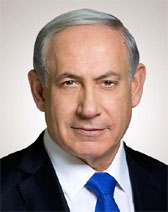
Benjamin Netanyahu
Born on October 21, 1949
Age: 77
Profession: Politician, Statesman
Place of Birth: Tel Aviv, Israel
Benjamin Netanyahu, widely known by his nickname “Bibi,” is regarded as the most right-wing and one of the most controversial politicians and prime ministers in the history of Israel.
Benjamin Netanyahu was born on 21 October 1949 in Tel Aviv as the son of Zila Netanyahu and Benzion Netanyahu. The Netanyahu family has roots connected to Lithuanian Jews. His father was a professor of Jewish history, the first editor of the Hebrew Encyclopedia, and an aide to Ze'ev Jabotinsky. His elder brother Yonatan Netanyahu was killed during the Entebbe Operation in 1976, becoming a national symbol in Israel. His younger brother Iddo Netanyahu is a radiologist and writer. All three brothers served in the elite Sayeret Matkal reconnaissance unit.
When Netanyahu was 14 years old, his family emigrated to the United States and settled in Cheltenham Township, Pennsylvania, a suburb of Philadelphia. He attended Cheltenham High School, where he completed his secondary education.
Between 1956–1958 and 1963–1967, Netanyahu lived in Philadelphia. After graduating from high school in 1967, he returned to Israel and enlisted in the Israel Defense Forces. He underwent combat training and became a team leader in the elite Sayeret Matkal special forces unit.
Following his military service, Netanyahu returned to the United States. In 1975, he completed his undergraduate studies in architecture. In 1977, he earned a master’s degree from the MIT Sloan School of Management. During his studies, he worked at the Boston Consulting Group. After graduating, he returned to Israel and briefly worked as a salesman for a furniture company.
Netanyahu was first elected Prime Minister on 18 June 1996, serving until 6 July 1999. He returned to office on 31 March 2009. He had already secured his place in history by becoming Israel’s youngest prime minister in 1996 and the first to be elected directly by popular vote. His first term, however, lasted only three years despite his electoral success based on a tough stance against terrorism and opposition to territorial concessions to the Palestinians.
Although short, his first term in office was highly turbulent. Following his order to reopen the Western Wall tunnel, clashes erupted between Palestinians and Israelis, resulting in dozens of deaths. Later in his term, he made a decision that contradicted his “hawkish” image by transferring much of the control of the West Bank city of Hebron to the Palestinians.
In 1997, and one year later through an agreement with Yasser Arafat, Netanyahu transferred 13 percent of the West Bank to the Palestinian Authority. These decisions disappointed the far right, while failing to convince supporters of land-for-peace agreements with the Palestinians.
In May 1999, early elections called by his own decision resulted in defeat against the Labor Party. Shortly thereafter, he also lost the leadership of the Likud Party to Ariel Sharon, leaving him with little choice but to step away from politics. His absence, however, was brief.
In 2002, during the government of Ariel Sharon, Netanyahu returned to politics as Foreign Minister. In 2005, while serving as Finance Minister, he resigned in protest against Sharon’s decision to dismantle Jewish settlements in Gaza.
Shortly afterward, political fortune turned in his favor once again. When Sharon left Likud to form a new party, Netanyahu was re-elected as leader of Likud. As party leader and a renewed contender for the premiership, he ran an election campaign marked by harsh rhetoric against Hamas.
Netanyahu argued that Israel’s military operations in Gaza had ended prematurely and pledged to eliminate Hamas if elected. His tough stance toward Iran also attracted global attention. At the Davos summit, he described Iran’s potential acquisition of nuclear weapons as a greater threat than the global financial crisis.
On the Palestinian issue, Netanyahu rejected a two-state solution in favor of an economic framework, advocating what he called “economic peace” as a prerequisite for political progress.
During his campaign, Netanyahu sought to soften his “hawkish” image by removing radical figures from the party list and pledging to continue peace negotiations with the Palestinians, as well as promising not to establish new Jewish settlements in Palestinian territories.
The world had first become familiar with Netanyahu during his tenure as Israel’s permanent representative to the United Nations. Educated in political science at Harvard University, he entered politics in 1988 and was elected to parliament the same year.
Marriages:
1st wife: Miriam Weizmann (m. 1972–1978), child: Noa Netanyahu-Roth (b. 1978)
2nd wife: Fleur Cates (m. 1981–1984)
3rd wife: Sara Netanyahu (m. 1991), children: Yair Netanyahu (b. 1991), Avner Netanyahu (b. 1994)
As leader of Likud, Netanyahu served uninterruptedly as Prime Minister from 31 March 2009 to 13 June 2021, becoming the longest-serving prime minister in Israeli history with a total of 12 consecutive years in office.
During this 12-year period, the Israeli military carried out multiple operations and attacks in the Gaza Strip, including operations named “Pillar of Defense” in 2012 and “Protective Edge” in 2014.
Under Netanyahu’s leadership, Israel signed normalization agreements in 2020 with the United Arab Emirates, Bahrain, Sudan, and Morocco.
Netanyahu also entered history as the first Israeli prime minister to be tried while in office, facing charges of corruption and abuse of power.
Following the dissolution of the Knesset on 29 June 2022 and the decision to hold early elections on 1 November 2022, Naftali Bennett transferred the premiership to his coalition partner Yair Lapid. After Likud’s victory in the elections, Yair Lapid handed over the office to Benjamin Netanyahu on 29 December 2022.
Source: Biyografiler.com
News about Benjamin Netanyahu

2026 Oscars: “One Battle After Another” Dominates a Historic Night
The 98th Academy Awards, held on March 15, 2026, delivered a ceremony packed with major victories, emotional speeches, historic milestones, and a few ...
Hollywood Stars Slam Donald Trump Over Iran Strikes, Call for Impeachment
U.S. and Israeli military operations against Iran have triggered strong reactions not only in diplomatic and political circles but also across the cul...
Frequently asked questions about Benjamin Netanyahu
Who is Benjamin Netanyahu?, Benjamin Netanyahu biography, Benjamin Netanyahu life story, Benjamin Netanyahu age, Benjamin Netanyahu facts, Benjamin Netanyahu birthplace, Benjamin Netanyahu photos, Benjamin Netanyahu videos, Benjamin Netanyahu career
Related Biographies

Lamine Yamal
Professional footballer

Erling Haaland
Professional footballer

Kylian Mbappe
Professional footballer

Austin Abrams
Actor

Bad Bunny
Rapper, Songwriter

Sam Altman
Entrepreneur, Investor, CEO


Hongjoong
Singer, Rapper, Songwriter, Composer

Ludacris
Rapper, Actor

Kwon Eunbi
Singer

Sarah Wayne Callies
Actress, Screenwriter, Producer, Director

LaTavia Roberson
Singer, Actress, Entrepreneur
Lamine Yamal
Professional footballer

Amber Heard
Actress, Model
Erling Haaland
Professional footballer
Bad Bunny
Rapper, Songwriter
Kylian Mbappe
Professional footballer
Austin Abrams
Actor