
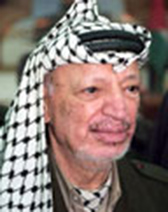
Yasser Arafat
“Abu Ammar” – Iconic Leader of the Palestinian National Struggle
Born on August 24, 1929
Died on November 11, 2004
Age at death: 75
Profession: Politician, Political Leader
Place of Birth: Cairo, Kingdom of Egypt
Place of Death: Clamart, France
Yasser Arafat was a Palestinian political leader, former President of Palestine, and one of the most prominent figures of the Arab–Israeli wars. He was internationally known as the leader of the Palestine Liberation Organization (PLO) and as the symbol of the Palestinian struggle for independence.
Yasser Arafat was born as Mohammed Abdel Rahman Abdel Raouf Arafat al-Qudwa al-Husseini on 24 August 1929 in Cairo, Egypt, as the sixth of seven children to Palestinian parents. His father, Abdel Raouf al-Qudwa al-Husseini, was a textile merchant from Gaza, while his mother, Zehwa Abu Saud, was Egyptian. After his mother died of kidney disease in 1933, Arafat and his younger brother Fathi Arafat were sent to live with their grandmother in the Moroccan Quarter of the Old City of Jerusalem. He later returned to Cairo, where he was raised by his sister Inam Arafat.
Arafat spent much of his childhood in East Jerusalem, living close to the Western Wall. His family home was later demolished following Israel’s occupation of East Jerusalem to make space for the plaza near the Wall. He completed his primary education in Jerusalem and his secondary education in Gaza, where his family relocated after the Israeli occupation.
His political awakening began at the age of 18 with the establishment of the State of Israel. In 1947, Arafat enrolled in the Faculty of Civil Engineering at King Fuad I University in Cairo, graduating in 1956. During his university years, he immersed himself in Arab nationalism and studied Zionist ideology through the works of Theodor Herzl and other leading Zionist thinkers.
During the 1947–1949 Arab–Israeli War, Arafat served as secretary to Palestinian commander Abdel Qadir al-Husseini and played a role in organizing Palestinian combat units. He helped smuggle weapons into British-mandate Palestine for use by the Arab Higher Committee and the Army of the Holy War. Around this period, together with fellow engineering students, he laid the foundations of what would later become Fatah.
In the 1948 war, Arafat attempted to join Arab forces fighting Israeli troops and was involved in guerrilla activities against British forces in the Suez Canal zone. He was responsible for training volunteer university students and remained active within the Palestinian Students’ Union. Though sympathetic to the Muslim Brotherhood, he never formally joined any political party, believing existing movements were incapable of carrying the Palestinian cause.
After the war turned decisively in Israel’s favor, Arafat returned to Cairo due to logistical difficulties and resumed his studies. From 1952 to 1956, he served as president of the Palestinian Students’ Federation. During the Suez Crisis of 1956, he joined the Egyptian Army and later participated in sabotage operations against British and French forces during the Second Arab–Israeli War.
Following the Suez Crisis, President Gamal Abdel Nasser accepted the deployment of UN emergency forces in Sinai and Gaza, leading to the expulsion of guerrilla fighters from the region. In 1957, Arafat moved to Kuwait, where he worked as a civil engineer and reunited with fellow Palestinians Salah Khalaf (Abu Iyad) and Khalil al-Wazir (Abu Jihad). Together, they reorganized Palestinian resistance, formally establishing Fatah in 1959. Arafat adopted the nom de guerre “Abu Ammar,” which would become synonymous with his identity.
International attention followed when Time magazine featured Arafat on its cover on 13 December 1963. He soon emerged as a national hero across the Arab world, attracting financial and military support for Fatah.

After the founding of the Palestine Liberation Organization (PLO) in June 1964, Fatah became its largest faction. In 1969, Yasser Arafat was appointed Chairman of the PLO Executive Committee. From 1973 onward, he shifted the organization toward diplomacy, gaining international recognition. In 1974, the Arab League, the Organization of Islamic Cooperation, and the United Nations recognized the PLO as the sole legitimate representative of the Palestinian people.
The PLO’s headquarters moved from Jordan to Lebanon and later to Tunisia following Israel’s 1982 invasion of Lebanon. On 1 October 1985, Arafat narrowly escaped death when Israeli F-15 jets bombed the PLO headquarters in Tunis during “Operation Wooden Leg.”
On 15 November 1988, the PLO proclaimed the independence of the State of Palestine. Arafat subsequently accepted UN Security Council Resolution 242, recognized Israel’s right to exist in peace and security, and renounced terrorism, paving the way for official talks with the United States. On 2 April 1989, he was elected President of the proclaimed State of Palestine by the Palestinian National Council.
In 1994, the Gaza–Jericho Agreement and the 1995 Oslo II Accord granted the Palestinian Authority control over Gaza and parts of the West Bank. In January 1996, Yasser Arafat was elected President of the Palestinian Authority, consolidating executive power within his office.
Arafat married Suha Tawil in 1990. Their daughter, Zehwa Arafat, was born on 24 July 1995 in Paris.
Yasser Arafat died on 11 November 2004 at the Percy Military Hospital in Clamart, near Paris, at the age of 75. After a funeral ceremony in Cairo, he was buried in Ramallah on 12 November 2004.
Following Arafat’s death, Mahmoud Abbas was elected Chairman of the PLO, while Farouk Kaddoumi assumed leadership of Fatah.
Source: Biyografiler.com
Frequently asked questions about Yasser Arafat
Who is Yasser Arafat?, Yasser Arafat biography, Yasser Arafat life story, Yasser Arafat age, Yasser Arafat facts, Yasser Arafat birthplace, Yasser Arafat photos, Yasser Arafat videos, Yasser Arafat career
Related Biographies

Lamine Yamal
Professional footballer

Erling Haaland
Professional footballer

Kylian Mbappe
Professional footballer

Austin Abrams
Actor

Bad Bunny
Rapper, Songwriter

Sam Altman
Entrepreneur, Investor, CEO


Hongjoong
Singer, Rapper, Songwriter, Composer

Ludacris
Rapper, Actor

Kwon Eunbi
Singer

Sarah Wayne Callies
Actress, Screenwriter, Producer, Director

LaTavia Roberson
Singer, Actress, Entrepreneur
Lamine Yamal
Professional footballer

Amber Heard
Actress, Model
Erling Haaland
Professional footballer
Bad Bunny
Rapper, Songwriter
Kylian Mbappe
Professional footballer
Austin Abrams
Actor