
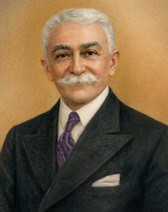
Pierre de Coubertin
Founder of the Modern Olympic Movement
Born on January 1, 1863
Died on September 2, 1937
Age at death: 74
Profession: Historian
Place of Birth: Paris, France
Place of Death: Geneva, Switzerland
Pierre de Coubertin (born Charles Pierre de Frédy, Baron de Coubertin) was a French educator, historian, and the visionary founder of the modern Olympic Games. As the architect of the Modern Olympic Movement and the second president of the International Olympic Committee, he transformed sport into a global cultural institution. His ideas influenced generations of athletes—from Jesse Owens and Muhammad Ali to Michael Phelps and Usain Bolt—whose Olympic achievements would later embody the international stage he helped create. More than a sports organizer, Pierre de Coubertin was an educational reformer who believed physical competition could serve diplomacy, youth development, and moral formation.
Early Life and Intellectual Formation
Pierre de Coubertin was born on January 1, 1863, in Paris into an aristocratic Catholic family whose lineage stretched back to the 15th century. His father, Charles Louis de Frédy, Baron de Coubertin, was a monarchist painter, while his mother, Marie Marcelle Gigault de Crisenoy, came from a distinguished noble background. Educated in Jesuit schools, he excelled academically and developed a deep interest in history, politics, and pedagogy.
He later studied at the Sciences Po in Paris, where he focused on political science, sociology, and education. The intellectual climate of post–Franco-Prussian War France profoundly shaped his worldview. Observing France’s military defeat, he concluded that national weakness stemmed partly from insufficient physical education. This conviction paralleled broader European debates about youth development, civic duty, and nationalism.
His travels to England beginning in 1883 exposed him to the educational reforms of Thomas Arnold at Rugby School. Arnold’s integration of organized sport into character education left a lasting mark on Coubertin’s thinking. He also drew inspiration from British sporting culture that later influenced institutions attended by figures such as Winston Churchill—a generation shaped by the same ideals of discipline, competition, and imperial civic identity.
The Vision of a Global Sporting Movement
Coubertin’s fascination with antiquity deepened after archaeological excavations in Olympia (1875–1881). He admired the cultural symbolism of ancient Greek athletic festivals and envisioned a modern revival grounded in internationalism rather than nationalism. In this sense, his ideal of transnational competition echoed broader humanist traditions associated with thinkers such as Immanuel Kant, who had theorized perpetual peace through international cooperation.
On June 23, 1894, at the Sorbonne in Paris, Pierre de Coubertin convened an international congress that led to the establishment of the International Olympic Committee. Greek intellectual Demetrios Vikelas became its first president, while Coubertin served as secretary-general. By 1896, when the first modern Olympic Games were held in Athens, Coubertin had positioned himself at the center of an emerging global institution.
IOC Presidency and Institutional Legacy
In 1896, Pierre de Coubertin became the second president of the IOC, a role he held until 1925. Under his leadership, the Olympic Games evolved into a permanent international event. He introduced the modern pentathlon at the 1912 Games and played a decisive role in designing the five interlocking rings—now one of the most recognizable symbols in the world.
The Olympic Movement he shaped would later host legendary athletes across eras, from track icon Carl Lewis to basketball figures such as Michael Jordan and global footballers like Pele. While these athletes belonged to different generations and disciplines, their Olympic appearances reinforced Coubertin’s belief in sport as a unifying spectacle transcending borders.
In 1915, amid World War I, he relocated the IOC headquarters to Lausanne, Switzerland, ensuring political neutrality. His tenure, however, was not without challenges. The 1900 Paris and 1904 St. Louis Games suffered from organizational weaknesses and were overshadowed by World Expositions. Yet, through perseverance, the Games regained prestige in subsequent editions.
Philosophy of Struggle
“The important thing in life is not the triumph but the struggle; the essential thing is not to have conquered but to have fought well.”
This maxim defined Pierre de Coubertin’s concept of Olympism. He insisted that moral effort mattered more than victory. The Olympic ethos he articulated would later be invoked during moments of political tension, including the Cold War Games that featured athletes from rival blocs, and during historic performances such as Jesse Owens’s 1936 Berlin triumph—an event that unfolded shortly before Coubertin’s death but symbolized the universalism he advocated.
Education, Literature, and Cultural Reform
Beyond sport administration, Pierre de Coubertin was a prolific writer. He authored more than 1,100 articles, around 50 pamphlets, and 34 books. His 1922 work Pédagogie sportive summarized his philosophy of sports pedagogy. He believed athletic participation should coexist with intellectual and artistic cultivation.
In 1912, at the Stockholm Olympics, he won a gold medal in literature for “Ode to Sport,” demonstrating his commitment to integrating art and athletics. His efforts anticipated later Olympic cultural programs that celebrate creative expression alongside competition.
Criticism and Debate
Modern scholars have scrutinized Pierre de Coubertin’s views on amateurism and his skepticism toward women’s competitive participation. Critics argue that his concept of amateur sport reflected elite social norms. Others question his belief that international competition could prevent war. Yet, despite these critiques, the global sporting structure he created remains foundational.
Personal Life and Final Years
In 1895, Pierre de Coubertin married Marie Rothan, with whom he had two children, Jacques and Renée. Though only 1.62 meters tall, he commanded significant intellectual authority in international circles.
He died of a heart attack on September 2, 1937, in Geneva, Switzerland. He was buried in Lausanne’s Bois-de-Vaux Cemetery, while his heart was interred in Olympia, Greece—symbolically anchoring his legacy to the birthplace of the Games.
The Olympic flame ceremony begins in the Coubertin Grove in Olympia. The Pierre de Coubertin World Trophy honors acts of fair play. The asteroid 2190 Coubertin bears his name. He was portrayed by Louis Jourdan in the NBC mini-series The First Olympics: Athens 1896. In 2013, a Russian postage stamp issued for the Sochi Paralympic Winter Games featured his image as part of a “Sports Legends” series.
Source: Biyografiler.com
Frequently asked questions about Pierre de Coubertin
Who is Pierre de Coubertin?, Pierre de Coubertin biography, Pierre de Coubertin life story, Pierre de Coubertin age, Pierre de Coubertin facts, Pierre de Coubertin birthplace, Pierre de Coubertin photos, Pierre de Coubertin videos, Pierre de Coubertin career
Related Biographies


Lamine Yamal
Professional footballer

Kylian Mbappe
Professional footballer

Erling Haaland
Professional footballer

Sam Altman
Entrepreneur, Investor, CEO

Bad Bunny
Rapper, Songwriter

Brad Pitt
Actor


Hongjoong
Singer, Rapper, Songwriter, Composer

Ludacris
Rapper, Actor

Kwon Eunbi
Singer

Sarah Wayne Callies
Actress, Screenwriter, Producer, Director

LaTavia Roberson
Singer, Actress, Entrepreneur
Brad Pitt
Actor

Sarah Jessica Parker
Actress, Producer

Quentin Tarantino
Film Director, Actor, Screenwriter

Zohran Mamdani
Politician, Musician
Lamine Yamal
Professional footballer

Javier Milei
Economist, Politician, President