
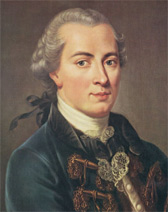
Immanuel Kant
Founding Figure of German Philosophy and Pioneer of Critical Philosophy
Born on April 22, 1724
Died on February 12, 1804
Age at death: 80
Profession: Philosopher
Place of Birth: Königsberg, East Prussia (now Kaliningrad)
Place of Death: Königsberg, Prussia
Immanuel Kant was one of the founding figures of German philosophy and, through his extensive works, became an illuminating guide for all subsequent periods of philosophy.
Immanuel Kant was born on April 22, 1724, in Königsberg, Germany (East Prussia), as the fourth child of a family with eight children. His original name was Emanuel Kandt. He lived in the city of his birth until his death. His mother, Regina Dorothea, was a deeply religious and authoritarian housewife. His father, Johann Georg, was of Scottish origin and worked as a saddler. At the age of eight, Kant was sent to a Pietist school called Collegium Fridericianum, where he learned Latin during eight years of fundamental education.
Between 1740 and 1746, Immanuel Kant studied philosophy, physics, and mathematics at the University of Königsberg, successfully developing himself in several fields. Having lost his mother at the age of thirteen and his father during his university years, Kant was forced to both work and study, leading him to become a private tutor. During his university education, he gave private lessons to students for approximately six years. In 1755, he became an associate professor at the University of Königsberg and began teaching in various fields of the social sciences. During his early academic career, he wrote primarily on physics and astronomy.
During his philosophical education, Immanuel Kant was influenced by Gottfried Wilhelm Leibniz and Christian Wolff. In 1755, he wrote the book Universal Natural History and Theory of the Heavens. In 1770, he was promoted to full professor and appointed to the chair of logic and metaphysics at the university. After 1770, under the influence of David Hume and Jean Jacques Rousseau, he developed his critical philosophy.
Immanuel Kant believed that his primary philosophical mission was to ground science, and subsequently to defend the rationality of morality and religion. To achieve this goal, he adopted what he considered essential elements from both René Descartes’s rationalism and David Hume’s empiricism, thereby developing his own theory of knowledge known as transcendental epistemological idealism. After demonstrating the philosophical foundations of emerging science, he sought to defend Christian morality based on the ideas of freedom and duty.
Immanuel Kant, through his doctrine, showed that scientific knowledge is possible and thereby provided a philosophical foundation for the physics of Isaac Newton. In accordance with the development of modern philosophy, he placed epistemology at the center of philosophical inquiry.
In Immanuel Kant’s view, science is a universal discipline with definitive principles and methods that can only be questioned when a philosophical skepticism like that of David Hume is adopted. Science is impartial and objective.
Immanuel Kant smoked a pipe regularly, but only in the mornings, and greatly enjoyed casual conversation. His daily life was as punctual as a clock. Never married, Kant lived the life of an ordinary man with a remarkably disciplined routine.
Immanuel Kant died on February 12, 1804, in Königsberg, Germany, at the age of 80.
Because the ground was frozen at the time of his death, his body could not be buried for sixteen days. During this period, the people of Königsberg lined up to visit him. The philosopher, who had become synonymous with the city, was buried with musical accompaniment. The following words were inscribed on his tombstone: “Two things fill the mind with ever new and increasing admiration and awe, the more often and steadily reflection is occupied with them: the starry heavens above me and the moral law within me.”
Books:
1755 – Universal Natural History and Theory of the Heavens
1781 – Critique of Pure Reason
1783 – Prolegomena to Any Future Metaphysics
1785 – Groundwork of the Metaphysics of Morals
1788 – Critique of Practical Reason
1790 – Critique of Judgment
1793 – Religion within the Bounds of Bare Reason
1797 – The Metaphysics of Morals
Quotes by Immanuel Kant:
“Those who choose to be worms should not complain when they are stepped on.”
“Knowledge begins with experience but does not arise from experience.”
“Out of the crooked timber of humanity, no straight thing was ever made.”
“Do not treat others merely as a means to achieve your own ends.”
“Even if one does not believe, it is necessary to accept the existence of God.”
“Enlightenment is the courage to use one’s own reason.”
“We regret not so much what we say, but what we leave unsaid. An unexpressed thought is an untaken path.”
“Take away hope and sleep from a person, and you make them the most miserable being in the world.”
Source: Biyografiler.com
Frequently asked questions about Immanuel Kant
Who is Immanuel Kant?, Immanuel Kant biography, Immanuel Kant life story, Immanuel Kant age, Immanuel Kant facts, Immanuel Kant birthplace, Immanuel Kant photos, Immanuel Kant videos, Immanuel Kant career
Related Biographies

Lamine Yamal
Professional footballer

Kylian Mbappe
Professional footballer

Erling Haaland
Professional footballer

Sam Altman
Entrepreneur, Investor, CEO

Austin Abrams
Actor

Bad Bunny
Rapper, Songwriter


Hongjoong
Singer, Rapper, Songwriter, Composer

Ludacris
Rapper, Actor

Kwon Eunbi
Singer

Sarah Wayne Callies
Actress, Screenwriter, Producer, Director

LaTavia Roberson
Singer, Actress, Entrepreneur

Adam Sandler
Actor

Cillian Murphy
Actor

Pedro Sanchez
Politician
Lamine Yamal
Professional footballer
Austin Abrams
Actor

Brad Pitt
Actor