
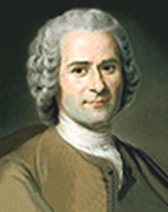
Jean Jacques Rousseau
Pioneer of popular sovereignty and the philosopher of the “general will”
Born on June 28, 1712
Died on July 2, 1778
Age at death: 66
Profession: Philosopher, Writer, Composer
Place of Birth: Geneva, Republic of Geneva
Place of Death: Ermenonville, France
Jean-Jacques Rousseau was one of the greatest French thinkers and essayists of the 18th century. His work The Social Contract became one of the main intellectual inspirations of the French Revolution.
Jean-Jacques Rousseau was born on 28 June 1712 in Geneva as the second son of a watchmaker who supplemented his modest income by giving dance lessons. His mother died fifteen days after his birth, and until the age of ten he was raised by his father, a nurse, and his aunt. His father taught him how to read and introduced him to the literary works of the time. In 1722, his father became involved in a legal case that forced him to choose between exile and imprisonment. Choosing exile, he fled to Lyons, leaving his son in the care of his brother.
Rousseau’s uncle Bernard had a son the same age as Jean-Jacques and sent both boys to the town of Boissy to be educated by a village priest named Lambercier, who lived with his sister. Rousseau fell in love with this woman at first sight, and this innocent, childish passion left a deep and lasting mark on his entire life.
After returning to his uncle Bernard, Rousseau first apprenticed with a notary and later worked for three years in an engraving workshop. However, his gentle and unstable temperament did not suit the harshly practical atmosphere of the trade. While he learned to draw, he also learned to steal and lie from the other apprentices. His master was harsh but honest. Claiming that he was burdened with heavy labor and humiliated, Rousseau eventually ran away.
After leaving, Rousseau went to Annecy to complete his interrupted religious education under the protection of a wealthy woman named Madame de Warens. She was twenty-eight years old at the time, while Rousseau was eighteen. Rousseau sought in her the maternal affection he had never experienced. She, in turn, found his passionate nature—sometimes bold, sometimes childishly shy and needy—deeply appealing and continued to protect him for many years despite his excesses.
In 1741, Rousseau went to Paris to work as a tutor, marking a turning point in his life. After many unproductive years, his genius began to emerge. In Paris, he met Denis Diderot, assistant editor of the Encyclopédie, and the Dupin family. Through the Dupins, he was appointed secretary at the French embassy in Venice, but he returned to Paris in 1745.
In 1742, he married a seamstress named Thérèse de Vasseur. In Confessions, he described her harshly as “ugly, ignorant, foolish, and contemptible.” From this marriage, five children were born, all of whom he placed in an orphanage to avoid financial responsibility. Despite this, Rousseau later wrote highly rational and forward-thinking essays on child-rearing and education.
During this period, Rousseau wrote constantly. His essay for the Dijon Academy, Discourse on the Sciences and Arts, brought him great success. An even greater success followed with the staging of his operetta The Village Soothsayer, which earned him the offer of a permanent income and entry into court life. Disturbed by court intrigues and human greed, Rousseau rejected both the income and the court, remaining faithful to the principles he defended.
Published in 1761, Julie, or the New Heloise addressed the rights of the poor and the duties of the wealthy. Accused of immorality for defending free thought, the book nevertheless achieved immediate and brilliant popular success.
In 1762, Rousseau published The Social Contract in Amsterdam, arguing that all governments must be founded on the consent of the governed. According to this work, society is based on a contract in which individuals surrender their individual wills to the general will in exchange for protection. In harmony with the spirit of the French Revolution, Rousseau advocated a republic with universal suffrage and defended the principles of liberty, equality, and fraternity.
That same year, he wrote his revolutionary work on education, Emile, or On Education, which rejected church doctrine in favor of a natural and absolute religious morality. The book offered a powerful critique of traditional education, emphasizing the intellectual, physical, and moral development of children. Its influence on later educators such as Friedrich Fröbel and Johann Heinrich Pestalozzi was profound.
Threatened with arrest after the publication of Emile, Rousseau fled first to Leurdon and then to Môtiers, under the protection of Frederick the Great. He responded to his attackers with Letters Written from the Mountain (1763). Eventually, even Switzerland became unsafe for him, and like Voltaire, he sought refuge in England, relying on the tolerance of David Hume. Accompanied by his wife Thérèse, Rousseau stayed in Derbyshire, where he wrote Confessions, a revealing document of his complex personality. A bitter conflict with Hume forced him to leave England and return to France.
In 1770, Rousseau returned to Paris and began his final masterpiece, Reveries of the Solitary Walker. In 1778, a wealthy financier offered him a house in Ermenonville. However, personal turmoil followed when he believed his wife Thérèse had betrayed him. Turning away from humanity, Rousseau was found dead on 2 July 1778. Whether his death was the result of suicide or a sudden stroke remains unknown.
One of the most unusual revolutionaries in history, Jean-Jacques Rousseau recognized that the monarchic systems of his time meant poverty for the majority and had the courage to say so. As Lord Morley observed, France owed more to Rousseau’s works than to any other source for escaping the fatal corruption of its social and political system.
Major Works
* Discourse on the Sciences and Arts
* Discourse on the Origin and Basis of Inequality Among Men
* Emile, or On Education
* The Social Contract
* Confessions
* Letter to d’Alembert on the Theatre
* Julie, or the New Heloise
* Reveries of the Solitary Walker
Source: Biyografiler.com
Frequently asked questions about Jean Jacques Rousseau
Who is Jean Jacques Rousseau?, Jean Jacques Rousseau biography, Jean Jacques Rousseau life story, Jean Jacques Rousseau age, Jean Jacques Rousseau facts, Jean Jacques Rousseau birthplace, Jean Jacques Rousseau photos, Jean Jacques Rousseau videos, Jean Jacques Rousseau career
Related Biographies

Lamine Yamal
Professional footballer

Kylian Mbappe
Professional footballer

Erling Haaland
Professional footballer

Sam Altman
Entrepreneur, Investor, CEO

Austin Abrams
Actor

Bad Bunny
Rapper, Songwriter


Hongjoong
Singer, Rapper, Songwriter, Composer

Ludacris
Rapper, Actor

Kwon Eunbi
Singer

Sarah Wayne Callies
Actress, Screenwriter, Producer, Director

LaTavia Roberson
Singer, Actress, Entrepreneur

Pedro Sanchez
Politician

Adam Sandler
Actor

Cillian Murphy
Actor
Lamine Yamal
Professional footballer
Austin Abrams
Actor

Brad Pitt
Actor