
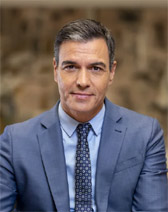
Pedro Sanchez
Prime Minister of Spain - The socialist leader who returned from an internal party defeat to become Prime Minister and reshape Spain’s era of coalition government
Born on February 29, 1972
Age: 54
Profession: Politician
Place of Birth: Madrid, Spain
Pedro Sánchez, whose full name is Pedro Sánchez Pérez-Castejón, is a Spanish politician and economist who has served as Prime Minister of Spain, officially President of the Government, since June 2018. He has been Secretary-General of the Spanish Socialist Workers’ Party since June 2017, having previously held the position between 2014 and 2016, and has served as President of the Socialist International since November 2022. His political career has been defined by an unusual return from defeat, the construction of parliamentary alliances across Spain’s fragmented political system and a premiership shaped by the COVID-19 pandemic, economic reform, Catalan separatism and intense political polarization.
Early Life and Family Background
Pedro Sánchez was born on February 29, 1972, in Madrid, Spain, into a financially comfortable family. He is the son of Pedro Sánchez Fernández and Magdalena Pérez-Castejón Barrios. His father worked as a senior public administrator at the National Institute of Performing Arts and Music under the Spanish Ministry of Culture before becoming involved in an industrial packaging business. His mother worked as a civil servant in Spain’s social security system and later qualified as a lawyer.
Raised in Madrid’s Tetuán district, Pedro Sánchez received his early education at Colegio Santa Cristina before attending the public Instituto Ramiro de Maeztu. He developed a strong interest in basketball and joined the youth system of Club Estudiantes, one of Madrid’s best-known basketball organizations. He progressed through its youth categories and played at under-21 level, although he did not pursue the sport professionally.
Education and International Experience
Pedro Sánchez began his university education in 1990 and graduated in 1995 with a degree in Economics and Business Studies from Real Colegio Universitario María Cristina, an institution affiliated with the Complutense University of Madrid. His undergraduate degree was not awarded by Camilo José Cela University; his formal association with that university came later through teaching and doctoral study.
After completing his undergraduate education, Pedro Sánchez worked in consultancy and spent a period in New York. He later continued his studies in Brussels, completing postgraduate work in European Union economics at the Free University of Brussels. He also obtained an Advanced Studies Diploma in European Economic and Monetary Integration from the Ortega y Gasset University Research Institute and completed a business leadership programme at IESE Business School of the University of Navarra.
During the late 1990s, Pedro Sánchez gained experience in European and international institutions. He worked as an assistant to Bárbara Dührkop, a German-born Spanish Member of the European Parliament belonging to the socialist delegation. He subsequently joined the team of Carlos Westendorp, the international High Representative responsible for supervising implementation of the peace settlement in Bosnia and Herzegovina.
Entry into the Spanish Socialist Workers’ Party
Pedro Sánchez joined the Spanish Socialist Workers’ Party, commonly known by its Spanish abbreviation PSOE, in 1993 while still a university student. His early political development took place within the party’s Madrid organization, where he worked on policy, electoral strategy and international affairs.
He stood as a candidate for the Madrid City Council in the 2003 municipal election but was placed too low on the PSOE list to obtain a seat immediately. In 2004, after the resignation of two socialist councillors, Pedro Sánchez entered the council and served as a municipal representative until September 2009. His work during this period focused on economic policy, finance and local administration.
Alongside his political responsibilities, Pedro Sánchez began teaching at Camilo José Cela University in 2008. He lectured on economic structure and the history of economic thought, combining academic work with his developing political career.
Congress of Deputies and Doctorate
In 2009, Pedro Sánchez entered the Congress of Deputies as a representative for Madrid, replacing former economy minister Pedro Solbes. He lost his seat after the PSOE’s heavy defeat in the 2011 general election but returned to parliament in January 2013 following the resignation of Cristina Narbona.
In 2012, Pedro Sánchez completed a doctorate in Economics at Camilo José Cela University. His dissertation was titled “Innovations in Spanish Economic Diplomacy: An Analysis of the Public Sector, 2000–2012.” The thesis examined the use of public institutions and economic diplomacy in advancing Spain’s international commercial and strategic interests.
Rise to the PSOE Leadership
Following the PSOE’s poor performance in the 2014 European Parliament election and the resignation of party leader Alfredo Pérez Rubalcaba, Pedro Sánchez announced his candidacy for the party leadership on June 12, 2014. He presented himself as a younger figure capable of rebuilding the organization after the financial crisis, austerity measures and declining public confidence in Spain’s traditional political parties.
On July 13, 2014, PSOE members elected Pedro Sánchez as Secretary-General. He defeated Eduardo Madina and José Antonio Pérez Tapias, and subsequently became Leader of the Opposition. His rise coincided with the emergence of new political movements, particularly Podemos and Ciudadanos, which weakened the long-standing two-party dominance of the PSOE and the conservative People’s Party.
Pedro Sánchez led the PSOE into the December 2015 general election. Although the party recorded what was then its poorest result in the democratic era, the election produced a divided parliament in which no party could easily form a government. After Mariano Rajoy declined an initial attempt to seek parliamentary approval, Pedro Sánchez negotiated an agreement with Ciudadanos, but his investiture attempt failed because it lacked sufficient support.
Resignation and Political Return
A second general election in June 2016 again failed to produce a clear governing majority. A serious internal conflict then developed within the PSOE over whether the party should continue blocking a new government led by Mariano Rajoy. Pedro Sánchez opposed allowing Rajoy to remain in office, while influential party figures argued that continued resistance risked forcing Spain into a third election.
After losing a decisive vote at a turbulent meeting of the PSOE Federal Committee on October 1, 2016, Pedro Sánchez resigned as Secretary-General. He later surrendered his seat in the Congress of Deputies rather than obey the party’s decision to abstain and facilitate Rajoy’s investiture.
His political career appeared to have reached an abrupt end. Instead, Pedro Sánchez travelled across Spain, met local party members and built a grassroots campaign against the PSOE’s established leadership. In the May 2017 leadership election, he defeated Susana Díaz, the preferred candidate of much of the party establishment, and former Basque regional president Patxi López. His victory returned him to the position of Secretary-General and became one of the most dramatic political recoveries in modern Spanish democracy.
Becoming Prime Minister
In May 2018, a Spanish court delivered its judgment in the Gürtel corruption case, which implicated former officials and associates of the governing People’s Party. The ruling created a political crisis for Prime Minister Mariano Rajoy and gave Pedro Sánchez an opportunity to submit a constructive motion of no confidence.
The motion was supported by the PSOE, Unidas Podemos and several Basque, Catalan and regional parties. On June 1, 2018, it passed with 180 votes in favour, 169 against and one abstention. Pedro Sánchez became the first opposition leader in Spain’s democratic period to remove a serving prime minister through a successful motion of no confidence.
On June 2, 2018, Pedro Sánchez formally took office before King Felipe VI. He initially led a small minority government supported by only 84 PSOE deputies, requiring regular negotiations with other parliamentary groups to pass legislation.
The 2019 Elections and Coalition Government
Pedro Sánchez called an early general election for April 2019 after parliament rejected his proposed state budget. The PSOE won 123 seats and became the largest party in the Congress of Deputies, securing its first national election victory since 2008. However, negotiations with Unidas Podemos failed to produce a stable government.
A second election was held in November 2019. The PSOE again finished first, although it lost three seats. Pedro Sánchez subsequently reached a coalition agreement with Pablo Iglesias and Unidas Podemos. In January 2020, parliament approved his investiture by a narrow margin, creating Spain’s first national coalition government since the country’s transition to democracy.
Government During the COVID-19 Pandemic
Only weeks after the coalition government was formed, Spain became one of the European countries most severely affected by the first stage of the COVID-19 pandemic. The government of Pedro Sánchez declared a national state of alarm in March 2020, imposed extensive restrictions on movement and centralized significant health-related powers. The management of the crisis generated disputes over mortality, hospital capacity, personal protective equipment, regional authority and the constitutional limits of emergency measures.
The government introduced employment-protection programmes, income support, loan guarantees and the Minimum Living Income for vulnerable households. It also supported the creation of the European Union Recovery and Resilience Facility, through which Spain became one of the principal recipients of European recovery funding.
During the coalition period, the government increased the statutory minimum wage, restored the indexation of pensions, negotiated a labour reform with trade unions and employers, introduced a national housing law and expanded legislation concerning climate policy, euthanasia and LGBT rights. Supporters regarded these measures as a reconstruction of the welfare state after years of austerity, while opponents criticized the government’s spending, taxation and regulatory policies.
Ukraine, Energy and European Politics
Russia’s full-scale invasion of Ukraine in February 2022 created another major challenge for the administration of Pedro Sánchez. Spain provided humanitarian, financial and military assistance to Ukraine and supported European sanctions against the government of Vladimir Putin. At the same time, rising energy prices and inflation forced the Spanish government to introduce fuel subsidies, electricity-market interventions and temporary taxes on banks and energy companies.
Madrid hosted the NATO Summit in June 2022, during which the alliance adopted a new strategic concept and invited Finland and Sweden to join. Pedro Sánchez used the summit to emphasize Spain’s role in European security, the Mediterranean and relations between Europe and North Africa.
President of the Socialist International
In November 2022, Pedro Sánchez was elected President of the Socialist International, succeeding former Greek prime minister George Papandreou. The role placed him at the head of a worldwide association of social-democratic, socialist and labour parties and strengthened his international profile within the centre-left political movement.
As of July 2026, Pedro Sánchez continued to hold the presidency of the organization alongside his positions as Spanish prime minister and PSOE Secretary-General.
The 2023 Election and a Third Premiership
After the PSOE and its allies suffered losses in Spain’s May 2023 regional and municipal elections, Pedro Sánchez called an early general election for July 23, 2023. The People’s Party, led by Alberto Núñez Feijóo, won the highest number of seats, while the PSOE finished second. Nevertheless, Feijóo was unable to assemble the parliamentary majority required to form a government.
Pedro Sánchez negotiated a coalition with Sumar, led by Yolanda Díaz, and obtained parliamentary support from Basque and Catalan nationalist parties. On November 16, 2023, he was confirmed as Prime Minister with 179 votes in favour and 171 against. King Felipe VI formally appointed him for another term the following day.
The Catalan Amnesty Law
The most controversial element of the agreement supporting the new government was an amnesty for people prosecuted over the Catalan independence movement, including events connected to the unauthorized 2017 independence referendum. Pedro Sánchez had previously opposed such an amnesty but argued in 2023 that it had become necessary to promote political normalization and coexistence in Catalonia.
The proposal was strongly opposed by the People’s Party, Vox, several judicial associations and large public demonstrations. Critics argued that the measure had been designed primarily to secure the parliamentary votes needed to keep Pedro Sánchez in office. Supporters maintained that it could reduce territorial conflict and return political disputes to democratic institutions.
The amnesty law was adopted in 2024. It became one of the defining political controversies of Pedro Sánchez’s third term and remained the subject of judicial, constitutional and European debate.
Foreign Policy and Recognition of Palestine
During the Spanish presidency of the Council of the European Union in the second half of 2023, Pedro Sánchez promoted European cooperation on migration, energy, Ukraine and institutional reform. His government also sought a more prominent diplomatic role in the Middle East following the Hamas attacks of October 7, 2023, and the subsequent Israeli military campaign in Gaza.
On May 28, 2024, Spain formally recognized the State of Palestine in coordination with Ireland and Norway. Pedro Sánchez described recognition as a contribution to a negotiated two-state solution rather than an act directed against Israel. The decision strengthened his standing among supporters of Palestinian statehood but led to a sharp diplomatic dispute with the Israeli government.
Public Controversies and Political Pressure
In 2018, Pedro Sánchez faced accusations in sections of the Spanish media that passages in his doctoral dissertation had been improperly reproduced. He rejected the allegations and made the thesis publicly accessible. The controversy became part of a wider national debate over academic credentials and political accountability.
From 2024 onward, his government came under growing pressure because of judicial investigations involving individuals close to him. His wife, Begoña Gómez, was investigated in relation to her professional and university activities. She denied wrongdoing, while Pedro Sánchez described the proceedings as politically motivated. The investigations did not in themselves constitute a conviction.
The PSOE was also affected by investigations involving former transport minister José Luis Ábalos, his former adviser Koldo García and former party organization secretary Santos Cerdán. The accused parties denied wrongdoing. Pedro Sánchez apologized to PSOE voters for having trusted Cerdán, rejected demands for an immediate general election and announced internal reforms and additional anti-corruption measures.
Despite these controversies, Pedro Sánchez remained Prime Minister of Spain as of July 2026. His continued survival in office reflected both his political resilience and the difficulty faced by opposition parties in assembling an alternative parliamentary majority.
Political Style and Cultural Impact
Pedro Sánchez has frequently been characterized as a highly adaptable and persistent political leader. His opponents have accused him of changing positions to retain power, particularly over cooperation with separatist parties and the Catalan amnesty. His supporters have instead presented his flexibility as a necessary response to Spain’s transition from two-party government to a fragmented parliamentary system.
His return to the PSOE leadership after being forced to resign in 2016 became central to his political identity. By appealing directly to party members against much of the organization’s senior establishment, Pedro Sánchez transformed the internal balance of the PSOE and strengthened the authority of its elected Secretary-General.
His premiership has also represented a generational change in Spanish politics. Rather than governing through a single-party parliamentary majority, Pedro Sánchez has depended on coalitions and agreements involving left-wing, Basque, Catalan and regional parties. This strategy has enabled him to remain in government but has also made nearly every major parliamentary decision the subject of complex negotiation.
Personal Life
Pedro Sánchez married marketing and fundraising specialist Begoña Gómez Fernández in 2006. Their civil wedding was officiated by socialist politician Trinidad Jiménez. The couple has two daughters, Ainhoa Sánchez Gómez and Carlota Sánchez Gómez. They have generally attempted to keep their daughters outside political life and away from sustained media attention.
Pedro Sánchez speaks Spanish and has used English and French during his international political career. He has maintained an interest in basketball and is publicly associated with Club Estudiantes, the Madrid team whose youth system he joined during his school years.
Political Party
Major Political Offices
2009–2011 – Member of the Congress of Deputies for Madrid
2013–2014 – Member of the Congress of Deputies for Madrid
2014–2016 – Secretary-General of the Spanish Socialist Workers’ Party
2014–2016 – Leader of the Opposition
2017–present – Secretary-General of the Spanish Socialist Workers’ Party
2018–present – Prime Minister of Spain / President of the Government
2022–present – President of the Socialist International
Source: Biyografiler.com
News about Pedro Sanchez
Orban era ends after 16 years as Peter Magyar secures historic victory
Hungary has entered a new political era after Viktor Orban lost power following 16 years in office. In the April 12, 2026 election, opposition leader ...
World Leaders Respond to the U.S.–Israeli Strikes on Iran and Death of Ali Khamenei
The international community has reacted strongly and with deep concern following the joint U.S. and Israeli military strikes against Iran that reporte...

Spain’s plan to restrict children’s access to social media sparks fury from Elon Musk
Spain’s proposed legislation to limit social media access for children under the age of 16 has triggered a fierce reaction from Elon Musk, the owner...
Frequently asked questions about Pedro Sanchez
Who is Pedro Sanchez?, Pedro Sanchez biography, Pedro Sanchez life story, Pedro Sanchez age, Pedro Sanchez facts, Pedro Sanchez birthplace, Pedro Sanchez photos, Pedro Sanchez videos, Pedro Sanchez career
Related Biographies

Lamine Yamal
Professional footballer

Erling Haaland
Professional footballer

Kylian Mbappe
Professional footballer

Austin Abrams
Actor

Bad Bunny
Rapper, Songwriter

Sam Altman
Entrepreneur, Investor, CEO


Hongjoong
Singer, Rapper, Songwriter, Composer

Ludacris
Rapper, Actor

Kwon Eunbi
Singer

Sarah Wayne Callies
Actress, Screenwriter, Producer, Director

LaTavia Roberson
Singer, Actress, Entrepreneur
Lamine Yamal
Professional footballer

Amber Heard
Actress, Model
Bad Bunny
Rapper, Songwriter
Erling Haaland
Professional footballer
Kylian Mbappe
Professional footballer
Austin Abrams
Actor