
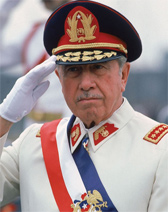
Augusto Pinochet
The Military Strongman of Chile’s Dictatorship Era
Born on November 25, 1915
Died on December 10, 2006
Age at death: 91
Profession: Military Officer, President
Place of Birth: Valparaíso, Chile
Place of Death: Santiago, Chile
Augusto José Ramón Pinochet Ugarte was the 30th President of Chile and ruled the country under a military dictatorship from September 11, 1973, to March 11, 1990. His regime, established through a violent coup d’état, left a deep and controversial mark on Chilean history, characterized by authoritarian rule, political repression, and radical economic transformation.
Augusto José Ramón Pinochet Ugarte was born on November 25, 1915, in Valparaíso, Chile. His father, Augusto Pinochet Vera, was descended from French immigrants who had arrived in Chile in the 18th century. Pinochet began his military education in 1933 at the Military Academy in Santiago and graduated in 1936, formally entering the Chilean Army.
Between 1942 and 1952, Pinochet served at the War Academy in Santiago. He was promoted to the rank of major in 1952 and later served abroad as a representative of the Chilean government, spending time in the United States. During this period, he also worked as a professor at the Ecuadorian Military Academy. His steady rise through the ranks continued: he became deputy director of the War Academy in 1964, was promoted to colonel in 1966, brigadier general in 1968, and major general in 1970.
In November 1972, Pinochet was appointed division commander, and in August 1973 he became Chief of the General Staff of the Chilean Army. On September 11, 1973, a military junta led by Pinochet overthrew the democratically elected president, Salvador Allende. Following the coup, Pinochet consolidated power and ruled Chile as a dictator from September 11, 1973, until March 11, 1990.
During his rule, Pinochet dissolved opposition political parties, shut down labor unions, and censored or closed independent media outlets. His government adopted a free-market economic model inspired by Friedmanite liberalism, opening Chile to international markets and radically restructuring the economy. In September 1980, he organized a national referendum that approved a new constitution, which came into force in March 1981. This constitution extended his rule until 1989 and postponed free general elections until 1997.
Mass protests erupted in Santiago on May 11, June 14, and July 12, 1983, drawing large crowds demanding political change. Pinochet responded by intensifying repression. On August 11, 1983, army and police forces opened fire on demonstrators, killing 32 people and wounding nearly 100. Despite continued crackdowns, widespread protests persisted intermittently until 1986.
Under mounting domestic and international pressure, Pinochet was forced to make limited political concessions. In March 1987, he allowed the formation of political parties, and in January 1988, he lifted the state of emergency. Later that year, in October 1988, he called a national plebiscite in an effort to remain in power until 1997. The referendum resulted in his defeat, leading to democratic presidential elections in December 1989.
In March 1990, Pinochet transferred the presidency to the newly elected leader, Patricio Aylwin Azócar, the candidate of the Christian Democratic Party. Nevertheless, Pinochet retained significant influence by continuing as Commander-in-Chief of the Armed Forces until the end of 1998. He also amended the constitution to grant himself the title of “senator for life,” ensuring political immunity.
Pinochet married Lucía Hiriart in 1943. The couple had five children: Lucía Pinochet, Augusto Osvaldo Pinochet, Jacqueline Marie Pinochet, Marco Antonio Pinochet, and María Verónica Pinochet.
Augusto José Ramón Pinochet Ugarte died of a heart attack on December 10, 2006, in Santiago, Chile. In accordance with his wishes, his body was cremated and returned to his family. Due to fears of possible attacks, no grave was constructed, and the armed forces refused to house his ashes in any military facility.
Source: Biyografiler.com
Frequently asked questions about Augusto Pinochet
Who is Augusto Pinochet?, Augusto Pinochet biography, Augusto Pinochet life story, Augusto Pinochet age, Augusto Pinochet facts, Augusto Pinochet birthplace, Augusto Pinochet photos, Augusto Pinochet videos, Augusto Pinochet career
Related Biographies

Lamine Yamal
Professional footballer

Erling Haaland
Professional footballer

Kylian Mbappe
Professional footballer

Austin Abrams
Actor

Bad Bunny
Rapper, Songwriter

Sam Altman
Entrepreneur, Investor, CEO


Hongjoong
Singer, Rapper, Songwriter, Composer

Ludacris
Rapper, Actor

Kwon Eunbi
Singer

Sarah Wayne Callies
Actress, Screenwriter, Producer, Director

LaTavia Roberson
Singer, Actress, Entrepreneur
Bad Bunny
Rapper, Songwriter

Margot Robbie
Actress
Kylian Mbappe
Professional footballer

Neymar
Professional footballer

Pedro Sanchez
Politician

Ronaldinho
Professional footballer