
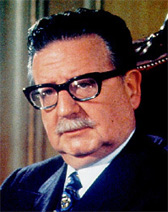
Salvador Allende
The First Democratically Elected Socialist President of the Western World
Born on June 26, 1908
Died on September 11, 1973
Age at death: 65
Profession: Physician, Politician, Former President
Place of Birth: Valparaíso, Chile
Place of Death: Santiago, Chile
Salvador Allende Gossens was the first socialist head of state in the Western world to come to power through free and democratic elections. Serving as President of Chile from November 4, 1970, until September 11, 1973, his presidency marked one of the most significant and polarizing chapters in modern Latin American history.
Salvador Allende Gossens was born on June 26, 1908, in Valparaíso, Chile, into a wealthy and well-established family. His father was Salvador Allende Castro and his mother was Laura Gossens Uribe. While studying at Eduardo de la Barra High School, Allende developed a growing interest in Marxist thought and began educating himself extensively on socialist ideology. After graduating from high school, he entered the University of Chile in 1926 to study medicine, marking the beginning of both his medical and political paths.
By 1930, Allende had become a highly visible and influential student figure and was elected Vice President of the Chilean Student Federation. His outspoken opposition to President Carlos Ibáñez del Campo made him a target of political repression, resulting in his arrest and temporary suspension from university. These consequences were short-lived, however, as Ibáñez was overthrown and fled to Argentina in July 1931 amid a severe economic crisis.
Allende graduated from medical school in 1932 and began working as an anatomist and pathologist. In 1933, alongside other left-wing intellectuals, he became one of the founding members of the Socialist Party of Chile, which he envisioned as a Marxist alternative to the Communist Party. He held various leadership roles within the party until 1937.
In 1937, Allende was elected to the Chilean Parliament. Between 1938 and 1940, he served as Minister of Health in the left-wing Popular Front government, implementing progressive public health reforms. In 1943, he became Secretary-General of the Socialist Party, and in 1945 he was elected to the Senate. He ran unsuccessfully as the unified left-wing presidential candidate in the elections of 1952, 1958, and 1964.
In his personal life, Salvador Allende Gossens married Hortensia Bussi in 1940. The couple had three daughters: Isabel Allende Bussi, Beatriz Allende, and Carmen Paz Allende.
Between 1966 and 1969, Allende served as President of the Senate. In 1970, he was nominated for the fourth time as the presidential candidate of the left-wing coalition known as the Popular Unity. In the three-way election held in September 1970, Allende emerged victorious, becoming Chile’s first Marxist president elected through democratic means.
The Popular Unity government pursued a socialist agenda aimed at transforming Chile into a republic of the working class. Chile became the first Latin American country to establish diplomatic relations with both Cuba and China. Allende’s administration nationalized major industries, including foreign-owned enterprises, particularly in the copper sector. His government introduced extensive social programs, including the daily distribution of half a liter of free milk to children under fifteen and to nursing mothers. Minimum wages were raised—often doubled or more—while salaries of high-ranking state officials were capped.
These policies generated widespread opposition among domestic elites and international actors. The nationalization of copper mines, most of which were owned by U.S. companies, provoked strong hostility from the United States. Economic pressure followed in the form of U.S. embargoes, along with the suspension of financial support from the World Bank and the IMF. The deliberate lowering of global copper prices further destabilized the Chilean economy. Meanwhile, the Soviet Union, wary of socialism emerging through electoral means, remained largely passive.
By 1972, shortages of consumer goods led to the rise of black markets and accelerated capital flight. A nationwide truck owners’ strike in October 1972, lasting over a month, paralyzed the country. Despite these challenges, the Popular Unity coalition secured 45 percent of the vote in the March 1973 parliamentary elections, preventing the opposition from achieving the two-thirds majority needed to remove Allende constitutionally.
Political violence escalated in 1973. After the Christian Democrats withdrew their support in April, the country descended into instability. A failed armored coup attempt took place in June, followed by renewed strikes by truckers in July. In August, the resignation of General Carlos Prats, Allende’s loyal Commander-in-Chief, severely weakened his position within the armed forces.
General Augusto Pinochet, appointed as Commander-in-Chief in August 1973, launched a U.S.- and CIA-backed military coup on September 11, 1973. The armed forces demanded Allende’s resignation. When he refused, the Presidential Palace was surrounded and attacked. Salvador Allende Gossens was killed during the assault, after fighting alongside his guards with an AK-47 rifle gifted to him by Fidel Castro. He died at the age of 65 in Santiago, Chile.
Following his death, Pinochet dissolved the constitution and established a military dictatorship. The copper mines nationalized under Allende were returned to U.S. companies, and Chile became heavily dependent on the United States.
Shortly before his death, Salvador Allende Gossens delivered a farewell address via radio. Excerpts from his final speech are remembered as one of the most powerful political testimonies of the 20th century:
Friends,
There is no doubt that this will be my last opportunity to speak to you. The Air Force has bombed the transmitters of Radio Magallanes.
My words carry not bitterness, but disappointment. May they be a moral lesson to those who have betrayed their oath…
In these circumstances, my words are addressed mainly to the workers: I will not resign!
History is ours, and it is made by the people.
Much sooner than later, the great avenues will open again, and free men will walk through them to build a better society.
Long live Chile! Long live the people! Long live the workers!
Salvador Allende Gossens remains a global symbol of democratic socialism, political integrity, and sacrifice. His life and death continue to inspire movements for social justice and popular sovereignty across the world.
Source: Biyografiler.com
Frequently asked questions about Salvador Allende
Who is Salvador Allende?, Salvador Allende biography, Salvador Allende life story, Salvador Allende age, Salvador Allende facts, Salvador Allende birthplace, Salvador Allende photos, Salvador Allende videos, Salvador Allende career
Related Biographies

Lamine Yamal
Professional footballer

Erling Haaland
Professional footballer

Kylian Mbappe
Professional footballer

Austin Abrams
Actor

Bad Bunny
Rapper, Songwriter

Sam Altman
Entrepreneur, Investor, CEO


Hongjoong
Singer, Rapper, Songwriter, Composer

Ludacris
Rapper, Actor

Kwon Eunbi
Singer

Sarah Wayne Callies
Actress, Screenwriter, Producer, Director

LaTavia Roberson
Singer, Actress, Entrepreneur

Pedro Sanchez
Politician

Ronaldinho
Professional footballer
Bad Bunny
Rapper, Songwriter

Margot Robbie
Actress

Antonio Conte
Football Manager, Professional footballer

Greta Thunberg
Activist