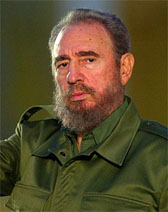
Fidel Castro
The Legendary Revolutionary Leader of Cuba
Born on August 13, 1926
Died on November 26, 2016
Age at death: 90
Profession: Lawyer, Politician, Head of State
Place of Birth: Mayarí, Oriente Province, Cuba
Place of Death: Havana, Cuba
Fidel Castro Ruz was the legendary revolutionary leader of Cuba and one of the most influential political figures of the 20th century. As the architect of the Cuban Revolution, he led the country under a communist system for nearly half a century and became a global symbol of anti-imperialism and revolutionary socialism.
Fidel Castro Ruz was born on August 13, 1926, in Mayarí, Cuba, into a relatively prosperous family by the standards of the time. His family earned their livelihood from sugarcane plantations. After completing his early education at private Catholic schools, he enrolled at the University of Havana in 1945. During his studies, he drew the attention of his professors with his extraordinary memory, which allowed him to memorize entire books.
While studying law at the university, Castro became involved with various opposition groups resisting the existing Cuban regime. After the government dismantled these groups in 1947, Castro and his associates participated in large-scale protests in Bogotá. He graduated with honors in 1950 and soon after joined the Orthodox Party, discovering the political power of mass movements. His ambition to secure a seat in the Cuban Parliament was interrupted when Fulgencio Batista seized control of the government to suppress the rising influence of the Orthodox movement. Under Batista’s rule, many politicians were killed and widespread political repression followed.
Determined to end Batista’s regime, Castro organized a guerrilla force of approximately 200 revolutionaries from across Cuba. On July 26, 1953, the group launched an attack on the Moncada military barracks in Santiago de Cuba. Although weapons and ammunition were seized, most of the attackers were later killed by government forces. Castro was captured and sentenced to fifteen years in prison.
One year later, Batista issued a general amnesty for political prisoners, including Castro. Upon his release, Castro remained committed to revolutionary ideals and traveled to Mexico to form a new guerrilla movement. There, he met Che Guevara, who was working as a physician at the time. Together, they trained an 82-member guerrilla force in preparation for armed struggle.
On December 2, 1956, the group returned to Cuba but was largely destroyed by naval forces. Castro and Che managed to escape and took refuge in the mountains, where they conducted guerrilla warfare and propaganda campaigns that gradually gained popular support. After two years of armed resistance, they amassed sufficient strength and public backing to overthrow the Batista government on January 1, 1959.
Following the victory, Castro marched into Havana and declared himself President of Cuba. During his first speech, a dove landed on his shoulder, leading the deeply religious Cuban population to believe he was a messenger of divine will. In his address, Castro promised honesty, an end to corruption, and the restoration of much of the 1940 Cuban Constitution. Shortly after taking power, many individuals affiliated with the Batista regime were executed.
In 1959, Castro embarked on an international tour that included the United States, seeking to promote unity among nations. Although U.S. President Dwight David Eisenhower refused to meet him, Vice President Richard Nixon received Castro. Nixon later described him as a communist dictator who needed to be overthrown. Castro later returned to the United States to address the United Nations General Assembly, where he was again met with hostility.
Upon returning to Cuba, Castro initiated socialist economic reforms aimed at reclaiming land and resources, nearly 70 percent of which were owned by foreign interests. He ordered the nationalization of all American-owned businesses and severed ties with the United States. In response, on January 31, 1961, the United States imposed a trade embargo on Cuba, resulting in losses exceeding one billion dollars for American companies.
After consolidating the revolution at home, Castro supported revolutionary movements abroad. He assisted Che Guevara in his efforts to ignite a communist uprising in Bolivia. Following Che’s execution in 1967, Castro extended military support to several politically unstable Latin American countries in hopes of spreading communist revolutions.
Cuba’s economy, which failed to recover after the communist transformation, deteriorated further following the collapse of the Soviet Union, as Soviet economic aid could no longer be sustained. Despite declining health in his later years, Castro remained committed to preserving Cuba’s communist system beyond his lifetime.
On July 31, 2006, Castro temporarily transferred his powers to his brother Raúl Castro after undergoing surgery related to gastrointestinal illness. Raúl served in an interim capacity until April 19, 2011, when he officially became Cuba’s second president. On February 19, 2008, Fidel Castro announced his resignation from the presidency of the Council of State, a position he had held since 1976.
Fidel Castro Ruz died on November 26, 2016, at the age of 90. In accordance with his wishes, his remains were cremated. As the leader who governed Cuba for nearly half a century, one of only five remaining communist states alongside North Korea, Vietnam, China, and Laos, Castro devoted his long political life entirely to communist ideology, repeatedly declaring that he would fight for it “until his last drop of blood.”
Source: Biyografiler.com
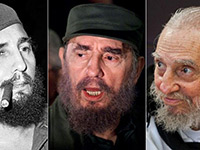
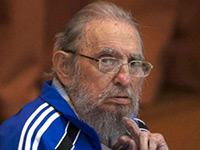
Fidel Castro Photos


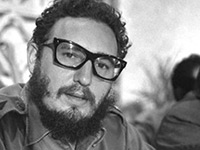
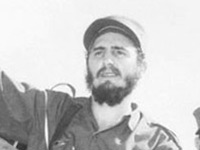
Frequently asked questions about Fidel Castro
Who is Fidel Castro?, Fidel Castro biography, Fidel Castro life story, Fidel Castro age, Fidel Castro facts, Fidel Castro birthplace, Fidel Castro photos, Fidel Castro videos, Fidel Castro career
Related Biographies

Lamine Yamal
Professional footballer

Erling Haaland
Professional footballer

Kylian Mbappe
Professional footballer

Sam Altman
Entrepreneur, Investor, CEO

Austin Abrams
Actor

Bad Bunny
Rapper, Songwriter


Hongjoong
Singer, Rapper, Songwriter, Composer

Ludacris
Rapper, Actor

Kwon Eunbi
Singer

Sarah Wayne Callies
Actress, Screenwriter, Producer, Director

LaTavia Roberson
Singer, Actress, Entrepreneur

Abbie Cornish
Actress

El Greco
Painter

Leonardo DiCaprio
Actor

Michael Douglas
Actor, Film Producer

Demi Moore
Actress

Mike Markkula
Businessperson, Entrepreneur