
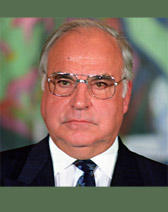
Helmut Kohl
“The Chancellor of Reunification” and one of the principal architects of modern Europe
Born on April 3, 1930
Died on June 16, 2017
Age at death: 87
Profession: Politician
Place of Birth: Ludwigshafen, Rhineland-Palatinate, Germany
Place of Death: Ludwigshafen, Rhineland-Palatinate, Germany
Helmut Kohl was a German politician and statesman who served as Chancellor of Germany from 1982 to 1998. Widely regarded as one of the most influential European leaders of the twentieth century, Helmut Kohl played a decisive role in the reunification of Germany following the collapse of the Eastern Bloc and was a key advocate of deeper European integration. His close partnerships with leaders such as François Mitterrand, George H. W. Bush, and Mikhail Gorbachev helped shape the political landscape of post-Cold War Europe.
Early Life and Education
Helmut Kohl, whose full name was Helmut Josef Michael Kohl, was born on April 3, 1930, in Ludwigshafen, Rhineland-Palatinate, Germany. He grew up during the turbulent years of the Second World War, an experience that profoundly influenced his political beliefs and his commitment to European peace and cooperation.
His father, Hans Kohl, was a civil servant and businessman, while his mother, Cäcilie Kohl, managed the family household. Like many members of his generation, Helmut Kohl witnessed the destruction of Germany and the challenges of reconstruction in the postwar years.
After the war, he studied law, political science, history, and sociology at the University of Frankfurt and later at Heidelberg University. He earned a doctorate in history, focusing on political and social developments in postwar Germany. His academic background contributed to the historical perspective that would later characterize his political leadership.
Entry into Politics
Helmut Kohl joined the Christian Democratic Union (CDU) in 1946, shortly after the party's foundation. His organizational skills, strategic thinking, and ability to connect with voters quickly distinguished him within the party structure.
Throughout the 1950s and 1960s, he steadily advanced through regional politics. He became one of the leading figures of the CDU in Rhineland-Palatinate and gained a reputation as a pragmatic reformer who favored modernization and economic development.
Minister-President of Rhineland-Palatinate
In 1969, Helmut Kohl became Minister-President of Rhineland-Palatinate, making him one of the youngest state leaders in postwar Germany. During his tenure, he implemented administrative reforms, expanded educational opportunities, and promoted economic modernization.
His success at the state level increased his national profile. In 1973, he was elected chairman of the Christian Democratic Union, positioning himself as the leading challenger to Chancellor Helmut Schmidt and the ruling coalition government.
Rise to the Chancellorship
On October 1, 1982, Helmut Kohl became Chancellor of West Germany through a constructive vote of no confidence that replaced Helmut Schmidt. The transition marked a major turning point in German politics and began what would become a sixteen-year chancellorship.
Under his leadership, West Germany pursued economic reforms, strengthened its alliance with the United States, and maintained a firm commitment to the North Atlantic Treaty Organization (NATO). His government emphasized political stability, market-oriented policies, and strong transatlantic relations.
German Reunification
The defining achievement of Helmut Kohl's political career came with the fall of the Berlin Wall in November 1989. Recognizing the historic opportunity, he quickly developed a strategy for the peaceful reunification of East and West Germany.
Working closely with George H. W. Bush, Mikhail Gorbachev, François Mitterrand, and Margaret Thatcher, he navigated complex diplomatic negotiations involving the victorious powers of the Second World War and Germany's European neighbors.
On October 3, 1990, Germany was officially reunified. Helmut Kohl emerged as the central political figure of this historic process and became known worldwide as the “Chancellor of Reunification.” His leadership during this period transformed both Germany and Europe.
Architect of European Integration
Beyond reunification, Helmut Kohl was one of the strongest supporters of European unity. He believed that a united Europe was essential to preventing future conflicts and ensuring long-term prosperity.
Together with French President François Mitterrand, he helped advance the Maastricht Treaty, which laid the foundation for the modern European Union. Their partnership became one of the most significant political relationships in postwar Europe.
Helmut Kohl also supported the creation of the euro, believing that economic integration would strengthen political cooperation among European nations. His commitment to the European project earned him recognition as one of the principal architects of contemporary Europe.
Political Challenges and Controversies
Despite his historic achievements, the later years of Helmut Kohl's political career were marked by controversy. Following his departure from office, a party financing scandal involving undisclosed CDU donations emerged.
The scandal damaged his reputation and generated significant public debate. Although many Germans criticized his refusal to reveal the identities of certain donors, others continued to view his accomplishments in reunification and European integration as outweighing these controversies.
Another subject of public discussion arose from declassified British government documents published decades later. Reports indicated that during discussions with British Prime Minister Margaret Thatcher in the early 1980s, Helmut Kohl expressed concerns about immigration and integration, particularly regarding Turkish guest workers in Germany. The release of these documents generated renewed debate about migration policy and attitudes in postwar Germany.
Personal Life
Helmut Kohl married Hannelore Kohl (born Hannelore Renner) in 1960. The couple had two sons, Walter Kohl and Peter Kohl. For decades, Hannelore Kohl was a highly respected public figure in Germany.
In 1993, Hannelore Kohl developed a severe light allergy following medical treatment. Her condition significantly affected her quality of life, and in 2001 she died by suicide, a tragedy that deeply affected the Kohl family.
That same year, son Peter Kohl married Elif Sözen, attracting considerable public attention due to the family's prominence in German society.
In 2008, Helmut Kohl married economist Maike Richter, who had been his companion for several years.
Health Problems and Final Years
During his later years, Helmut Kohl faced significant health challenges. In 2007, he underwent major knee replacement surgeries on both legs. Despite extensive rehabilitation efforts, mobility problems persisted.
Because his legs could no longer support his weight, he spent much of his final decade using a wheelchair. Although increasingly absent from public life, he remained an influential voice on German and European affairs.
Death
Helmut Kohl died on June 16, 2017, at the age of 87 in his hometown of Ludwigshafen, Germany.
His death prompted tributes from political leaders across Europe and around the world. Figures including Angela Merkel, Emmanuel Macron, and leaders of the European Union praised his contribution to German reunification and European integration.
Today, Helmut Kohl remains one of the most consequential political leaders in modern European history. His role in uniting Germany, strengthening European institutions, and helping to shape the post-Cold War order secured his place among the defining statesmen of the twentieth century.
Source: Biyografiler.com
Frequently asked questions about Helmut Kohl
Who is Helmut Kohl?, Helmut Kohl biography, Helmut Kohl life story, Helmut Kohl age, Helmut Kohl facts, Helmut Kohl birthplace, Helmut Kohl photos, Helmut Kohl videos, Helmut Kohl career
Related Biographies

Lamine Yamal
Professional footballer

Sam Altman
Entrepreneur, Investor, CEO

Kylian Mbappe
Professional footballer

Alice Weidel
Politician, Economist

Erling Haaland
Professional footballer

Giorgia Meloni
Politician, Journalist


Hongjoong
Singer, Rapper, Songwriter, Composer

Ludacris
Rapper, Actor

Kwon Eunbi
Singer

Sarah Wayne Callies
Actress, Screenwriter, Producer, Director

LaTavia Roberson
Singer, Actress, Entrepreneur
Lamine Yamal
Professional footballer

Austin Abrams
Actor

Xi Jinping
Politician, Statesman, Head of State

Claudia Sheinbaum
President, Politician, Scientist, Academic

Colman Domingo
Actor, Director, Producer

Kaia Gerber
Model, Actress