
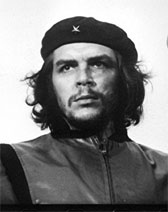
Che Guevara
The Icon of Revolutionary Humanism
Born on June 14, 1928
Died on October 9, 1967
Age at death: 39
Profession: Physician, Military Commander
Place of Birth: Rosario, Santa Fe, Argentina
Place of Death: La Higuera, Vallegrande, Bolivia
Ernesto Guevara de la Serna, globally known as Che Guevara, was an Argentine revolutionary leader, physician, and guerrilla commander of Irish and Basque descent. One of the most iconic figures in modern history, he devoted his life to fighting exploitation, injustice, inequality, and poverty, leaving a profound impact on global revolutionary movements. Together with Fidel Castro, he was one of the founding figures of revolutionary Cuba, and his life, ideals, and moral conviction elevated him to a universal symbol of resistance and human dignity.
Ernesto Guevara de la Serna was born on June 14, 1928, in Rosario, Argentina, although some sources list his birth date as May 14. His father, Ernesto Guevara Lynch, was a civil engineer of Irish descent, while his mother, Celia de la Serna, came from a family of Irish and Spanish origins. At the age of two, Guevara suffered a severe asthma attack, a condition that would affect him throughout his life. When his health worsened, his family relocated from Buenos Aires to Córdoba upon medical advice, as climate conditions played a crucial role in managing his illness.
The Guevara family was known for its progressive and left-leaning liberal views and openly supported the Republicans during the Spanish Civil War. Despite initially enjoying financial stability, the family gradually faced economic hardship. Guevara attended Dean Funes High School under the Ministry of Education and, despite his illness, led an active childhood. He excelled in athletics and rugby, earning the nickname “El Furibundo” for his aggressive playing style, combined with his mother’s surname into the moniker “Fuser.” During this period, he learned chess from his father and began participating in local tournaments at the age of twelve.
In his adolescence, Guevara developed a deep interest in poetry and literature, particularly admiring the works of Pablo Neruda and later Charles Baudelaire. A voracious reader, he studied authors ranging from Jack London and Jules Verne to Sigmund Freud and Bertrand Russell. He also pursued photography, documenting people, landscapes, and archaeological sites wherever he traveled. While receiving formal education in English at school, he learned French from his mother, nurturing a lifelong connection to language and expression.
In 1944, the family returned to Buenos Aires, where their financial situation deteriorated further, prompting Guevara to work while studying. In 1948, he enrolled in the Faculty of Medicine at the University of Buenos Aires. During his studies, he undertook extensive journeys across Latin America, exploring Argentina’s northern and western regions and conducting medical research on leprosy and other diseases in remote forest villages.
In 1951, his close friend, biochemist Alberto Granado, proposed a long-discussed journey across South America. The two set out from Alta Gracia on a 1939 Norton 500 cc motorcycle named “La Poderosa II.” Their travels took them to Peru, where they volunteered at the San Pablo leper colony along the Amazon River. This journey exposed Guevara to the harsh realities of exploitation and poverty across Latin America and profoundly shaped his political consciousness. Witnessing systemic injustice firsthand, he became increasingly influenced by Marxism and concluded that revolution was the only viable solution to the region’s deep-rooted inequalities.
Guevara envisioned a unified Latin America without borders, bound by shared culture and collective resistance. Determined to complete his medical degree, he returned to Argentina and graduated in March 1953, receiving his diploma on June 12. Shortly thereafter, on July 7, 1953, he resumed his travels through Central and South America, initially intending to work in a leper colony in Venezuela.
After a brief stay in Peru, where he was imprisoned due to a previously published study on indigenous populations, Guevara traveled to Ecuador. There, he met lawyer Ricardo Rojo, a pivotal encounter that redirected his path toward Guatemala. At the time, Guatemalan President Jacobo Árbenz Guzmán was pursuing ambitious land reforms before being overthrown by a right-wing coup. In Guatemala, Guevara became involved with revolutionary groups and later sought refuge in the Argentine embassy. In a letter to his aunt Beatriz Guevara, he wrote:
In Guatemala, I will do everything necessary to become a true revolutionary and perfect myself.
The CIA-backed overthrow of Árbenz reinforced Guevara’s belief that the United States functioned as an imperialist power suppressing social reform. Forced to flee Guatemala, he moved to Mexico, where he met Raúl Castro and was introduced to Fidel Castro on July 8, 1955. Recognizing Castro as a genuine revolutionary leader, Guevara joined the 26th of July Movement to overthrow Cuban dictator Fulgencio Batista. Although initially designated as the group’s physician, he underwent full military training under Colonel Alberto Bayo and was regarded as one of the most outstanding trainees.
On August 18, 1955, Guevara married Hilda Gadea, with whom he later had a daughter, Hilda Beatriz Guevara. On November 25, 1956, he boarded the Granma yacht in Tuxpan, Veracruz, bound for Cuba. Upon landing, the group was ambushed by Batista’s forces. During the clash, Guevara abandoned his medical kit to retrieve ammunition, a moment he later described as his transformation from doctor to revolutionary fighter.
Taking refuge in the Sierra Maestra mountains, Guevara distinguished himself through bravery and discipline, earning the title of Comandante. In December 1958, he led the decisive assault on Santa Clara, a turning point in the Cuban Revolution. On February 7, 1959, the victorious government declared him a “Cuban citizen by birth.” After divorcing Gadea, he married fellow revolutionary Aleida March on June 2, 1959.
Guevara was appointed commander of La Cabaña fortress, overseeing trials and executions of former Batista officials. According to Time Magazine, these trials lacked fairness. He later held key roles as head of the National Institute of Agrarian Reform and President of the Cuban National Bank, before becoming Minister of Industries. In 1960, he assisted victims of the explosion of the ship La Coubre and played a crucial role in shaping Cuban socialism.
During the 1961 Bay of Pigs Invasion, Guevara commanded forces in Pinar del Río, successfully repelling a decoy landing. He was also instrumental during the Cuban Missile Crisis. In 1964, he represented Cuba at the United Nations in New York and appeared on the CBS program Face the Nation. He met figures such as Malcolm X and later embarked on a three-month international tour, visiting China, Egypt, Algeria, Ghana, Guinea, Mali, Congo-Brazzaville, and Tanzania.
On February 24, 1965, in Algiers, he delivered his final public speech at the Second Afro-Asian Economic Solidarity Seminar, declaring:
There are no borders in this fight to the death. We cannot remain indifferent to what happens anywhere in the world. A victory against imperialism anywhere is our victory, and a defeat is our defeat.
Shortly afterward, Guevara disappeared from public life. On October 3, 1965, Castro revealed a letter in which Guevara renounced all official positions and Cuban citizenship to fight for revolution abroad. He later led failed revolutionary efforts in the Congo before turning his focus to Bolivia.
In 1967, Guevara led the ELN guerrilla force in Bolivia. On October 8, his camp was betrayed, and he was captured in the Quebrada del Yuro. Wounded and unarmed, he reportedly declared:
Do not shoot. I am Che Guevara, and I am more valuable to you alive.
Following orders from Bolivian President René Barrientos, Guevara was executed on October 9, 1967, in La Higuera. His final words were reported as:
I know you have come to kill me. Shoot, coward. You are only going to kill a man.
After his death, his body was displayed, his hands severed for identification, and his remains concealed. In 1997, his remains were recovered, identified through DNA analysis, and returned to Cuba. On October 17, 1997, Ernesto Guevara de la Serna was laid to rest with full military honors in a mausoleum in Santa Clara, the city of his greatest revolutionary victory.
His life inspired the film The Motorcycle Diaries, in which he was portrayed by Gael García Bernal. Renowned philosopher Jean-Paul Sartre described Guevara as “the most complete human being of our age.”
Source: Biyografiler.com
Frequently asked questions about Che Guevara
Who is Che Guevara?, Che Guevara biography, Che Guevara life story, Che Guevara age, Che Guevara facts, Che Guevara birthplace, Che Guevara photos, Che Guevara videos, Che Guevara career
Related Biographies

Lamine Yamal
Professional footballer

Erling Haaland
Professional footballer

Kylian Mbappe
Professional footballer

Austin Abrams
Actor

Bad Bunny
Rapper, Songwriter

Sam Altman
Entrepreneur, Investor, CEO


Hongjoong
Singer, Rapper, Songwriter, Composer

Ludacris
Rapper, Actor

Kwon Eunbi
Singer

Sarah Wayne Callies
Actress, Screenwriter, Producer, Director

LaTavia Roberson
Singer, Actress, Entrepreneur

Margot Robbie
Actress
Bad Bunny
Rapper, Songwriter
Kylian Mbappe
Professional footballer

Neymar
Professional footballer

Pedro Sanchez
Politician

Ronaldinho
Professional footballer