
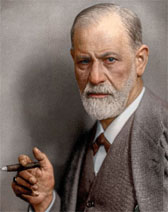
Sigmund Freud
The Father of Psychoanalysis
Born on May 6, 1856
Died on October 23, 1939
Age at death: 83
Profession: Neurologist, Psychoanalyst
Place of Birth: Pribor, Austrian–Hungarian Empire
Place of Death: United Kingdom
Sigmund Freud was the founder of psychoanalysis and is regarded as one of the three major founders of depth psychology, together with Carl Jung and Alfred Adler. His ideas fundamentally shaped modern psychology and influenced many fields including psychiatry, literature, philosophy, and cultural studies.
Sigmund Freud was born on May 6, 1856, in Pribor, in the Austrian–Hungarian Empire. His father, Jacob Freud, was a small-scale merchant, and his mother was his father’s second wife. Freud had two half-brothers who were almost twenty years older than him and seven younger siblings. When Freud was four years old, his family moved to Vienna, where he would live until 1938. Coming from a Jewish family, Freud’s father was a free-thinking man and respected his son’s decision when Freud later declared himself an atheist.
At that time, Jews were generally allowed to work only in medicine and law. Because of his interest in science, Sigmund Freud entered the Medical Faculty of the University of Vienna in 1873. Although he initially wished to pursue neuropsychological research, financial limitations led him to focus on neurology. During this period, he met Josef Breuer, with whom he later collaborated. Together, Breuer and Freud developed the “talking cure.” Between 1882 and 1883, Freud worked at the psychiatric clinic of Theodor Meynert. He conducted extensive research on cocaine and later traveled to Paris to study hypnosis and hysteria under the famous neurologist Jean-Martin Charcot.
In 1886, Sigmund Freud returned to Vienna, opened a private practice, and married. He initially used hypnosis in treating his patients, but over time he realized its limitations and abandoned the method. In 1900, he published The Interpretation of Dreams, followed by The Psychopathology of Everyday Life in 1901. His studies on sexuality, which he began publishing in 1905, caused widespread controversy. He emphasized the importance of childhood experiences and introduced the theory of the Oedipus complex.
Sigmund Freud had a long and happy marriage, from which he had six children. His youngest child, Anna Freud, held a special place in his life. Anna followed in her father’s footsteps and became a highly respected theorist, eventually assuming leadership within the psychoanalytic movement. Freud personally conducted Anna’s psychoanalysis, creating a highly unusual and Oedipal situation.
In 1902, Sigmund Freud became a professor at the University of Vienna. In 1906, he founded the Psychoanalytic Society, after which similar societies began to spread internationally. In 1909, he delivered his first international lectures at Clark University in Massachusetts.
In 1923, Sigmund Freud was diagnosed with jaw cancer as a result of his heavy smoking habit. Over the next 16 years, he underwent 33 surgeries. During this same period, Nazi oppression intensified across Europe, and Freud’s works were banned and burned. In 1938, following Germany’s occupation of Austria, Freud fled to England with his wife. He died there on September 23, 1939. Today, the apartments in which he lived in both London and Vienna serve as Sigmund Freud Museums.
Major Works of Sigmund Freud:
- The Psychopathology of Everyday Life
- The Interpretation of Dreams
- Five Lectures on Psychoanalysis
- Moses and Monotheism
- On Narcissism: An Introduction
- Inhibitions, Symptoms and Anxiety (1926)
- Beyond the Pleasure Principle / The Ego and the Id
- Case Histories
- Three Essays on the Theory of Sexuality (1905)
- Jokes and Their Relation to the Unconscious (1905)
- On the History of the Psycho-Analytic Movement (1914)
- Introductory Lectures on Psycho-Analysis (1917)
- Psychoanalysis and Practice
- Totem and Taboo
- The Future of an Illusion (1927)
- Civilization and Its Discontents (1930)
- My Life and Psychoanalysis (1925)
Source: Biyografiler.com
Frequently asked questions about Sigmund Freud
Who is Sigmund Freud?, Sigmund Freud biography, Sigmund Freud life story, Sigmund Freud age, Sigmund Freud facts, Sigmund Freud birthplace, Sigmund Freud photos, Sigmund Freud videos, Sigmund Freud career
Related Biographies

Lamine Yamal
Professional footballer

Kylian Mbappe
Professional footballer

Erling Haaland
Professional footballer

Sam Altman
Entrepreneur, Investor, CEO

Austin Abrams
Actor

Bad Bunny
Rapper, Songwriter


Hongjoong
Singer, Rapper, Songwriter, Composer

Ludacris
Rapper, Actor

Kwon Eunbi
Singer

Sarah Wayne Callies
Actress, Screenwriter, Producer, Director

LaTavia Roberson
Singer, Actress, Entrepreneur

Adam Sandler
Actor

Cillian Murphy
Actor

Pedro Sanchez
Politician
Lamine Yamal
Professional footballer
Austin Abrams
Actor

Brad Pitt
Actor