
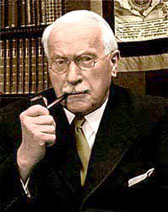
Carl Jung
Founder of Analytical Psychology
Born on July 26, 1875
Died on June 6, 1961
Age at death: 86
Profession: Psychiatrist
Place of Birth: Kesswil, Switzerland
Place of Death: Küsnacht, Switzerland
Carl Gustav Jung was the founder of Analytical Psychology and one of the three major pioneers of depth psychology, alongside Sigmund Freud and Alfred Adler. His theories reshaped not only psychotherapy but also profoundly influenced psychology, theology, anthropology, literature, and the arts.
Carl Gustav Jung was born on July 26, 1875, in Kesswil, Switzerland. His full name was Carl Gustav Jung, named after his grandfather, a medical professor at the University of Basel. Jung was the son of a Swiss Protestant pastor. Raised in an unhappy household, he experienced a lonely and introverted childhood before later breaking free from this disposition. He began learning Latin at the age of six and developed a deep interest in linguistics and literature, particularly ancient texts. Jung could read writings in many ancient languages, including Sanskrit, the sacred language of ancient Indian scriptures, in addition to numerous modern European languages.
Although his first career interest was archaeology, Jung turned toward philosophy—strongly influenced by Arthur Schopenhauer—and ultimately pursued medicine. In 1895, he began studying medicine in Basel, and by 1899, at the age of twenty-four, he decided to specialize in psychiatry.
After graduation, Jung joined the Burghölzli Psychiatric Hospital in Zurich, where he worked as an assistant to Eugene Bleuler, the renowned psychiatrist and the originator of the term “schizophrenia.” In 1900, Jung began serving as a psychiatrist at Burghölzli under Bleuler’s supervision. In 1902, he completed his doctoral dissertation on occult phenomena and their relationship to psychology and pathology.
Jung later worked in Paris with Pierre Janet, deepening his studies on the unconscious and hypnosis over a six-month period. In 1903, he married Emma Rauschenbach. After reading Sigmund Freud’s The Interpretation of Dreams, Jung began corresponding with Freud, and in 1907 they met in Vienna.
At the age of thirty-six, Jung became the first president of the International Psychoanalytical Association. He is also known for incorporating astrology into his psychological analyses. Together with Freud, Jung became widely associated with the concept of the collective unconscious.
In 1909, during a joint lecture tour in the United States with Sigmund Freud, tensions between the two thinkers began to surface. As their personal relationship cooled, theoretical disagreements intensified. By 1913, their correspondence ended entirely. After separating from Freud, Jung withdrew into solitude and undertook an intense self-analysis.
Between 1913 and 1917, Jung embarked on a profound inner journey into his own unconscious psyche. This period, later termed the “Creative Illness” by Marvin Goldwert, was marked by visionary experiences, spiritual revelations, intuitions, psychological disturbances, and hallucinations—which Jung himself referred to as “visions.” World War I proved to be a deeply painful personal trial for Jung and simultaneously marked the genesis of one of the most original personality theories ever developed.
After the war, Jung traveled extensively, studying tribes in Africa, indigenous cultures in the Americas, and societies in India. He retired in 1946 and, following the death of his wife in 1955, lived a largely secluded life.
Though initially a close follower of Sigmund Freud, Jung eventually distanced himself from both Freud and Alfred Adler. As the founder of Analytical Psychology, Jung emphasized continuous observation and intellectual openness rather than rigid adherence to established concepts. Alongside clinical psychology, he explored social, artistic, and religious dimensions of human experience. A gifted writer, Jung’s influence continued to expand even after his death on June 6, 1961.
Carl Gustav Jung introduced and developed numerous foundational psychological concepts, many of which gained widespread acceptance: complex, introversion and extraversion, the shadow, archetypes, the collective unconscious, anima, and animus.
Jung married Emma Rauschenbach on February 14, 1903, the daughter of wealthy industrialist Johannes Rauschenbach. They had five children: Helene Hoerni, Gret Baumann, Marianne Niehus, Agathe Niehus, and Franz Jung-Merker. Although Jung had relationships with several women throughout his life, none played as significant a role as Toni Wolff, a former patient and his companion for over thirty years. Another notable relationship was with his former patient Sabina Spielrein.
Jung died on June 6, 1961, in Küsnacht, Switzerland, at the age of eighty-six.
Raised as a Protestant Christian, Jung never fully embraced atheism despite distancing himself from institutional religion. His belief in traditional Christian doctrine weakened in childhood and disappeared during adolescence. He replaced the external image of God with an inner conception, placing it at the core of his model of the psyche. Drawing upon Islamic mysticism, Eastern philosophies, and Sufi teachings—particularly the concept of unity—Jung sought to reconcile his lifelong spiritual contradictions. In a 1959 interview, when asked whether he believed in God, he replied:
Jung’s hobbies included woodcarving, stone cutting, and sailing on Lake Constance. He actively engaged with alchemy, archaeology, Eastern philosophies, history, religion, mythology, and ethnology. Fluent in German, Latin, Greek, French, and English, Jung was a remarkably prolific writer. His collected works exceed twenty volumes, and much of what is known about his life comes from his autobiography, recorded and edited by his longtime collaborator Aniela Jaffé.
Carl Gustav Jung remains one of the most influential thinkers of the twentieth century, a figure whose ideas continue to illuminate the depths of the human psyche.
Carl Gustav Jung’s Quotations:
Source: Biyografiler.com
Frequently asked questions about Carl Jung
Who is Carl Jung?, Carl Jung biography, Carl Jung life story, Carl Jung age, Carl Jung facts, Carl Jung birthplace, Carl Jung photos, Carl Jung videos, Carl Jung career
Related Biographies

Lamine Yamal
Professional footballer

Kylian Mbappe
Professional footballer

Erling Haaland
Professional footballer

Sam Altman
Entrepreneur, Investor, CEO

Austin Abrams
Actor

Bad Bunny
Rapper, Songwriter


Hongjoong
Singer, Rapper, Songwriter, Composer

Ludacris
Rapper, Actor

Kwon Eunbi
Singer

Sarah Wayne Callies
Actress, Screenwriter, Producer, Director

LaTavia Roberson
Singer, Actress, Entrepreneur

Adam Sandler
Actor

Cillian Murphy
Actor

Pedro Sanchez
Politician
Lamine Yamal
Professional footballer
Austin Abrams
Actor

Brad Pitt
Actor