
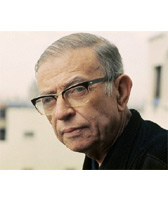
Jean-Paul Sartre
Founder of Modern Existentialism & Influential 20th-Century Intellectual
Born on June 21, 1905
Died on April 15, 1980
Age at death: 75
Profession: Philosopher, Writer, Journalist
Place of Birth: Paris, France
Place of Death: Paris, France
Jean-Paul Sartre was one of the most influential thinkers of the 20th century, leaving a profound mark through his philosophical novels, his uniquely developed existentialist philosophy, his formulation of existentialist Marxism, and his active engagement in political life. As a philosopher, writer, playwright, and public intellectual, Sartre shaped modern thought and cultural debate on freedom, responsibility, and human existence.
Jean-Paul Sartre was born on 21 June 1905 in Paris into a wealthy bourgeois family. His father, Jean-Baptiste Sartre, was an officer in the French army, and his mother, Anne-Marie Schweitzer, was a cousin of the Nobel Prize–winning humanitarian Albert Schweitzer. Sartre lost his father at the age of fifteen months and was raised primarily by his maternal grandfather, a German professor at the Sorbonne, who played a decisive role in his intellectual formation. His mother closely supervised his education.
As a child, Sartre suffered from an illness that caused partial blindness in his right eye and resulted in a noticeable strabismus, which influenced both his appearance and self-perception. After his mother remarried, Sartre moved to La Rochelle to live with his stepfather. From an early age, he received intensive instruction in mathematics and literature. He studied at the prestigious Lycée Louis-le-Grand in Paris, completing part of his secondary education in La Rochelle. He later continued his studies at the University of Fribourg in Switzerland and completed further academic work at the French Institute in Berlin.
Sartre was deeply influenced in his youth by the work of Henri Bergson, particularly Essay on the Immediate Data of Consciousness. His intellectual interests extended across Western philosophy, with a strong focus on Immanuel Kant, Georg Wilhelm Friedrich Hegel, and Martin Heidegger. After graduating from Lycée Louis-le-Grand, he enrolled at the elite École Normale Supérieure. During his student years, he met Simone de Beauvoir in 1928 at the Sorbonne. Their intellectual and emotional partnership, which began during their studies, lasted for the rest of their lives.
In 1929, Jean-Paul Sartre earned his doctorate in philosophy and graduated first in the highly competitive philosophy teaching examination, securing his position as one of France’s most promising young intellectuals.
Between 1931 and 1945, Sartre taught philosophy in Le Havre, Lyon, and Paris. He spent two years in Berlin studying German philosophy. Seeking time to write, he temporarily stepped away from teaching and published his first book, The Imagination, in 1936. Although he paused his teaching career, he never abandoned his role as an educator and public thinker.
With the outbreak of World War II in 1939, Sartre served in the French army as a meteorologist. In 1940, he was captured by German forces and spent nine months as a prisoner of war. After his release, he joined the French Resistance and wrote the play The Flies during this period.
While continuing his philosophical work, Sartre published several major literary texts, including The Transcendence of the Ego (1937), Nausea (1938), and The Wall (1939). After his imprisonment in Padoux in 1940, he committed himself fully to resistance activities. During these years, he wrote both The Flies and his philosophical masterpiece Being and Nothingness, in which he articulated the foundations of his existentialist philosophy.
From August 1944 onward, Sartre collaborated with figures such as Albert Camus and André Malraux on the French newspaper Combat. In 1945, he permanently left teaching and devoted himself entirely to writing and intellectual activism. That same year, he founded the influential literary and political journal Les Temps Modernes.
In the postwar years, Sartre became one of the most prominent public intellectuals in France. He wrote plays such as No Exit and The Respectful Prostitute and took strong political positions during the Cold War. Although sympathetic to communism, he never officially joined the Communist Party. He opposed France’s war in Algeria and supported anti-colonial movements.
His 1948 play Dirty Hands combined philosophical inquiry with political critique. Sartre traveled extensively between 1956 and 1960, visiting the Soviet Union, Scandinavia, Africa, the United States, and Cuba. In 1960, he met Che Guevara during a visit to Cuba. He also presided over the Russell Tribunal (1966–1967), which investigated war crimes during the Vietnam War.
In 1964, Sartre published The Words, a work marked by irony and self-reflection, and was awarded the Nobel Prize in Literature. He famously refused the prize, arguing that acceptance would compromise his intellectual independence and political stance.
The events of 1968 led Sartre to reassess both his own ideas and the traditional role of intellectuals. In response to the Soviet invasion of Prague and the French student movements, he reevaluated political theory and, in 1973, co-founded the newspaper Libération. Between 1960 and 1971, he devoted extensive research to a major study of Gustave Flaubert.
By 1974, Sartre’s eyesight had deteriorated severely, leaving him nearly blind. He died on 15 April 1980 in Paris at the age of seventy-five due to pulmonary edema. He left behind a vast body of work that integrated philosophy, literature, and political commitment. As he famously stated, “Existentialism is a humanism.” Sartre reshaped existentialism by infusing it with political and social responsibility, establishing a distinct and enduring intellectual legacy.
Selected Major Works:
Books:
Existentialism Is a Humanism
Being and Nothingness
Critique of Dialectical Reason
What Is Literature?
The Words
Nausea
The Imagination
The Transcendence of the Ego
The Wall
Roads to Freedom
The Age of Reason
The Reprieve
Troubled Sleep
Plays:
No Exit
The Flies
Dirty Hands
The Devil and the Good Lord
The Respectful Prostitute
Essays and Other Works:
Anti-Semite and Jew
Colonialism Is a System
War Diaries
Search for a Method
On Intellectuals
Essays on Aesthetics
Source: Biyografiler.com
Frequently asked questions about Jean-Paul Sartre
Who is Jean-Paul Sartre?, Jean-Paul Sartre biography, Jean-Paul Sartre life story, Jean-Paul Sartre age, Jean-Paul Sartre facts, Jean-Paul Sartre birthplace, Jean-Paul Sartre photos, Jean-Paul Sartre videos, Jean-Paul Sartre career
Related Biographies

Lamine Yamal
Professional footballer

Erling Haaland
Professional footballer

Kylian Mbappe
Professional footballer

Austin Abrams
Actor

Bad Bunny
Rapper, Songwriter

Sam Altman
Entrepreneur, Investor, CEO


Hongjoong
Singer, Rapper, Songwriter, Composer

Ludacris
Rapper, Actor

Kwon Eunbi
Singer

Sarah Wayne Callies
Actress, Screenwriter, Producer, Director

LaTavia Roberson
Singer, Actress, Entrepreneur

Amber Heard
Actress, Model
Lamine Yamal
Professional footballer
Bad Bunny
Rapper, Songwriter
Erling Haaland
Professional footballer
Kylian Mbappe
Professional footballer
Austin Abrams
Actor