
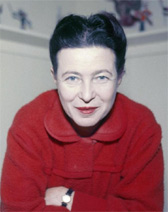
Simone de Beauvoir
Foundational Figure of Modern Feminism & Existentialist Philosophy
Born on January 9, 1908
Died on April 14, 1986
Age at death: 78
Profession: Writer
Place of Birth: Paris, France
Place of Death: Paris, France
Simone de Beauvoir was one of the most influential intellectuals of the 20th century. Her philosophical novels, memoirs, and essays—most notably her groundbreaking work on women’s oppression—reshaped modern feminist thought. Her 1949 book The Second Sex became a worldwide bestseller and laid the intellectual foundations for second-wave feminism and the global women’s movement of the 1970s.
Simone de Beauvoir was born on 9 January 1908 in Paris as Simone Lucie-Ernestine-Marie-Bertrand de Beauvoir, the daughter of Georges Bertrand de Beauvoir and Françoise Brasseur. Her father was a lawyer, while her mother came from a wealthy banking family and was a devout Catholic. Beauvoir received early training in mathematics at the Catholic Institute and studied literature and foreign languages at the Sainte-Marie Institute before enrolling at the Sorbonne, where she pursued philosophy and graduated in 1929.
In 1929, she enrolled at the prestigious École Normale Supérieure and, during the same year, met Jean-Paul Sartre—with whom she would share a lifelong intellectual and emotional partnership without entering into a formal marriage. That year, she became the youngest person to pass the highly competitive agrégation in philosophy. Sartre ranked first, Beauvoir second, though many contemporaries acknowledged Beauvoir as the most brilliant philosopher of the two.
Shortly after their meeting, Simone de Beauvoir and Jean-Paul Sartre became inseparable. Their lifelong relationship was marked by deep intellectual collaboration, emotional intensity, and an openly non-monogamous structure that included other men and women. Despite its complexity, this bond remained unbroken and profoundly shaped both of their lives and works.
After graduating, Beauvoir became the youngest female philosophy teacher in France. She taught in Rouen, Marseille, and Paris until 1943, when she left teaching to devote herself entirely to writing.
In 1943, she published her first novel She Came to Stay (L’Invitée), a semi-autobiographical work inspired by her relationship with one of her former students, Olga Kosakiewicz, and the emotional tensions within the Sartre–Beauvoir–Kosakiewicz triangle. The novel explores jealousy, freedom, and the fragility of open relationships, reflecting Beauvoir’s lived experience.
Simone de Beauvoir openly defended free relationships and rejected conventional marriage. In The Second Sex, she wrote that by the age of twenty-one she had experienced relationships with both sexes. She detailed these experiences in She Came to Stay and discussed her unconventional partnership with Sartre in numerous interviews, consistently affirming her belief in personal freedom.
After World War II, Beauvoir became a central figure in the intellectual life of postwar France. She worked for the political and literary journal Les Temps Modernes, remaining an editor until her death. Although she never formally identified herself as a feminist early in her career, her life and work consistently challenged traditional gender roles and social constraints.
One of the most significant personal relationships of her later life occurred during a trip to the United States, when she met the American writer Nelson Algren in Chicago. Their intense love affair left a deep emotional mark on Beauvoir, but ultimately ended because Algren refused to move to Paris and Beauvoir was unwilling to leave Sartre. Their correspondence was later published and revealed the depth of this relationship.
Her most influential work, The Second Sex (1949), stands as a foundational text of modern feminism. In this extensive philosophical and sociological study, Beauvoir analyzed the historical, biological, psychological, and social mechanisms of women’s oppression. Drawing on existentialist principles, she famously declared: “One is not born, but rather becomes, a woman,” asserting that gender is socially constructed rather than biologically predetermined.
In 1981, she published Adieux: A Farewell to Sartre, a deeply personal account of Jean-Paul Sartre’s final years. Later publications, including her diaries and letters released in 1990, revealed further details of her intimate life and relationships with both women and men.
Simone de Beauvoir died on 14 April 1986 in Paris at the age of seventy-eight. She was buried at the Cimetière du Montparnasse beside Jean-Paul Sartre, who had died in 1980. Their shared grave bears both names engraved one beneath the other.
In 2008, controversy arose when a nude photograph of Beauvoir taken by the American photographer Arthur Shay in 1952 was published by Le Nouvel Observateur, reigniting public discussion of her life, legacy, and enduring cultural impact.
Selected Works:
Books:
She Came to Stay (1943)
Pyrrhus and Cinéas (1944)
The Blood of Others (1945)
All Men Are Mortal (1946)
The Ethics of Ambiguity (1947)
America Day by Day (1948)
The Second Sex (1949)
The Mandarins (1954)
Should We Burn Sade? (1955)
Memoirs of a Dutiful Daughter (1958)
The Prime of Life (1960)
The Force of Circumstance (1963)
A Very Easy Death (1964)
The Woman Destroyed (1967)
Old Age (1970)
All Said and Done (1972)
Adieux: A Farewell to Sartre (1974–1981)
Letters to Sartre (1990)
Love Letters to Nelson Algren (1998)
Source: Biyografiler.com
Frequently asked questions about Simone de Beauvoir
Who is Simone de Beauvoir?, Simone de Beauvoir biography, Simone de Beauvoir life story, Simone de Beauvoir age, Simone de Beauvoir facts, Simone de Beauvoir birthplace, Simone de Beauvoir photos, Simone de Beauvoir videos, Simone de Beauvoir career
Related Biographies

Lamine Yamal
Professional footballer

Erling Haaland
Professional footballer

Kylian Mbappe
Professional footballer

Austin Abrams
Actor

Bad Bunny
Rapper, Songwriter

Sam Altman
Entrepreneur, Investor, CEO


Hongjoong
Singer, Rapper, Songwriter, Composer

Ludacris
Rapper, Actor

Kwon Eunbi
Singer

Sarah Wayne Callies
Actress, Screenwriter, Producer, Director

LaTavia Roberson
Singer, Actress, Entrepreneur

Amber Heard
Actress, Model
Lamine Yamal
Professional footballer
Bad Bunny
Rapper, Songwriter
Erling Haaland
Professional footballer
Kylian Mbappe
Professional footballer
Austin Abrams
Actor