
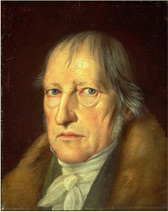
Georg Wilhelm Friedrich Hegel
German Idealist Philosopher
Born on August 27, 1770
Died on November 14, 1831
Age at death: 61
Profession: Philosopher
Place of Birth: Stuttgart, Württemberg, Germany
Place of Death: Berlin, Germany
Georg Wilhelm Friedrich Hegel was born on August 27, 1770, in Stuttgart, Württemberg, as the son of a civil servant. After studying theology in Tübingen, he began working as a philosophy tutor in Bern and Frankfurt. In 1805, he was appointed professor at the University of Jena.
Georg Wilhelm Friedrich Hegel studied the philosophy of Immanuel Kant and wrote several texts on Christianity. His extensive examination of different intellectual movements led him into a period of deep intellectual crisis. To overcome his growing melancholy, he devoted himself even more intensely to work. Alongside Greek philosophy, he turned toward contemporary history and politics and studied economics. Freeing himself from Kant’s philosophical influence, he re-examined the fundamental principles of Christianity with a new perspective and frequently criticized Christianity in his writings. He also reassessed his earlier Kant-influenced texts and, finding them inadequate, openly criticized Kant in his later essays.
After his father’s death, Georg Wilhelm Friedrich Hegel moved to Jena in 1801 and became a university lecturer. In 1805, he was appointed professor at the University of Jena. He attended lectures by his former Tübingen friend Friedrich Schelling and, together with him, founded a literary-philosophical journal titled Kritisches Journal der Philosophie. In this journal, he published writings on the works of Immanuel Kant, Johann Gottlieb Fichte, Friedrich Schelling, and skepticism. Although he initially embraced Schelling’s ideas, he later made clear that he disagreed with him on many points.
At first, Georg Wilhelm Friedrich Hegel appeared to accept Schelling’s subjective idealism, but he later developed and defended his own independent philosophical system. He presented this system in Phänomenologie des Geistes. After spending some time in Nuremberg, he held professorships at the universities of Berlin and Heidelberg. Among the notable works of this period were Wissenschaft der Logik and Enzyklopädie der philosophischen Wissenschaften.
At one point, he changed professions and worked as the political editor of the newspaper Bamberger Zeitung. In 1808, he moved to Nuremberg, where he served as the headmaster of a secondary school for eight years. During this time, he summarized his philosophical ideas in Philosophische Propädeutik and wrote Wissenschaft der Logik.
In 1816, Georg Wilhelm Friedrich Hegel was appointed to the chair of philosophy at Heidelberg University, where he presented his system as a unified whole in Enzyklopädie der philosophischen Wissenschaften im Grundrisse. In 1818, he assumed the philosophy chair at the University of Berlin, which had remained vacant since the death of Johann Gottlieb Fichte.
In 1821, he published Grundlinien der Philosophie des Rechts, in which he systematically set out his political and economic views. He criticized all political systems other than constitutional monarchy, which he regarded as the most rational form of governance.
From 1818 until his death, Georg Wilhelm Friedrich Hegel taught philosophy at the University of Berlin, carefully developing his system in the areas of philosophy of history, history of philosophy, philosophy of law, and philosophy of religion. Notes taken by him and his students were later compiled and published posthumously as Berliner Vorlesungen.
He traveled to the Netherlands in 1822, Vienna in 1824, and Paris in 1827. Beginning in 1827, he published the journal Jahrbücher für Wissenschaftliche Kritik in Berlin. He was deeply affected by the upheavals of the 1830 Revolution. In 1831, he was awarded a medal by the Prussian ruler Friedrich Wilhelm III.
Georg Wilhelm Friedrich Hegel argued that, for philosophy to escape its endless circular debates, history and structure must be taken seriously—perhaps for the first time in philosophical thought. His conceptualization of the master–slave dialectic emphasized the importance of the other in the formation of self-consciousness.
The influence of Georg Wilhelm Friedrich Hegel extended across a remarkably wide spectrum, from admirers such as Francis Bradley, Jean-Paul Sartre, Hans Küng, Bruno Bauer, Max Stirner, and Karl Marx, to fierce critics including Søren Kierkegaard, Arthur Schopenhauer, Friedrich Nietzsche, Martin Heidegger, and Friedrich Schelling.
The philosophical system developed by Georg Wilhelm Friedrich Hegel is known as dialectical logic. According to this system, an idea (thesis) encounters its opposite (antithesis), and from their interaction a new understanding (synthesis) emerges.
Although Georg Wilhelm Friedrich Hegel respected the philosophy of Immanuel Kant, he found it insufficient. Unlike Kant, he believed that humans are capable of knowing everything. For Hegel, the world was identical with logic itself. Once humanity comprehends the limits of logic, it will also comprehend the limits of human existence. According to him, the only living philosophy is the philosophy of contradictions: the flower gives rise to the fruit, yet for the fruit to emerge, the flower must perish. Death is thus both destruction and the condition for rebirth.
Georg Wilhelm Friedrich Hegel spent his final years in Berlin. During the cholera epidemic that swept the city in the summer and autumn of 1831, he became one of its last victims. He died suddenly after a brief illness on November 14, 1831, in Berlin, at the age of sixty-one.
Even in his youth, Georg Wilhelm Friedrich Hegel appeared elderly. He struggled with speech and behaved restlessly while lecturing. His thought aimed to unite oppositions and to gather, transcend, and reconcile the fragmented and contradictory ideas of his predecessors. For this reason, his system could be interpreted as both idealist and realist, and it was understood in different ways by different thinkers. Hegelian philosophy found followers both during his lifetime and after his death, spreading throughout Europe—especially in France and Italy—and influencing the development of Existentialism, Marxism, Positivism, and Analytic philosophy.
Quotes by Georg Wilhelm Friedrich Hegel
Books
1801 – Differenz des Fichteschen und Schellingschen Systems der Philosophie
1807 – Phänomenologie des Geistes
1808 – Wissenschaft der Logik
1809 – Philosophische Propädeutik
1816 – Enzyklopädie der philosophischen Wissenschaften im Grundrisse
1821 – Grundlinien der Philosophie des Rechts
1837 – Vorlesungen über die Philosophie der Geschichte
Source: Biyografiler.com
Frequently asked questions about Georg Wilhelm Friedrich Hegel
Who is Georg Wilhelm Friedrich Hegel?, Georg Wilhelm Friedrich Hegel biography, Georg Wilhelm Friedrich Hegel life story, Georg Wilhelm Friedrich Hegel age, Georg Wilhelm Friedrich Hegel facts, Georg Wilhelm Friedrich Hegel birthplace, Georg Wilhelm Friedrich Hegel photos, Georg Wilhelm Friedrich Hegel videos, Georg Wilhelm Friedrich Hegel career
Related Biographies

Lamine Yamal
Professional footballer

Erling Haaland
Professional footballer

Kylian Mbappe
Professional footballer

Austin Abrams
Actor

Bad Bunny
Rapper, Songwriter

Sam Altman
Entrepreneur, Investor, CEO


Hongjoong
Singer, Rapper, Songwriter, Composer

Ludacris
Rapper, Actor

Kwon Eunbi
Singer

Sarah Wayne Callies
Actress, Screenwriter, Producer, Director

LaTavia Roberson
Singer, Actress, Entrepreneur
Bad Bunny
Rapper, Songwriter

Margot Robbie
Actress
Kylian Mbappe
Professional footballer

Neymar
Professional footballer

Pedro Sanchez
Politician

Ronaldinho
Professional footballer