
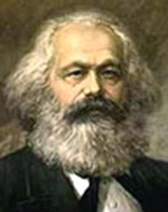
Karl Marx
Born on May 5, 1818
Died on March 14, 1883
Age at death: 65
Profession: Philosopher, Economist, Political Theorist
Place of Birth: Trier, Prussia (now Germany)
Place of Death: London, England
Karl Marx was one of the first and most influential representatives of communism, a German philosopher and economist whose ideas profoundly shaped modern political thought.
Karl Marx was born on 5 May 1818 in Trier, Germany. His father was a lawyer named Hirschel Marx, and his mother was Henrietta Marx. While Marx was still a child, his family converted from Judaism to Protestantism. After completing his classical education in Trier, he studied law at the University of Bonn. However, his growing interest in philosophy led him away from legal studies. He spent five years living in Berlin, which was known at the time as the “metropolis of enlightenment.”
After leaving Berlin, Karl Marx worked in Bonn as the editor of a newspaper called Rheinische Zeitung. Later, in order to publish a more radical journal titled Franco-German Annals, he moved to Paris in 1843. Before leaving for Paris, he married Jenny von Westphalen. One year later, he met Friedrich Engels, who would become both his lifelong friend and collaborator. Engels was also conducting studies on industrial workers, and at the time, both men were involved in revolutionary groups. During this period, Marx devoted himself to the study of political economy and the history of the French Revolution.
From his earliest articles published in Paris, Karl Marx argued that the working class would liberate society. These writings were immediately banned in Germany. In 1844, he published Economic and Philosophic Manuscripts, in which he introduced and explained the concept of alienation.
In 1845, Karl Marx was expelled from Paris for being considered a dangerous revolutionary and moved to Brussels. In 1847, he published The Poverty of Philosophy, a critique of Pierre-Joseph Proudhon’s work. In the same year, together with Friedrich Engels, he prepared the Communist Manifesto. This manifesto was adopted by workers’ unions and published in London in 1848 as the Manifesto of the Communist Party, shortly before the February Revolution.
After being expelled from Belgium, Karl Marx temporarily set aside his theoretical work to take part more directly in revolutionary activity. He went first to France and then to Cologne, Germany, where he and Friedrich Engels began publishing the newspaper Neue Rheinische Zeitung. This paper made the most effective use of the press freedom of 1848. In 1849, Marx moved to London, where he would spend the rest of his life. He continued publishing the newspaper there for a while and also worked as a European political correspondent for the New York Tribune, a role he maintained until the outbreak of the American Civil War.
The coup d’état of 2 December inspired Karl Marx to write The Eighteenth Brumaire of Louis Bonaparte. In 1859, his studies in political economy produced their first major result with the publication of A Contribution to the Critique of Political Economy. This work introduced new perspectives. Finally, in 1867, Capital: A Critique of Political Economy, Volume I was published, bringing together the studies to which he had devoted his life.
Capital, regarded as both the foundation and a critical reference point for all past and future socialist studies, represents a scientific analysis of the political economy of the working class supported by empirical research and findings. It was the first work to systematically examine the relationship between capital and labor, addressing for the first time issues such as the presentation of workers as components of industry, overtime labor, and the exploitation of women’s and children’s labor.
For many years, Karl Marx was viewed among German writers as the “greatest scoundrel.” Alongside his theoretical work, he actively participated in labor movements and was among the founders of the International Workingmen’s Association. After the defeat of his movement in the French elections of 1871, his already fragile health deteriorated further, preventing him from completing the remaining two volumes of Capital.
The Marx family lived in severe poverty, often struggling to pay their rent. Jenny and Karl Marx had six children. Jenny and their daughters, especially Eleanor Marx, assisted him in his work. Marx spent most of his days studying in the library of the British Museum. Eleanor later left home to become a teacher but returned in 1881 to care for her ailing parents.
Karl Marx died on 14 March 1883 in London.
Source: Biyografiler.com
Frequently asked questions about Karl Marx
Who is Karl Marx?, Karl Marx biography, Karl Marx life story, Karl Marx age, Karl Marx facts, Karl Marx birthplace, Karl Marx photos, Karl Marx videos, Karl Marx career
Related Biographies

Lamine Yamal
Professional footballer

Kylian Mbappe
Professional footballer

Erling Haaland
Professional footballer

Sam Altman
Entrepreneur, Investor, CEO

Austin Abrams
Actor

Bad Bunny
Rapper, Songwriter


Hongjoong
Singer, Rapper, Songwriter, Composer

Ludacris
Rapper, Actor

Kwon Eunbi
Singer

Sarah Wayne Callies
Actress, Screenwriter, Producer, Director

LaTavia Roberson
Singer, Actress, Entrepreneur

Adam Sandler
Actor

Cillian Murphy
Actor

Pedro Sanchez
Politician
Lamine Yamal
Professional footballer
Austin Abrams
Actor

Brad Pitt
Actor