
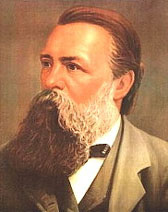
Friedrich Engels
Co-author of the Communist Manifesto and a foundational theorist of scientific socialism
Born on November 28, 1820
Died on August 5, 1895
Age at death: 75
Profession: Philosopher, Political Theorist, Economist, Writer
Place of Birth: Barmen, Rhine Province, Prussia (today Wuppertal, Germany)
Place of Death: London, United Kingdom
Friedrich Engels was born on November 28, 1820, in Barmen, Rhine Province, Prussia, an area that today lies within the borders of the Federal Republic of Germany, in the city of Wuppertal. His mother was Elisabeth Franciska Maurita, and his father, Friedrich Engels, was a cotton textile industrialist. He began primary school in Barmen and continued his secondary education in Elberfeld in 1834. In 1837, one year before graduating, he was withdrawn from school by his father and forced to work as an accountant in the family business in Barmen.
In 1838, Engels was sent to Bremen to learn commerce, where he worked for the industrialist Heinrich Leopold while completing his interrupted education in 1841. During his time in Bremen, he entered literary and artistic circles and began writing reviews for various newspapers. He also produced works in the form of articles, poetry, and drama.
In 1841, Friedrich Engels completed his military service in Berlin as a member of the Prussian artillery. During this period, he attended philosophy lectures at the University of Berlin. After his military service, in 1842, he wrote a series of critical articles for the bourgeois opposition newspaper Rheinische Zeitung, sharply criticizing the direction of the Prussian state.
In the same year, while traveling to Manchester to work at his father’s textile factory, Engels visited the Rheinische Zeitung office in Cologne and met Karl Marx for the first time. They discovered a shared understanding of social problems and their possible solutions through socialism, forming a lifelong friendship. In 1845, Engels published The Condition of the Working Class in England, based on his observations in England.
The first joint work of Friedrich Engels and Karl Marx was The German Ideology, completed in 1845. That same year, after Marx was expelled from France, they traveled together to Belgium. In 1848, Engels and Marx co-authored The Communist Manifesto, a work summarizing their views on how the working class could seize political power through revolution. The book had a profound influence on Vladimir Ilyich Lenin and other Russian revolutionaries. Following its publication in February 1848, Engels and Marx were expelled from Belgium in March and moved to Cologne, where they began publishing the radical newspaper Neue Rheinische Zeitung.
Friedrich Engels actively participated in the revolutions of 1848. He took part in the uprising in Elberfeld and fought against Prussian forces during the Baden campaign, serving as aide-de-camp to August Willich, commander of the volunteer forces in the Baden-Palatinate uprising.
After 1849, Engels returned to Manchester and resumed work at his father’s factory, eventually becoming a partner. Although Prussian authorities pressured the British government to expel Engels and Marx, Prime Minister Lord John Russell refused. During this period, Engels provided financial support to Marx, who settled in London in 1870 and focused on economic research. In 1869, Engels sold his shares in the company, securing enough financial resources to support both himself and Marx for the rest of their lives.
Friedrich Engels played an active role in the founding of the International Workingmen’s Association, commonly known as the First International, established in London in 1864 and officially dissolved at the Philadelphia Congress in 1876. The organization aimed to unite workers’ movements across different countries. In the years leading up to World War II, three additional Internationals were established.
After Karl Marx’s death in 1883, Friedrich Engels edited and completed the final two volumes of Das Kapital using Marx’s extensive notes, ensuring the preservation and continuation of Marx’s most significant work.
Friedrich Engels died on August 5, 1895, at the age of 75 in a hotel room in London. He never married.
A collection of Engels’ correspondence, titled Zwischen Bureau und Barrikade – Ein Leben in Briefen, was translated from German by Necla Kuglin and Jörg Kuglin and published in Turkish as Between Office and Barricade – A Life in Letters by Sol Publications in August 1996, printed at Şahin Printing House in Ankara.
Source: Biyografiler.com
Frequently asked questions about Friedrich Engels
Who is Friedrich Engels?, Friedrich Engels biography, Friedrich Engels life story, Friedrich Engels age, Friedrich Engels facts, Friedrich Engels birthplace, Friedrich Engels photos, Friedrich Engels videos, Friedrich Engels career
Related Biographies

Lamine Yamal
Professional footballer

Kylian Mbappe
Professional footballer

Erling Haaland
Professional footballer

Sam Altman
Entrepreneur, Investor, CEO

Austin Abrams
Actor

Bad Bunny
Rapper, Songwriter


Hongjoong
Singer, Rapper, Songwriter, Composer

Ludacris
Rapper, Actor

Kwon Eunbi
Singer

Sarah Wayne Callies
Actress, Screenwriter, Producer, Director

LaTavia Roberson
Singer, Actress, Entrepreneur

Pedro Sanchez
Politician

Adam Sandler
Actor

Cillian Murphy
Actor
Lamine Yamal
Professional footballer
Austin Abrams
Actor

Brad Pitt
Actor