
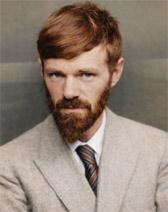
D. H. Lawrence
Born on September 11, 1885
Died on March 2, 1930
Age at death: 45
Profession: Novelist, Poet
Place of Birth: Eastwood, Nottinghamshire, England
Place of Death: Vence, France
David Herbert Richards Lawrence, widely known as D. H. Lawrence, stands among the most controversial, daring, and psychologically penetrating English writers of the twentieth century. A novelist of instinct and rebellion, he transformed modern literature through his uncompromising exploration of sexuality, industrial alienation, emotional intensity, and the spiritual fractures of modern life. Within the landscape of English modernism shaped by figures such as James Joyce and Virginia Woolf, D. H. Lawrence emerged not primarily as a formal experimentalist, but as a radical innovator of content—forcing literature to confront the primal forces of desire, class conflict, and existential unrest.
Early Life and Background
D. H. Lawrence was born on September 11, 1885, in Eastwood, a coal-mining town in Nottinghamshire, England. He was the fourth child of a working-class coal miner father and a refined, educated mother whose intellectual ambitions exceeded the boundaries of industrial village life. The emotional and cultural tension between his parents—one rooted in manual labor and instinct, the other aligned with aspiration and education—left a lasting psychological imprint on him. This domestic divide would later become the emotional core of his most autobiographical novel.
After attending Nottingham High School on a scholarship, he continued his studies at Nottingham University College. He briefly worked as a teacher, but writing increasingly became his dominant calling. During his early twenties, he began publishing poems and short stories, some of which appeared in The English Review, a literary journal that also featured writers such as H. G. Wells and Ford Madox Ford.
Career Beginnings and Literary Breakthrough
His debut novel, The White Peacock (1911), introduced his sensitivity to rural landscapes and emotional complexity. It was followed by The Trespasser (1912), but it was with Sons and Lovers (1913) that D. H. Lawrence established himself as a major literary voice. The novel, deeply autobiographical, explores a young man’s intense attachment to his mother and its psychological impact on his adult relationships. Its emotional depth and psychoanalytic nuance drew comparisons to emerging Freudian theories and secured his place in English letters.
In 1915, he published The Rainbow, a multigenerational family saga exploring shifting sexual and social identities. The novel was banned for alleged obscenity, a fate that would repeatedly shadow his career. Its sequel, Women in Love (1920), deepened his exploration of love, power, erotic tension, and spiritual isolation. The novel’s philosophical undertones and complex character studies resonated with intellectual contemporaries, even as they unsettled conservative critics.
Lady Chatterley’s Lover and the Obscenity Trial
No discussion of D. H. Lawrence can avoid Lady Chatterley’s Lover (1928), the novel that ignited one of the most significant censorship battles in modern literary history. The book tells the story of an aristocratic woman who engages in an explicit affair with her estate’s gamekeeper—a narrative that boldly challenged class hierarchy and sexual repression. Its frank language and erotic content led to widespread bans.
The controversy reached its climax in 1960, three decades after his death, when Penguin Books published an unexpurgated edition in the United Kingdom. The resulting obscenity trial became a cultural watershed. Penguin’s acquittal marked a turning point in literary freedom, reshaping publishing standards and signaling a broader liberalization of British society.
Marriage, Exile, and the “Savage Pilgrimage”
In 1912, D. H. Lawrence fell in love with Frieda von Richthofen, the wife of his former professor Ernest Weekley. Frieda left her husband and children to join him, and they married on July 13, 1914. Their union was passionate, volatile, and intellectually charged. Frieda’s German heritage, however, placed the couple under suspicion during World War I. Lawrence’s outspoken anti-militarism and unconventional views led to surveillance and social hostility in England.
After the war, he embarked on what he called his “savage pilgrimage,” traveling extensively through Italy, Sardinia, Sri Lanka, Australia, the United States, Mexico, and France. These journeys inspired works such as Twilight in Italy, Sea and Sardinia, Mornings in Mexico, and Sketches of Etruscan Places. His time in New Mexico proved particularly transformative, culminating in the critical study Studies in Classic American Literature (1923), where he re-evaluated writers like Herman Melville, Walt Whitman, and Edgar Allan Poe. His reassessment contributed significantly to the twentieth-century revival of Melville’s reputation.
Poetry, Drama, and Visual Art
Although best known for his novels, D. H. Lawrence was also a prolific poet, composing nearly 800 poems. Collections such as Look! We Have Come Through! (1917), Birds, Beasts and Flowers (1923), and Last Poems (1932, posthumous) demonstrate his lyrical intensity and fascination with natural imagery, sexuality, and mystical transformation.
His dramatic works, including A Collier’s Friday Night, The Daughter-in-Law, and Touch and Go, often focused on working-class domestic life and psychological conflict. Many of these plays were staged only decades after his death, revealing a dramatic sensibility that anticipated later twentieth-century realism.
Lawrence also pursued painting in his final years. In 1929, he exhibited his artworks at the Warren Gallery in London’s Mayfair district. The exhibition was raided by police, and several paintings were confiscated for alleged indecency—an episode that mirrored the censorship battles surrounding his fiction.
Themes and Intellectual Position
The innovation of D. H. Lawrence lay not in stylistic fragmentation but in thematic audacity. While contemporaries such as James Joyce and Virginia Woolf experimented with narrative structure, Lawrence delved into instinct, erotic consciousness, mythic symbolism, and the spiritual consequences of industrial modernity. He argued that sexual energy was not merely biological but existential—an essential pathway to authenticity.
His recurring themes include liberation from mechanized society, the redemptive potential of erotic connection, and the tragic weight of familial entanglement. His work often provoked accusations of obscenity, yet he consistently defended his art as a search for emotional and spiritual truth rather than sensationalism.
Illness and Death
Throughout much of his adult life, D. H. Lawrence struggled with fragile health, particularly tuberculosis. Despite declining strength, he continued to write with remarkable intensity. On March 2, 1930, at the age of 44, he died in Vence, France.
After his death, his reputation steadily rose. The novelist E. M. Forster famously described him as “the greatest imaginative novelist of our generation.” Today, D. H. Lawrence is recognized as one of the most influential and debated figures of twentieth-century English literature. His fearless confrontation of sexuality, class division, and emotional vulnerability permanently altered the course of modern fiction.
Major Works
Selected Novels: The White Peacock (1911); The Trespasser (1912); Sons and Lovers (1913); The Rainbow (1915); Women in Love (1920); The Lost Girl (1920); Aaron’s Rod (1922); Kangaroo (1923); The Plumed Serpent (1926); Lady Chatterley’s Lover (1928); The Man Who Died (1929).
Short Story Collections: The Prussian Officer and Other Stories (1914); England, My England (1922); The Fox (1923); The Rocking-Horse Winner (1926); The Virgin and the Gypsy (1930).
Poetry Collections: Amores (1916); Look! We Have Come Through! (1917); Birds, Beasts and Flowers (1923); Collected Poems (1928); Last Poems (1932).
Plays: A Collier’s Friday Night (1909); The Widowing of Mrs. Holroyd (1911); The Daughter-in-Law (1912); Touch and Go (1918); David (1925).
Source: Biyografiler.com
Frequently asked questions about D. H. Lawrence
Who is D. H. Lawrence?, D. H. Lawrence biography, D. H. Lawrence life story, D. H. Lawrence age, D. H. Lawrence facts, D. H. Lawrence birthplace, D. H. Lawrence photos, D. H. Lawrence videos, D. H. Lawrence career
Related Biographies

Lamine Yamal
Professional footballer

Kylian Mbappe
Professional footballer

Erling Haaland
Professional footballer

Sam Altman
Entrepreneur, Investor, CEO

Bad Bunny
Rapper, Songwriter

Brad Pitt
Actor


Hongjoong
Singer, Rapper, Songwriter, Composer

Ludacris
Rapper, Actor

Kwon Eunbi
Singer

Sarah Wayne Callies
Actress, Screenwriter, Producer, Director

LaTavia Roberson
Singer, Actress, Entrepreneur
Brad Pitt
Actor

Sarah Jessica Parker
Actress, Producer

Quentin Tarantino
Film Director, Actor, Screenwriter

Zohran Mamdani
Politician, Musician
Lamine Yamal
Professional footballer

Javier Bardem
Actor, Producer