
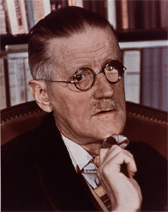
James Joyce
Master of Stream of Consciousness, Chronicler of Dublin
Born on February 2, 1882
Died on January 12, 1941
Age at death: 59
Profession: Novelist, Writer, Poet
Place of Birth: Rathgar, Dublin, Ireland
Place of Death: Zurich, Switzerland
James Joyce was one of the most influential writers of the 20th century, profoundly shaping modern literature through his innovative use of the stream of consciousness technique. Drawing inspiration from experimental narrative forms, he transformed the inner workings of the human mind into literary structure. Nearly all of his works use the city of Dublin—where he was born and raised—as both their primary setting and raw material, turning the city into a literary universe of its own.
James Joyce was born on February 2, 1882, in Rathgar, Dublin, Ireland, as the eldest of ten children. His full name was James Augustine Aloysius Joyce. At the age of six, he began his education at Jesuit boarding schools, often referred to as “the Eton of Ireland.” After studying for a time at Clongowes Wood College, he attended University College Dublin, where he studied philosophy and modern languages. During this period, he learned German and Norwegian.
In 1900, while still a university student, James Joyce published a lengthy critical essay on the play When We Dead Awaken (1899) by Henrik Ibsen in *The Fortnightly Review*. His admiration for Ibsen was so great that he learned Swedish in order to read the playwright in the original language. Around the same time, Joyce also devoted himself to poetry.
After graduating from university on October 31, 1902, James Joyce moved to Paris, where he supported himself by teaching English. He continued his literary studies at the Sainte-Geneviève Library, developing an aesthetic theory influenced by Aristotle, Thomas Aquinas, and Gustave Flaubert. After living in Paris for a year, he returned to Ireland in April 1903 upon receiving news of his mother’s severe illness. He spent a short period teaching in Dublin.
In October 1904, James Joyce left Ireland with his companion and future wife Nora Barnacle, choosing a life of voluntary exile. He found employment at the Berlitz School in Pula, then part of the Austro-Hungarian Empire, while continuing to work on his novels and short stories in his spare time. In 1905, the couple moved to Trieste, Italy, where Joyce’s brother Stanislaus Joyce later joined them. During this period, Joyce and Nora had two children.
After a brief period working at a bank in Rome in 1906, James Joyce returned to Trieste in 1907 and resumed teaching English. In 1914, he published Dubliners, a work that vividly portrayed the lives of ordinary Dubliners.
In 1909, Joyce traveled twice to Ireland in an attempt to publish Dubliners and to establish a chain of cinemas, but both efforts failed. Around this time, he was deeply shaken by claims that an old friend had been involved with Nora during the summer of 1904. Joyce expressed his emotional turmoil in a series of letters now housed at the Cornell University Library. Selected, softened versions of these letters were later published in Letters of James Joyce, a collection that also includes some of the most striking examples of erotic literature.
In 1916, James Joyce published his autobiographical novel A Portrait of the Artist as a Young Man. Following Italy’s entry into World War I, Joyce and his family moved to Zurich. There, he began work on his most groundbreaking novel, Ulysses. The novel was initially serialized in an American literary magazine but was not published in book form until 1922, when it appeared in Paris.
After World War I, Joyce briefly returned to Trieste before moving to Paris in July 1920 at the invitation of Ezra Pound. When France fell during World War II in 1940, Joyce and his family once again relocated to Zurich.
During his years in Paris, James Joyce worked extensively on Finnegans Wake. Until its complete publication in May 1939, the book was known as Work in Progress. Throughout this time, Joyce struggled with severe eye problems, while his daughter’s deteriorating mental health caused him profound distress. Eventually, he was forced to place her in a psychiatric hospital near Paris. In 1931, despite long-standing doubts about marriage, Joyce married Nora Barnacle in London at his daughter’s request.
Between February 1917 and 1930, James Joyce underwent 25 eye surgeries due to glaucoma, cataracts, and iritis, at times losing his sight entirely. Despite these hardships, he continued to work, and it is often noted that he wrote some of the most joyful sections of his work during periods of extreme physical suffering.
James Joyce’s most celebrated work, Ulysses, occupies a central place in world literature. Structurally inspired by Homer’s *Odyssey*, the novel depicts a single day—24 hours—in the life of Dublin. Through this bold narrative construction, Joyce revolutionized the modern novel. The work has posed immense challenges for translators and was rendered into Turkish only in 1996 by Nevzat Erkman.
Joyce consistently chose Dublin as the primary setting of his works, transforming the city into a symbolic and psychological landscape. His mastery of the stream of consciousness technique introduced a radical innovation that deeply influenced the literature of his century.
James Joyce married Nora Barnacle in 1931. He spent his final years in Zurich, earning a living through journalism and teaching languages at Berlitz schools. After a life marked by poverty and illness, he died in Switzerland, on the brink of blindness.
James Joyce died on January 13, 1941, in Zurich, Switzerland, at the age of 59.
The story The Dead, from Dubliners, was adapted into a film in 1987 by director John Huston, starring Anjelica Huston. Joyce’s poetry was later translated under the title Giacomo Joyce.
Works
1907 – Chamber Music / *Poems*
1914 – Dubliners
1916 – A Portrait of the Artist as a Young Man
1918 – Exiles
1922 – Ulysses
1927 – Pomes Penyeach / *Poems*
1936 – Collected Poems
1939 – Finnegans Wake
1944 – Stephen Hero
1991 – Letters of James Joyce
Source: Biyografiler.com
Frequently asked questions about James Joyce
Who is James Joyce?, James Joyce biography, James Joyce life story, James Joyce age, James Joyce facts, James Joyce birthplace, James Joyce photos, James Joyce videos, James Joyce career
Related Biographies

Lamine Yamal
Professional footballer

Erling Haaland
Professional footballer

Austin Abrams
Actor

Keanu Reeves
Actor

Kylian Mbappe
Professional footballer

Brad Pitt
Actor


Hongjoong
Singer, Rapper, Songwriter, Composer

Ludacris
Rapper, Actor

Kwon Eunbi
Singer

Sarah Wayne Callies
Actress, Screenwriter, Producer, Director

LaTavia Roberson
Singer, Actress, Entrepreneur

Alice Weidel
Politician, Economist

Mackenzie Davis
Actress

Maria Corina Machado
Politician, Political Activist
Erling Haaland
Professional footballer

Bad Bunny
Rapper, Songwriter
Keanu Reeves
Actor