
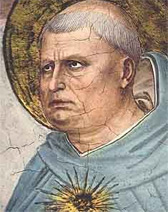
Thomas Aquinas
The Greatest Christian Philosopher of the Middle Ages
Born on ?? ??, 1225
Died on March 7, 1274
Age at death: 49
Profession: Priest
Place of Birth: Aquino, Kingdom of Sicily (modern-day Italy)
Place of Death: Fossanova Abbey, Priverno, Italy
Thomas Aquinas is regarded as one of the greatest Christian philosophers in the history of thought. Just as Plato and Aristotle define classical Greek philosophy, Thomas Aquinas stands as the central figure of medieval philosophy. His synthesis of Christian theology with Aristotelian philosophy fundamentally shaped Western intellectual history and Catholic doctrine.
Thomas Aquinas, also known as Aquinas or Thomas of Aquino, was born in 1225 in the town of Aquino in the Kingdom of Sicily. He was the seventh child of a noble family. His father was Landulf of Aquino, a lord, and his mother was Theodora Rossi, a noblewoman. He had seven siblings named Mary, Theodora, James, Martha, Landulf, Ronald, and Aimo.
At the age of five, Thomas Aquinas began his education at the Benedictine monastery of Monte Cassino, where he studied until the age of fourteen. In 1239, he returned home and later enrolled at the University of Naples, where he spent six years studying science, history, and philosophy. During this period, he joined the Dominican Order, a decision that caused strong opposition from his family.
While studying in Naples, Thomas focused extensively on the seven liberal arts (*septem artes liberales*). His teachers were predominantly Aristotelian scholars. His mother, Theodora Rossi, strongly opposed his decision to join the Dominicans. At the age of nineteen, with the help of the Dominican Order, Thomas planned to travel first to Rome and then to Paris to escape family pressure. However, before reaching Rome, he was captured by his brothers and imprisoned for one year in a castle in Frosinone. When his family failed to dissuade him, they eventually allowed him to continue his university education.
After Naples, Thomas Aquinas studied at the universities of Paris and Cologne. In Cologne, he completed four years of study and earned the degree of *baccalaureate*. He then returned to Paris to teach and pursue a master’s degree in theology. In 1256, at the age of thirty-one, he received the title of Master and was appointed to one of the two Dominican chairs at the University of Paris.
In 1272, Thomas Aquinas returned to his homeland and began teaching at the University of Naples. His philosophical system centered on the belief that God is one, pure spirit, and perfect. Below God are angels, who are also immaterial beings, followed by humans in the hierarchy of existence. According to Aquinas, humans attain happiness by moving toward God. True and infinite happiness cannot be found in wealth, fame, physical pleasure, or even moral virtue alone, but only through divine grace. Due to the original sin of Adam, humanity is destined for eternal punishment unless redeemed by God’s grace.
Aquinas believed that political authority derives from God, provided that rulers govern society toward goodness, order, and happiness. However, since society’s ultimate purpose is eternal salvation, guiding people toward this goal falls under the responsibility of the clergy rather than secular rulers. Rulers must ensure peace and order so that religious authorities can fulfill this mission. While political power originates from God and is part of natural law, it is not unlimited. Aquinas argued that when rulers become tyrants—governing arbitrarily for personal gain—the Church has the authority to depose them.
In Aquinas’s philosophy, the world consists of natural and artificial objects. Natural objects are created by God, while artificial objects are produced by humans. Thus, God is the creator, and humans are producers. His metaphysical framework distinguished between mind and matter, emphasizing the primacy of the intellect while integrating faith and reason into a unified system.
Thomas Aquinas was canonized as a saint by the Papacy in 1322. In 1567, nearly three centuries after his death, Pope Pius V declared him a Doctor of the Catholic Church. In 1879, Pope Leo XIII officially adopted Thomistic philosophy as the foundation of Catholic theology. By 1914, opposing Aquinas’s views was considered sinful, and in 1917, Church law formally declared his teachings as the official doctrine of the Catholic Church.
Aquinas deeply influenced all subsequent philosophy, including political philosophy, where he followed Aristotle while extending his ideas into a Christian framework. While Aristotle focused on the goals of human life within the polis, Aquinas emphasized humanity’s orientation toward God. He regarded humans as social beings and the state as a natural institution, but insisted that in matters concerning spiritual life, the state must be subordinate to the Church.
Thomas Aquinas was summoned by Pope Gregory X to attend a conference in Paris. However, he fell ill during the journey and died on March 7, 1274, at Fossanova Abbey in Priverno, Italy, at the age of forty-nine.
His teachings reshaped Christian theology, philosophy, and Western thought, creating a rational structure in which faith and reason coexist. Aquinas remains one of the most influential intellectual figures in human history.
Books:
Summa Contra Gentiles
Summa Theologica
De Principiis Naturae
De Ente et Essentia
De Unitate Intellectus
Source: Biyografiler.com
Frequently asked questions about Thomas Aquinas
Who is Thomas Aquinas?, Thomas Aquinas biography, Thomas Aquinas life story, Thomas Aquinas age, Thomas Aquinas facts, Thomas Aquinas birthplace, Thomas Aquinas photos, Thomas Aquinas videos, Thomas Aquinas career
Related Biographies

Lamine Yamal
Professional footballer

Erling Haaland
Professional footballer

Austin Abrams
Actor

Keanu Reeves
Actor

Kylian Mbappe
Professional footballer

Brad Pitt
Actor


Hongjoong
Singer, Rapper, Songwriter, Composer

Ludacris
Rapper, Actor

Kwon Eunbi
Singer

Sarah Wayne Callies
Actress, Screenwriter, Producer, Director

LaTavia Roberson
Singer, Actress, Entrepreneur

Alice Weidel
Politician, Economist

Maria Corina Machado
Politician, Political Activist

Bad Bunny
Rapper, Songwriter
Erling Haaland
Professional footballer

Mackenzie Davis
Actress
Keanu Reeves
Actor