
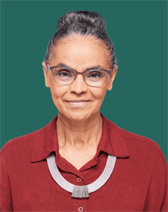
Marina Silva
Symbol of Brazil’s Environmental Struggle
Born on February 8, 1958
Age: 68
Profession: Political Activist, Historian
Place of Birth: Rio Branco, Acre, Brazil
Marina Silva, born Maria Osmarina Marina da Silva Vaz de Lima on February 8, 1958, in Rio Branco, Acre, Brazil, is one of Latin America’s most influential environmental leaders and a central figure in global climate politics. A Brazilian politician, historian, psychopedagogue, and environmentalist of African and Portuguese descent, she has served multiple terms as Brazil’s Minister of the Environment and Climate Change. Founder of Sustainability Network (REDE), Marina Silva has run for the Brazilian presidency three times and has become internationally recognized as a tireless defender of the Amazon rainforest.
Early Life and Background
Marina Silva was born near Rio Branco in the small community of Breu Velho, deep within the Amazon region of Acre state. She grew up in the Bagaço rubber plantation, one of eleven children in a family of rubber tappers. Her father, Pedro Augusto da Silva, worked collecting rubber in harsh and isolated conditions, while her mother, Maria Augusta da Silva, was a homemaker. Poverty defined her early years. She endured malaria, hepatitis, leishmaniasis, and mercury poisoning, losing several family members at a young age. Her mother died when Marina Silva was just fifteen.
At sixteen, she moved to Rio Branco seeking medical treatment and educational opportunity. Sheltered by Catholic nuns, she became the first member of her family to learn to read and write. To finance her studies, she worked as a domestic servant. Demonstrating remarkable academic progress, she later graduated in History from the Federal University of Acre. She continued her education with specialization studies in Psychoanalytic Theory at the University of Brasília and Psychopedagogy at the Catholic University of Brasília.
Political Awakening and Activism
The political consciousness of Marina Silva was shaped through participation in grassroots Christian communities known as Base Ecclesial Communities. A decisive turning point came when she attended a trade union leadership course led by liberation theologian Clodovis Boff and rubber tapper leader Chico Mendes.
Together with Chico Mendes, she organized nonviolent resistance actions known as “empates.” Rubber tappers and their families formed human chains to block illegal logging operations, physically standing between loggers and the forest. These actions helped preserve thousands of hectares of Amazon rainforest and laid the groundwork for sustainable extractive reserves. After Chico Mendes was assassinated on December 22, 1988, Marina Silva continued the struggle to defend the Amazon, becoming one of its most prominent political voices.
Entry into Politics and Senate Career
Marina Silva began her formal political career in 1988 when she was elected to the Rio Branco City Council. In 1990, she became a state deputy, and in 1994 she was elected to the Federal Senate. At the time, she was the youngest senator in Brazilian history and the first former rubber tapper to serve in the Senate.
As Senator for Acre from 1995 to 2011, Marina Silva championed environmental protection, social justice, and sustainable development policies. She was among the earliest Brazilian political leaders to argue that the country must establish official greenhouse gas reduction targets. Her Senate tenure coincided with Brazil’s increasing prominence in global environmental negotiations, where her influence extended beyond national borders.
Minister of the Environment (2003–2008)
In 2003, President Luiz Inacio Lula da Silva appointed Marina Silva as Minister of the Environment. During her first term, Amazon deforestation rates dropped by approximately 59 percent between 2004 and 2007. She implemented the Action Plan for the Prevention and Control of Deforestation in the Legal Amazon, strengthened environmental enforcement mechanisms, and oversaw the creation of the Chico Mendes Institute for Biodiversity Conservation. She also contributed to structuring the Amazon Fund, designed to finance sustainable development and conservation initiatives.
However, internal government disagreements over hydroelectric projects, agricultural expansion, and genetically modified crops led to growing tensions. In 2008, citing policy conflicts and lack of sufficient institutional support, Marina Silva resigned from her ministerial position.
Presidential Campaigns
Marina Silva ran for president of Brazil in 2010, 2014, and 2018. In 2010, representing the Green Party (Brazil), she secured nearly 20 percent of the vote, finishing third and reshaping Brazil’s political landscape by demonstrating the electoral strength of environmental politics.
In 2014, after the death of Eduardo Campos in a plane crash, she became the presidential candidate of the Brazilian Socialist Party, again finishing third. In 2018, she ran as the candidate of her own political movement, Sustainability Network (REDE), reinforcing her long-standing commitment to ethical governance, environmental protection, and social equity.
Return to Office After 2023
Following the defeat of Jair Bolsonaro by Luiz Inacio Lula da Silva in the 2022 presidential election, Marina Silva returned to government in January 2023 as Minister of the Environment and Climate Change. Under her renewed leadership, Amazon deforestation rates declined to their lowest levels in a decade. She has advocated for achieving “zero deforestation” by 2030 and for strengthening Brazil’s role in global climate diplomacy, positioning the country as a central actor in international environmental negotiations.
Religious and Political Views
Since 1996, Marina Silva has identified as a Pentecostal Christian. Politically, she is generally regarded as centrist and environmentally progressive. She has built her platform on anti-corruption principles, opposition to nuclear energy, and support for renewable energy investment. On social issues such as abortion, she has taken a conservative stance while advocating for referendums to resolve controversial national debates.
Awards and International Recognition
Marina Silva received the Goldman Environmental Prize in 1996, often referred to as the “Green Nobel Prize.” In 2007, the United Nations named her one of the “Champions of the Earth,” and the British newspaper The Guardian included her among 50 people who could help save the planet. In 2008, she was awarded the Duke of Edinburgh Conservation Medal by Prince Philip at St James’s Palace in London for her defense of the Brazilian Amazon.
In 2012, she was one of eight individuals chosen to carry the Olympic flag at the London 2012 Summer Olympics opening ceremony. In 2024, Time Magazine named her among the world’s 100 most influential people. In 2020, a newly discovered marsupial species was named Marmosops marina in her honor, recognizing her contribution to reducing Amazon deforestation.
Personal Life
Marina Silva married for the first time in 1980 and had two children, Shalon and Danilo. The marriage ended in 1985. In 1986, she married agricultural technician Fábio Vaz de Lima, who had worked advising rubber tappers in Xapuri. The couple has two daughters, Moara and Mayara, and their marriage has endured for decades.
Legacy and Cultural Impact
With more than four decades of activism and public service, Marina Silva has become a defining symbol of environmental justice in Brazil. A former rubber tapper, domestic worker, teacher, senator, and minister, she represents a rare trajectory from extreme poverty in the Amazon to the highest levels of national leadership. Her life story embodies resilience, ethical commitment, and the belief that socio-environmental struggles can reshape national destiny.
Her journey from a rubber plantation in the Amazon rainforest to Brazil’s federal government illustrates the transformative potential of perseverance and civic engagement. Marina Silva has consistently argued that protecting the Amazon is inseparable from protecting humanity’s climate future.
“To destroy the Amazon is to destroy the planet.” — Marina Silva
Source: Biyografiler.com
Frequently asked questions about Marina Silva
Who is Marina Silva?, Marina Silva biography, Marina Silva life story, Marina Silva age, Marina Silva facts, Marina Silva birthplace, Marina Silva photos, Marina Silva videos, Marina Silva career
Related Biographies

Lamine Yamal
Professional footballer

Erling Haaland
Professional footballer

Kylian Mbappe
Professional footballer

Keanu Reeves
Actor

Austin Abrams
Actor

Bad Bunny
Rapper, Songwriter


Hongjoong
Singer, Rapper, Songwriter, Composer

Ludacris
Rapper, Actor

Kwon Eunbi
Singer

Sarah Wayne Callies
Actress, Screenwriter, Producer, Director

LaTavia Roberson
Singer, Actress, Entrepreneur

Pedro Sanchez
Politician

Leonardo DiCaprio
Actor
Keanu Reeves
Actor
Erling Haaland
Professional footballer
Austin Abrams
Actor
Lamine Yamal
Professional footballer