
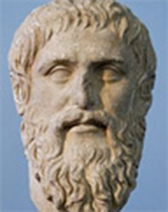
Plato
Born on -
Age: -
Profession: Greek philosopher
Place of Birth: Athens or Aegina
Plato was a Greek philosopher, writer, and mathematician who stands as one of the most influential figures in the history of thought. He is regarded as one of the founders of Western philosophy and is widely considered among the thinkers who most profoundly shaped all subsequent intellectual traditions. A student of Socrates and the teacher of Aristotle, Plato systematized the concept of the “Rule of the Wise,” inherited from Socrates, into a comprehensive philosophical system. His original name, Aristocles, is the root of the words “aristocrat” and “aristocracy.” Because of his broad shoulders and athletic build, he was known by the nickname “Plato,” meaning “broad-chested” in Greek, while in Eastern philosophy he became known as Eflatun. His ideas are closely associated with the term “Platonic,” referring to the notion of realities that exist not materially but purely on an intellectual level. Plato exerted immense influence on both Islamic and Christian philosophy and was the founder of the world’s first university, the Academia.
Plato is believed to have been born either in Athens or Aegina, though his exact birthplace and birth year remain uncertain. Most sources agree that he was born around 428 or 427 BC. According to Diogenes Laertius, his lineage traced back to Codrus, regarded as a king of Athens, and to Melanthus of Messenia. His mother, Perictione, was related to the famous lawgiver and poet Solon. His uncles Charmides and Critias, to whom Plato later dedicated two dialogues, were members of the oligarchic group known as the Thirty Tyrants, supporters of Spartan rule. Following the collapse of Athenian democracy after the Peloponnesian War, Plato’s family held considerable political power.
According to the writer Apuleius, Plato was known in his youth for his diligence, quick intellect, and humility. He received education in grammar, music, and gymnastics from renowned teachers of his era and even competed in wrestling at the Isthmian Games. He was also among the first to study under Cratylus, a follower of Heraclitus and one of the pre-Socratic philosophers.
Plato sought to counter the negative influence of the Sophists on Greek society and attended philosophical schools in his pursuit of truth. He began philosophical inquiry by searching for the “first principle” and for knowledge itself, adopting a firmly dogmatic stance that absolute and certain knowledge exists. His famous Theory of Forms arose from his understanding of the universe. In particular, the allegory of the cave in his dialogue Republic offers critical insight into the foundations of his philosophy.
In this allegory, Plato describes people who have lived since birth chained inside a dark cave, facing a wall upon which shadows are cast by objects passing in front of a fire behind them. Mistaking shadows for reality, they are unable to comprehend the true forms beyond the cave. When one person escapes and sees the real sources of the shadows, his attempts to enlighten the others fail. This story illustrates Plato’s distinction between two realms of reality: the World of Senses, accessed through the five senses and yielding uncertain knowledge, and the World of Ideas, apprehended through reason and containing absolute truth.
According to Plato, knowledge is only possible if there exist immutable and eternal entities independent of the human mind. Everything in the natural world is subject to change and decay, whereas ideas or forms are unchanging and perfect. For example, although countless physical rulers exist, the concept of “one meter” remains constant and exact. Similarly, as Heraclitus observed, one can never step into the same river twice, even though it appears to be the same river.
For Plato, ideas were not merely mental representations of physical objects but also included abstract concepts such as justice, equality, and beauty. At the summit of the hierarchy of ideas stood the Form of the Good, which Plato identified with the divine. While physical objects can only be known approximately, knowledge of ideas is complete and certain because they never change.
Building upon the Theory of Forms, Plato constructed philosophical systems that extended from logic and metaphysics to mathematics, art, theology, and the ideal structure of society. His metaphysics blended rationalism and spiritualism, drawing inspiration from both traditions. He admired mathematics for its precision and considered it essential preparation for philosophy, famously inscribing above the entrance of the Academy: “Let no one ignorant of geometry enter.”
In dialogues such as Parmenides and Timaeus, Plato explored the relationship between the intelligible world and the sensory world. He argued that after long study of mathematics and dialectics, a philosopher could grasp the source of reality through a mystical intuition. Because ideas are immutable and cannot act upon the material world directly, Plato introduced the concept of the Demiurge, an active force that shapes matter by imposing the forms upon it. Thus, the order and intelligibility of the physical world derive from the world of ideas and the activity of the Demiurge.
Plato’s philosophy of human nature mirrors his epistemology. Humans consist of a changing, unreliable body and an immortal soul. Knowledge, according to Plato, is a form of recollection, implying the soul’s preexistence and immortality. He believed that the soul existed in the world of ideas before entering the body, a view reflecting Orphic and Pythagorean influences.
Plato divided the human being into three parts: head, chest, and abdomen, corresponding to reason, spirit, and appetite. Each part aligned with a virtue—wisdom, courage, and moderation. A harmonious individual emerged when these elements functioned together in balance.
In his dialogue Republic, Plato described his vision of the ideal state, a utopian society ruled by philosophers. Just as reason governs the body, philosophers should govern the state. He argued that women, possessing the same rational capacity as men, could also be rulers. Plato rejected private property and the traditional family structure for the ruling and guardian classes, believing that communal life would better serve justice and harmony.
Plato’s encounter with Socrates at the age of twenty transformed his life. All thirty-five of his surviving works were written as dialogues, many featuring Socrates as the main character. Although Socrates’ ideas and Plato’s own philosophy are difficult to distinguish, scholars have identified developmental stages in Plato’s writings. Early dialogues are strongly Socratic, while later works reveal Plato’s mature and independent thought.
After the restoration of democracy in Athens in 403 BC, Socrates was condemned to death on charges of corrupting the youth and introducing new gods. This event profoundly affected Plato and led him to withdraw from political life. He later immortalized Socrates’ defense in Apology of Socrates.
Following Socrates’ death, Plato traveled to Southern Italy and Egypt, studying Pythagorean and Orphic doctrines. Upon returning to Athens, he founded the Academia, near the tomb of the hero Academus. As the world’s first permanent institution of higher learning, it offered instruction not only in philosophy but also in mathematics, astronomy, and the natural sciences, attracting students from across the Greek world.
Plato taught at the Academy throughout his life, with brief interruptions, including his journeys to Syracuse at the invitation of Dion to educate Dionysius II. Political tensions ultimately forced his return to Athens, where he continued his work until his death in 347 BC. Plato remained active at the Academy until the end of his life, leaving behind a philosophical legacy that has shaped intellectual history for over two millennia.
Source: Biyografiler.com
Frequently asked questions about Plato
Who is Plato?, Plato biography, Plato life story, Plato age, Plato facts, Plato birthplace, Plato photos, Plato videos, Plato career
Related Biographies

Lamine Yamal
Professional footballer

Kylian Mbappe
Professional footballer

Erling Haaland
Professional footballer

Sam Altman
Entrepreneur, Investor, CEO

Bad Bunny
Rapper, Songwriter

Brad Pitt
Actor


Hongjoong
Singer, Rapper, Songwriter, Composer

Ludacris
Rapper, Actor

Kwon Eunbi
Singer

Sarah Wayne Callies
Actress, Screenwriter, Producer, Director

LaTavia Roberson
Singer, Actress, Entrepreneur

Austin Abrams
Actor
Lamine Yamal
Professional footballer

Sadio Mane
Professional footballer
Erling Haaland
Professional footballer

Alexei Mordashov
Businessperson, Investor

James David Vance
Politician, Lawyer, Author