
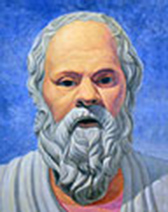
Socrates
Born on -
Age: -
Profession: Greek philosopher
Place of Birth: Alopeke, Attica
A Greek philosopher, regarded as one of the founders of philosophy. Investigating what the relationship of human beings should be with themselves, the universe, and society, Socrates introduced to the world of thought the Socratic Method, also known as Dialectic, which is fundamentally based on the principle of “Answering a question with another question.” Through his dialogues, he deeply influenced Plato, Aristophanes, and Xenophon, founded moral philosophy—also called the “Doctrine of Values,” and passed away leaving behind a better world. Having devoted his life to the personal development of humanity, the philosopher’s teachings have continued to exert influence for centuries. Socrates spread his philosophy and worldview through dialogues and wrote nothing himself. By gifting humanity the keys to reaching knowledge, he became one of the true heroes of human history. Proposing the idea that the world we live in is an illusion and that truth resides in thought, accessible through reason, Socrates is also considered an inspiration for the film The Matrix, directed by the Wachowski Brothers. Following the great interest the film received, the book Matrix and Philosophy associated the movie with the famous philosopher’s ideas. There are even opinions suggesting that the film narrates the life of Socrates.
Born in 469 BC in Alopeke, Attica, as the son of the sculptor Sophroniscus and the midwife Phaenarete, Socrates always preferred speaking and questioning over writing, and left no written works behind. For this reason, details of his life were derived from dialogues with other philosophers of his era. The most important reference regarding Socrates’ life was Plato, who provided the most extensive information about his personality and works.
It is stated that during his childhood, Socrates received education in geometry, arithmetic, and astronomy, in line with the scientific and social developments of his time, as was typical for an ordinary Athenian. It is also said that he read Greek poets and made an effort to master his native language.
After his education, the thinker focused on natural sciences concerning the origins of living beings, their survival, reproduction, and death, and began to evaluate his thoughts on human life based on these foundations.
Socrates rejected all rigid disciplines, acted in accordance with ideas he described as a sacred inner voice, was devout, yet evaluated religion and values through the lens of utility. He was indifferent to worldly pleasures but sensitive to beauty. Believing that the foundation of knowledge lay in human reason, and trusting reason profoundly, he was a strict rationalist.
Living in Athens, Socrates deeply influenced and transformed the intellectual development of the 5th century BC. There is no clear information on how he earned his living. According to Timon of Phlius, he sustained himself through stone carving learned from his father, while older sources, including those by Plato, state that he was engaged in no occupation other than philosophy. In Symposium by Xenophon, Socrates appears as a figure fully devoted to philosophical discussion.
Sources claiming he practiced stone carving state that Socrates abandoned this craft in middle age and devoted himself entirely to philosophy. During this period, although he became famous as a philosopher, he neither withdrew into seclusion nor founded a school to spread his teachings.
Unwilling to be known as a teacher, Socrates conversed with everyone he encountered in the streets of Athens, regardless of social hierarchy. It is said that he began his walking tours early in the morning, spending his days in the busiest parts of the city, engaging deeply with Athenians. These conversations, centered on life and meaning, involved mutual questioning without adherence to rigid doctrines, aiming for openness, lack of prejudice, and enlightenment. Through these dialogues, he revealed contradictions and weaknesses in his interlocutors’ thinking, compelling them to confront what was right and wrong. Pretending to know nothing, Socrates forced others to use reason—this practice is known as “[ Socratic Irony ].”
Driven by the desire to transcend superficial knowledge and reach true understanding, Socrates developed a method that questioned all acquired knowledge. Through the art of dialogue or dialectic, he encouraged people to reconsider what they believed they knew, emphasizing the importance of reaching pure thought and knowledge free from conditioning. This teaching, known as the Socratic Method, is considered one of his greatest contributions to Western philosophy.
Claiming that he knew nothing except that he knew nothing, Socrates asked successive questions to define concepts collectively. He stated: “You may not believe me, but the highest form of humanity is to question oneself and others.”
The Socratic Method, used to examine moral concepts such as goodness and justice, first appeared in Plato’s Socratic Dialogues. For this reason, Socrates is regarded as the father of Political Philosophy and Moral Philosophy, and a founder of Western philosophy.
Socrates employed the method of induction, later highlighted by Aristotle. While his approach paved the way for systematic induction, it was later refined by subsequent thinkers.
Although some of Socrates’ ideas differed from Plato’s, historians found it difficult to distinguish between them due to the dominance of Plato’s accounts. Separating the philosophical views of Plato and Xenophon from those of Socrates remains challenging, as Socratic ideas are reflected in their works.
Socrates’ moral, intellectual, and political views positioned him uniquely in Athenian society. In courts judging behaviors contrary to social or religious norms, he used questioning to challenge jurors’ moral assumptions, striving for just decisions. He believed in the immortality of the soul and felt divinely tasked with provoking thought, even at the risk of ridicule.
Although living contemporaneously with the Sophists, Socrates differed significantly from them. Unlike the Sophists, who claimed to possess knowledge and taught for money, Socrates viewed himself as a philosopher—a “lover of wisdom”—not a possessor of it.
Socrates held that true knowledge must be universal and stable, contrasting with the Sophists’ relativism. He opposed doxa (opinion) to episteme (knowledge), asserting that knowledge emerges through collective inquiry rather than instruction.
Accepting his own ignorance as the boundary of wisdom, Socrates concluded that wrongdoing stemmed from ignorance. He famously stated: “No one knowingly does evil.”
Interested deeply in language, meaning, and definition, Socrates argued that without clear understanding of concepts like wisdom, justice, courage, and morality, no action could truly be judged as virtuous.
Socrates described his philosophical role as akin to that of a midwife, helping ideas be born rather than producing them himself. Through disciplined questioning, he sought to bring dormant truths from the soul into consciousness.
He emphasized that the greatest wealth was virtue and excellence, dedicating his philosophy to moral improvement. He believed virtue and knowledge were identical, asserting that all virtues stemmed from knowledge.
Socrates spoke of an inner divine voice, the Daimonion, which guided him morally. Though not rational, it complemented his ethical philosophy and contributed to interpretations of his mystical aspect.
Contrary to accusations of impiety, Socrates sought to purify religious understanding from superstition. His influence stemmed not only from his ideas but from living them authentically.
During the rise and fall of the Athenian Empire through the Peloponnesian War, Socrates also served as a soldier, fighting at Potidaea, Amphipolis, and Delium, as recounted by Alcibiades.
Socrates believed the best life focused on personal development over material wealth. Even when sentenced to death, he refused to flee Athens, honoring the law despite its injustice.
Accused of corrupting youth and introducing new gods, Socrates was sentenced to death by the Council of Five Hundred with a vote of 281 to 220.
After drinking hemlock in 399 BC, Socrates died with dignity, leaving behind a legacy that reshaped human thought.
Years later, Plato recorded his defense in Apology of Socrates.
Roman philosopher Cicero said of Socrates:
"He brought philosophy down from the heavens to the earth, placed it in cities, introduced it into homes, and compelled people to reflect on life, morals, good and evil."
FROM SOCRATES
“Bad men live to eat and drink, while good men eat and drink to live.”
“There is only one good: knowledge; and one evil: ignorance.”
“The unexamined life is not worth living.”
“I am different from other men because I know that I know nothing.”
“Virtue is the beauty of the soul.”
“No one does wrong willingly; evil comes from ignorance mistaken for knowledge.”
Source: Biyografiler.com
Frequently asked questions about Socrates
Who is Socrates?, Socrates biography, Socrates life story, Socrates age, Socrates facts, Socrates birthplace, Socrates photos, Socrates videos, Socrates career
Related Biographies

Lamine Yamal
Professional footballer

Kylian Mbappe
Professional footballer

Erling Haaland
Professional footballer

Sam Altman
Entrepreneur, Investor, CEO

Bad Bunny
Rapper, Songwriter

Brad Pitt
Actor


Hongjoong
Singer, Rapper, Songwriter, Composer

Ludacris
Rapper, Actor

Kwon Eunbi
Singer

Sarah Wayne Callies
Actress, Screenwriter, Producer, Director

LaTavia Roberson
Singer, Actress, Entrepreneur

Austin Abrams
Actor
Lamine Yamal
Professional footballer

Sadio Mane
Professional footballer

Alexei Mordashov
Businessperson, Investor
Erling Haaland
Professional footballer

James David Vance
Politician, Lawyer, Author