
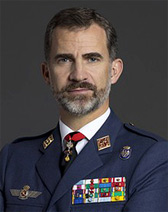
Felipe VI
King of Spain and Constitutional Monarch
Born on January 30, 1968
Age: 58
Profession: King, Head of State
Place of Birth: Madrid, Spain
Felipe VI, born Felipe Juan Pablo Alfonso de Todos los Santos de Borbón y de Grecia on January 30, 1968, in Madrid, Spain, is the reigning King of Spain and Head of State. He ascended the throne on June 19, 2014, following the abdication of his father, Juan Carlos I. As the constitutional monarch of Spain, Felipe VI serves as Captain General of the Spanish Armed Forces and represents the unity and permanence of the Spanish state under the 1978 Constitution.
Early Life and Royal Background
Felipe VI is the third child and only son of Juan Carlos I and Queen Sofía. He has two older sisters: Infanta Elena, Duchess of Lugo and Infanta Cristina of Spain. His birth occurred during the dictatorship of Francisco Franco, who in 1969 formally designated Juan Carlos as his successor, thereby making young Felipe second in line to the future restored monarchy.
After Franco’s death on November 20, 1975, Juan Carlos was proclaimed King on November 23, 1975. In 1977, at the age of nine, Felipe VI was officially declared Prince of Asturias, the traditional title for the heir to the Spanish throne.
Education and Academic Formation
Felipe VI received his primary and secondary education at Santa María de los Rosales School in Madrid. He later attended Lakefield College School in Ontario, Canada, broadening his international outlook at a young age.
From October 1988 to June 1993, he studied law at the Autonomous University of Madrid, while also completing coursework in economics. In September 1993, he enrolled in the Master of Science in Foreign Service program at Georgetown University in Washington, D.C., graduating on May 26, 1995, with a master’s degree in international relations.
Military Training and Armed Forces Career
Between September 1985 and July 1988, Felipe VI underwent comprehensive military training. He began at the General Military Academy in Zaragoza, where he was commissioned as a lieutenant in July 1986. In September 1986, he started naval training at the Naval Military School of Marín, later continuing aboard the training ship Juan Sebastián de Elcano.
In September 1987, he commenced air force training and qualified as a military helicopter pilot. Upon his accession to the throne in 2014, he assumed the rank of Capitán General (Captain General), the highest command of Spain’s Army, Navy, and Air and Space Force.
Role as Prince of Asturias
As heir apparent, Felipe VI undertook extensive institutional responsibilities. Beginning in 1990, he conducted official visits to Spain’s Autonomous Communities to deepen his understanding of the nation’s diverse regional identities. After completing his studies in the United States, he intensified both domestic and international engagements.
From October 1995 onward, he represented Spain in numerous official visits abroad. As Prince of Asturias, he visited every Latin American country except Cuba and undertook more than 200 foreign trips. He regularly met with constitutional bodies and key institutions of Spain’s central and regional governments, reinforcing the Crown’s constitutional role.
In 1992, at the age of 24, he participated in the Barcelona 1992 Summer Olympics as a member of Spain’s Olympic sailing team and served as the nation’s flag bearer during the opening ceremony.
Accession to the Throne
On June 19, 2014, following the abdication of Juan Carlos I, Felipe VI was proclaimed King of Spain before the Cortes Generales, taking the constitutional oath outlined in Article 61 of the Spanish Constitution. His accession marked a generational transition in the monarchy amid economic and political challenges facing Spain.
As king, he has emphasized transparency, institutional integrity, and the modernization of the Crown. His reign has been characterized by efforts to reinforce constitutional order, national unity, and Spain’s role within the European Union.
Languages and Personal Interests
Felipe VI speaks Spanish, Catalan, French, and English fluently, and has knowledge of Greek, reflecting his maternal heritage. Since 2003, he has served as honorary president of Atlético Madrid, maintaining a visible interest in Spanish sports culture.
Marriage and Family
On May 22, 2004, Felipe VI married journalist Queen Letizia (born Letizia Ortiz Rocasolano) in Madrid. The couple has two daughters: Leonor, Princess of Asturias (born October 31, 2005) and Infanta Sofía of Spain (born April 29, 2007). As the elder child, Princess Leonor is the heir apparent to the Spanish throne.
Under Felipe VI’s reign, the Spanish monarchy continues to navigate its constitutional responsibilities within a modern parliamentary democracy, balancing centuries-old royal tradition with contemporary governance and public accountability.
Source: Biyografiler.com
Frequently asked questions about Felipe VI
Who is Felipe VI?, Felipe VI biography, Felipe VI life story, Felipe VI age, Felipe VI facts, Felipe VI birthplace, Felipe VI photos, Felipe VI videos, Felipe VI career
Related Biographies

Lamine Yamal
Professional footballer

Erling Haaland
Professional footballer

Kylian Mbappe
Professional footballer

Austin Abrams
Actor

Bad Bunny
Rapper, Songwriter

Sam Altman
Entrepreneur, Investor, CEO


Hongjoong
Singer, Rapper, Songwriter, Composer

Ludacris
Rapper, Actor

Kwon Eunbi
Singer

Sarah Wayne Callies
Actress, Screenwriter, Producer, Director

LaTavia Roberson
Singer, Actress, Entrepreneur

Amber Heard
Actress, Model
Lamine Yamal
Professional footballer
Bad Bunny
Rapper, Songwriter
Erling Haaland
Professional footballer
Kylian Mbappe
Professional footballer
Austin Abrams
Actor