

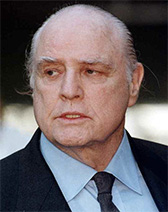
Mario Puzo
American novelist and screenwriter of Italian descent, best known for The Godfather (1969). He won two Academy Awards for Best Adapted Screenplay for The Godfather (1972) and The Godfather Part II (1974), sharing both awards with director Francis Ford Coppola. He also received a Golden Globe Award for Best Screenplay.
Born on October 15, 1920
Died on July 2, 1999
Age at death: 79
Profession: Novelist, Screenwriter
Place of Birth: Hell's Kitchen, Manhattan, New York City, United States
Place of Death: Bay Shore, New York, United States
Mario Puzo (1920–1999) was an American novelist and screenwriter of Italian descent, known for his books about organized crime, family relationships and power. His best-known novel, The Godfather (1969), was adapted into a film directed by Francis Ford Coppola in 1972. Puzo and Coppola jointly won the Academy Award for Best Adapted Screenplay for both The Godfather and The Godfather Part II. Puzo also received a Golden Globe Award for his screenplay work on The Godfather and contributed to the screenplays of Superman and Superman II.
Early Life and Education
Mario Puzo, whose full name was Mario Francis Puzo, was born on October 15, 1920, in the Hell's Kitchen neighborhood of Manhattan, New York City. He grew up in a working-class Italian-American family whose parents had emigrated from the Naples region of Italy. His childhood in a neighborhood populated by immigrant families later provided material for his novels.
During World War II, Puzo served in the United States Army Air Forces. Because of his poor eyesight, he was not assigned to combat duties. Instead, he served in Germany, where he worked in a military public relations office.
After returning to the United States, he continued his education, attending City College of New York and taking courses at The New School for Social Research and Columbia University. He developed an interest in fiction and began writing short stories.
Early Literary Career
Mario Puzo published his first short story, The Last Christmas, in American Vanguard magazine in 1950. Five years later, he published his first novel, The Dark Arena (1955), which examined the experiences of an American veteran in postwar Germany.
During the 1950s and 1960s, Puzo supported his family by working as a writer and editor for magazines associated with publisher Martin Goodman. His work appeared in men's adventure magazines and other popular publications.
His second novel, The Fortunate Pilgrim (1965), drew on the experiences of Italian immigrant families in New York. It followed a widowed mother struggling to raise her children in the city's Italian-American community. Although the book received favorable literary attention, it did not achieve substantial commercial success at the time.
The Godfather and International Recognition
In 1969, Mario Puzo published The Godfather, a novel about the fictional Corleone crime family and its position within the Italian-American Mafia. The story explored the relationships between organized crime, family loyalty, business interests and political influence.
The novel became an international bestseller and spent an extended period on The New York Times bestseller list. Its commercial success brought Puzo a much larger readership than his previous books.
Film director Francis Ford Coppola adapted the novel for cinema in 1972. Puzo and Coppola collaborated on the screenplay. The film starred Marlon Brando as Vito Corleone and Al Pacino as Michael Corleone, with James Caan, Robert Duvall and Diane Keaton in supporting roles.
The Godfather received eleven Academy Award nominations and won three awards, including Best Picture, Best Actor for Marlon Brando and Best Adapted Screenplay for Puzo and Coppola. The screenplay also won a Golden Globe Award.
The Godfather Film Trilogy
Following the success of the first film, Mario Puzo continued collaborating with Francis Ford Coppola on The Godfather Part II (1974). The film followed Michael Corleone's leadership of the family while also depicting the early life of his father, Vito Corleone, played as a young man by Robert De Niro.
At the 1975 Academy Awards, Puzo and Coppola won their second Oscar for Best Adapted Screenplay. The Godfather Part II received six Academy Awards, including Best Picture and Best Director.
Puzo and Coppola reunited for The Godfather Part III (1990), which continued the story of Michael Corleone. The film starred Al Pacino, Diane Keaton and Andy Garcia. Puzo again shared screenplay credit with Coppola.
Other Novels and Screenwriting
Following The Godfather, Mario Puzo continued writing novels about crime, politics and family relationships. His publications included Fools Die (1978), The Sicilian (1984) and The Fourth K (1990).
In 1996, he published The Last Don, a novel concerning a Mafia family attempting to establish legitimate business interests. The book was adapted into a television miniseries in 1997.
His later novels included Omertà (2000), which was published after his death, and The Family (2001), a historical novel about the Borgia family. The Family was completed after Puzo's death by his longtime companion, writer Carol Gino.
Puzo also worked on the screenplays of Superman (1978) and Superman II (1980), the superhero films featuring Christopher Reeve. His additional screenwriting work included contributions to The Cotton Club (1984), directed by Francis Ford Coppola.
Personal Life
Mario Puzo married Erika Lina Broske in 1946. The couple had five children. His wife died in 1978.
In his later years, Puzo shared his life with writer and nurse Carol Gino, who also worked on the publication of his final novel.
Death
Mario Puzo died on July 2, 1999, at his home in Bay Shore, Long Island, New York. He was seventy-eight years old. His death was attributed to heart failure.
At the time of his death, Puzo had completed Omertà and had been working on The Family, which was published posthumously.
Novels
- 1955 – The Dark Arena
- 1965 – The Fortunate Pilgrim
- 1969 – The Godfather
- 1978 – Fools Die
- 1984 – The Sicilian
- 1990 – The Fourth K
- 1996 – The Last Don
- 2000 – Omertà (Posthumous)
- 2001 – The Family (Posthumous; completed by Carol Gino)
Selected Screenplays
- 1972 – The Godfather
- 1974 – The Godfather Part II
- 1978 – Superman
- 1980 – Superman II
- 1984 – The Cotton Club (Story and screenplay contribution)
- 1990 – The Godfather Part III
Awards
- 1973 – Academy Award for Best Adapted Screenplay – The Godfather, shared with Francis Ford Coppola.
- 1973 – Golden Globe Award for Best Screenplay – The Godfather, shared with Francis Ford Coppola.
- 1975 – Academy Award for Best Adapted Screenplay – The Godfather Part II, shared with Francis Ford Coppola.
Source: Biyografiler.com
Mario Puzo Movies

The Godfather Part III
Release Date: December 25, 1990
Director: Francis Ford Coppola
Writer: Mario Puzo, Francis Ford Coppola
Cast: Al pacino, Diane Keaton, Talia Shire, Andy Garcia, Eli Wallach, Joe Mantegna, George Hamilton, Bridget Fonda, Sofia Coppola

The Godfather Part II
Release Date: December 20, 1974
Director: Francis Ford Coppola
Writer: Mario Puzo, Francis Ford Coppola
Cast: Al pacino, Robert Duvall, Diane Keaton, Robert De Niro, John Cazale, Talia Shire, Lee Strasberg, Michael V. Gazzo, G.D. Spradlin, Richard Bright, Gastone Moschin

The Godfather
Release Date: March 24, 1972
Director: Francis Ford Coppola
Writer: Mario Puzo, Francis Ford Coppola
Cast: Marlon Brando, Al Pacino, James Caan, Richard S. Castellano, Robert Duvall, Sterling Hayden, John Marley, Richard Conte, Al Lettieri, Diane Keaton, Talia Shire, John Cazale
Frequently asked questions about Mario Puzo
Who is Mario Puzo?, Mario Puzo biography, Mario Puzo life story, Mario Puzo age, Mario Puzo facts, Mario Puzo birthplace, Mario Puzo photos, Mario Puzo videos, Mario Puzo career
Related Biographies


Lamine Yamal
Professional footballer

Brad Pitt
Actor

Erling Haaland
Professional footballer

Leonardo DiCaprio
Actor

Kylian Mbappe
Professional footballer

Sam Altman
Entrepreneur, Investor, CEO

Marc Andreessen
Engineer, Entrepreneur

Manuel Pellegrini
Football Manager, Former Professional Footballer

Manuel Neuer
Professional footballer

Malin Maria Akerman
Model, Actress

Malcolm McDowell
Actor, Voice Actor

Margaret Mitchell
Novelist, Journalist

Aidan Gillen
Actor

Mario Puzo
Novelist, Screenwriter

Adam Sandler
Actor
Brad Pitt
Actor
Manuel Neuer
Professional footballer
Margaret Mitchell
Novelist, Journalist