
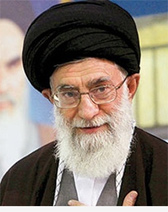
Ali Khamenei
Second Supreme Leader of the Islamic Republic of Iran
Born on July 17, 1939
Age: 87
Profession: Religious Leader, Politician
Place of Birth: Mashhad, Iran
Ali Khamenei is the second Supreme Leader of the Islamic Republic of Iran, holding the highest religious and political authority in the country since 1989.
Ali Khamenei was born on 17 July 1939 in Mashhad, Iran, as the second son of Seyyed Javad Hosseini Khamenei and the daughter of Seyyed Hashem Najafabadi. On his father’s side, he is of Azerbaijani Turkic origin, while his mother’s family originates from Yazd. At the age of four, he was sent together with his elder brother Seyyed Mohammad Khamenei to a traditional religious primary school (maktab), where he learned the alphabet and began Qur’anic studies. The two brothers later continued their primary education at the newly established Islamic school known as “Diyanat Dar al-Ta‘lim.”
After secondary religious studies in which he learned Jami‘ al-Muqaddamat, Sarf, and Nahw, Khamenei entered the religious seminary (hawza). He studied literature and preliminary religious sciences under his father and other teachers. He read “Rasa’il” and “Makasib” under Haj Sheikh Hashem Qazvini and studied advanced jurisprudence (Fiqh) and principles of jurisprudence (Usul al-Fiqh) primarily under his father. He completed the Mukaddamat and Sathi stages of seminary education in approximately five and a half years.
At the age of 18, he began higher-level studies (Dars al-Kharij) in Fiqh and Usul at the Mashhad seminary under Grand Ayatollah Milani. In 1957, he traveled to Najaf to visit the shrines of the infallible Imams. Observing the teachings of prominent mujtahids such as Seyyed Mohsen Hakim, Seyyed Mahmoud Shahroudi, Mirza Baqer Zanjani, Sheikh Yahya Yazdi, and Mirza Hasan Borujerdi, he initially decided to remain in Najaf for advanced studies. Due to his father’s opposition, however, he returned to Mashhad. Between 1958 and 1964, he continued advanced studies in Fiqh, Usul, and philosophy at the Qom seminary.
In 1963, after joining the Islamic and political movement led by Ruhollah Khomeini, Khamenei was arrested and subsequently spent nearly 15 years experiencing imprisonment and internal exile, during which he was detained multiple times. In early 1977, during the reign of Mohammad Reza Shah Pahlavi, he was again arrested and exiled for three years due to his political activities.
By mid-1978, as the Islamic revolutionary movement expanded nationwide, he was released from exile and returned to Mashhad. After Ruhollah Khomeini returned from exile in Paris to Tehran, Khamenei was appointed a member of the Revolutionary Council, prompting his move from Mashhad to Tehran.
In 1979, Ali Khamenei served as Deputy Minister of Defense and was appointed head of the Islamic Revolutionary Guard Corps. That same year, he was elected as a Tehran representative to the Islamic Consultative Assembly (Majlis). In 1980, he was appointed by Ruhollah Khomeini as the Imam’s representative to the Supreme Defense Council.
During the Iran–Iraq War beginning in 1980, he took part in resistance efforts against the forces of Saddam Hussein. On 27 June 1981, he was seriously injured in a bomb attack at the Abu Dhar Mosque in Tehran.
Following the assassination of Iran’s second president Mohammad-Ali Rajai in a bombing attack, new elections were held in October 1981. Khamenei won approximately 16 million votes and, with the approval of Ruhollah Khomeini, became President of Iran. He was re-elected for a second presidential term in 1985.
In 1986, he became Chairman of the Expediency Discernment Council. In 1989, he was appointed Chairman of the Council for the Revision and Amendment of the Iranian Constitution.
After the death of Supreme Leader Ruhollah Khomeini on 3 June 1989, the Assembly of Experts selected Ali Khamenei as Supreme Leader on 4 June 1989, following the recommendation of then-President Akbar Hashemi Rafsanjani. His clerical rank was elevated from Hojjat al-Islam to Ayatollah.
Ali Khamenei has since served as the Supreme Leader of the Islamic Republic of Iran, consolidating religious, political, military, and economic authority under his leadership.
It has been widely alleged that Khamenei oversees a financial empire valued at approximately 95 billion US dollars through various organizations. According to these claims, 52 billion dollars are tied to real estate holdings and 43 billion dollars to other assets. Central to these allegations is a conglomerate known as Setad, reportedly established by decree of Ruhollah Khomeini. International media outlets, including The Independent and Reuters, have described Setad as a little-known organization that forms a major foundation of Khamenei’s power.
Originally founded during the revolutionary period to assist the poor and war veterans, Setad is alleged to have grown into a vast network with holdings in telecommunications, finance, oil, medicine, and real estate. Reuters highlighted that its estimated value exceeded Iran’s 2012 oil export revenues by approximately 40 percent. It is claimed that much of Setad’s wealth originates from properties confiscated from Iranians who fled the country after the 1979 revolution or whose assets were seized by court rulings.
Reports further allege that Khamenei possesses collections including jewel-adorned pipes, approximately 170 antique walking canes, and more than 100 horses, including rare breeds. He is said to own six palaces, two of which reportedly contain nuclear-attack shelters, as well as a private underground hospital and mobile medical facilities operating on land and by air. These claims, however, remain the subject of international controversy and debate.
Ali Khamenei married Khojasteh Bagherzadeh in 1964. They have six children: Mojtaba Khamenei, Hoda Khamenei, Boshra Khamenei, Masoud Khamenei, Meysam Khamenei, and Mostafa Khamenei.
Books:
1. General Outline of Islamic Thought in the Qur’an
2. The Depth of Prayer
3. A Reflection on Patience
4. The Four Principal Books of Ilm al-Rijal
5. Wilayat
6. History and Condition of the Mashhad Seminary
7. The Lives of the Shi‘a Imams
8. The Truthful Leader
9. Unity and Factionalism
10. Art from the Perspective of Ayatollah Khamenei
11. Understanding Religion Correctly
12. Elements of Struggle in the Lives of the Imams of Ahl al-Bayt
13. Tawhid: Rejection of Servitude to Anything Other Than God
14. The Necessity of Returning to the Qur’an
15. A Study of the Life of Imam Sajjad
16. Imam Reza and the Issue of Succession
17. Cultural Assault
18. Hadith of Wilayat (9 volumes)
Source: Biyografiler.com
News about Ali Khamenei
Ali Khamenei Killed in U.S.–Israeli Strike, Iran Confirms
Iran’s state television has officially confirmed that the country’s Supreme Leader, Ali Khamenei, was killed in a large-scale military operation c...
World Leaders Respond to the U.S.–Israeli Strikes on Iran and Death of Ali Khamenei
The international community has reacted strongly and with deep concern following the joint U.S. and Israeli military strikes against Iran that reporte...
Iran’s Supreme Leader Ali Khamenei Dismisses Protesters as Trump Supporters
Iran’s Supreme Leader Ali Khamenei has dismissed ongoing anti-government protests as acts of vandalism carried out by “troublemakers” seeking to...
Frequently asked questions about Ali Khamenei
Who is Ali Khamenei?, Ali Khamenei biography, Ali Khamenei life story, Ali Khamenei age, Ali Khamenei facts, Ali Khamenei birthplace, Ali Khamenei photos, Ali Khamenei videos, Ali Khamenei career
Related Biographies

Lamine Yamal
Professional footballer

Erling Haaland
Professional footballer

Kylian Mbappe
Professional footballer

Austin Abrams
Actor

Bad Bunny
Rapper, Songwriter

Sam Altman
Entrepreneur, Investor, CEO


Hongjoong
Singer, Rapper, Songwriter, Composer

Ludacris
Rapper, Actor

Kwon Eunbi
Singer

Sarah Wayne Callies
Actress, Screenwriter, Producer, Director

LaTavia Roberson
Singer, Actress, Entrepreneur
Lamine Yamal
Professional footballer

Amber Heard
Actress, Model
Bad Bunny
Rapper, Songwriter
Erling Haaland
Professional footballer
Kylian Mbappe
Professional footballer
Austin Abrams
Actor