
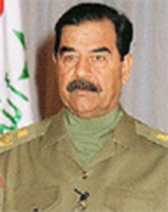
Saddam Hussein
The Authoritarian Ruler of Modern Iraq
Born on April 28, 1937
Died on December 30, 2006
Age at death: 69
Profession: Former President, Politician, Military Commander
Place of Birth: Al-Awja village, near Tikrit, Iraq
Place of Death: Baghdad, Iraq
Saddam Hussein was the authoritarian leader of Iraq who served as President from 1979 until April 2003, when he was overthrown by coalition forces led by the United States and the United Kingdom.
Born as Saddam Hussein Abd al-Majid al-Tikriti on April 28, 1937, in the village of Al-Awja, approximately 13 kilometers from Tikrit, he came from a poor family that survived through shepherding. His father disappeared six months before his birth. Until the age of three, he lived with his deeply religious Sunni uncle; afterward, he stayed with his mother, who gave him the name “Saddam,” meaning “one who confronts or resists.” After his mother remarried, Saddam suffered violence from his stepfather and returned to live with his uncle at the age of ten, under whose care he was raised.
Saddam became involved in politics during his youth. His ambitions of becoming a nationalist, liberationist, and anti-imperialist leader of the Arab world intensified in 1955 when he moved to Baghdad and joined the Arab Socialist Ba'ath Party, which aimed to lead the Arab world first to independence and then to socialism.
In 1956, Saddam participated in an unsuccessful coup attempt. In 1959, he became involved in an assassination plot targeting Iraq’s military-origin President, Abdul Karim Qasim. After being wounded in the leg, Saddam fled with the alleged assistance of the CIA and Egyptian intelligence, first to Syria, then to Beirut, where he reportedly received training, and later to Egypt. During his time in Cairo, he frequently visited the American Embassy and studied law at Cairo University.
In 1963, Saddam married his cousin Sajida Talfah. They had three daughters—Rana, Raghad, and Hala—and two sons, Uday and Qusay. Saddam later married twice more and had another son named Ali.
After returning to Iraq in 1964, Saddam was imprisoned. Released in 1967, he quickly rose within the Ba'ath Party. In 1968, the Ba'ath Party seized power through a bloodless coup. Saddam played a significant role in this takeover and became Vice Chairman of the Revolutionary Command Council in 1969.
In 1970, Saddam granted autonomy to Kurdish groups, but the agreement later collapsed, leading to renewed conflict. In 1972, he oversaw the nationalization of Iraqi oil. By 1976, he had assumed many powers of President Ahmed Hassan al-Bakr. On July 16, 1979, Saddam formally took power, forcing al-Bakr to resign.
His rule relied on repression, a vast intelligence network, and severe punishment of dissent. Saddam simultaneously held the offices of President, Prime Minister, and Chairman of the Revolutionary Command Council. Using oil revenues, he initiated large-scale development projects.
Seeking regional dominance, Saddam launched an invasion of Iran in 1980, aiming to control the Strait of Hormuz. The Iran–Iraq War lasted until 1988, resulting in hundreds of thousands of deaths and devastating both economies without yielding territorial gains.
In 1988, Iraqi forces carried out chemical attacks against Kurdish civilians in Halabja, killing approximately 5,000 people. The operation was overseen by General Ali Hassan al-Majid, known as “Chemical Ali.” Thousands of Kurds were forcibly relocated, an event remembered as the Halabja Massacre.
On August 2, 1990, Iraqi forces invaded Kuwait, triggering the Gulf War. Following UN sanctions and military authorization, a US-led coalition launched operations in January 1991. Iraqi troops set fire to over 700 oil wells and caused extensive environmental damage.
After the September 11, 2001 attacks, attention once again turned to Saddam. On March 20, 2003, the United States and the United Kingdom invaded Iraq, citing allegations of weapons of mass destruction. No such weapons were later found.
Baghdad fell on April 9, 2003, symbolized by the toppling of Saddam’s statue in Firdos Square. Saddam went into hiding until December 13, 2003, when he was captured near Tikrit in a concealed underground shelter.
He was found with $750,000 in cash, two Kalashnikov rifles, and a handgun. His identification was confirmed with the assistance of former Deputy Prime Minister Tariq Aziz.
Saddam was tried by a tribunal established under the US-led occupation. He and seven other defendants, including Barzan Ibrahim al-Tikriti and Taha Yassin Ramadan, faced charges of crimes against humanity, genocide, and war crimes.
During his trial, Saddam declared:
“I am using my constitutional rights as the President of Iraq. I do not recognize this court. This is an example of injustice. This court is illegitimate.”
On October 5, 2006, Saddam was sentenced to death for crimes against humanity related to the killing of 143 Shiites in the town of Dujail in 1982. His appeal was rejected on December 3, 2006.
Before his execution, Saddam wrote a farewell letter calling on Iraqis to remain united against foreign occupiers and internal division.
“I offer my soul as a sacrifice to God. If He wills, He will grant me martyrdom… Do not hate, for hatred blinds justice and closes the doors of reason.”
On December 30, 2006, Saddam Hussein was executed by hanging in Baghdad. He was buried in Al-Awja, alongside his sons Uday and Qusay, who had been killed by US forces in 2003.
His execution was welcomed by the United States, Israel, and the United Kingdom, while several countries and organizations criticized it as politically motivated and legally questionable. Many legal experts later argued that the trial did not meet international standards of fairness.
Saddam Hussein remains one of the most controversial figures in modern Middle Eastern history, symbolizing both ruthless authoritarianism and, for some supporters, resistance against foreign intervention.
Source: Biyografiler.com
Frequently asked questions about Saddam Hussein
Who is Saddam Hussein?, Saddam Hussein biography, Saddam Hussein life story, Saddam Hussein age, Saddam Hussein facts, Saddam Hussein birthplace, Saddam Hussein photos, Saddam Hussein videos, Saddam Hussein career

Lamine Yamal
Professional footballer

Erling Haaland
Professional footballer

Kylian Mbappe
Professional footballer

Austin Abrams
Actor

Bad Bunny
Rapper, Songwriter

Sam Altman
Entrepreneur, Investor, CEO


Hongjoong
Singer, Rapper, Songwriter, Composer

Ludacris
Rapper, Actor

Kwon Eunbi
Singer

Sarah Wayne Callies
Actress, Screenwriter, Producer, Director

LaTavia Roberson
Singer, Actress, Entrepreneur
Lamine Yamal
Professional footballer

Amber Heard
Actress, Model
Bad Bunny
Rapper, Songwriter
Erling Haaland
Professional footballer
Kylian Mbappe
Professional footballer
Austin Abrams
Actor