
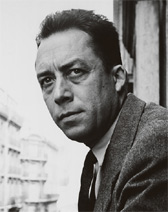
Albert Camus
Pioneer of Absurdism – Nobel Prize–Winning Author
Born on November 7, 1913
Died on January 4, 1960
Age at death: 47
Profession: Writer, Philosopher, Journalist
Place of Birth: Mondovi (Dréan), French Algeria
Place of Death: Le Grand Fossard, near Sens, France
Albert Camus was a French writer, philosopher, and journalist, regarded as one of the leading figures of Absurdism. Although often associated with existentialism, Camus consistently rejected this label. His literary and philosophical works explore the conflict between humanity’s search for meaning and the silent indifference of the universe. In 1957, he was awarded the Nobel Prize in Literature, becoming one of the youngest recipients in history.
Albert Camus was born on 7 November 1913 in French Algeria. His mother was a French cleaning woman, and his father, Lucien Camus, of Spanish origin, died while serving in an infantry regiment during World War I. Raised in poverty, Camus spent most of his childhood in the working-class district of Belcourt in Algiers. Despite harsh conditions, his intellectual talents were recognized early.
After completing high school in 1923, Camus enrolled at the University of Algiers. During his university years, he played as a goalkeeper for the university football team. However, after contracting tuberculosis, he was forced to abandon both his athletic career and his formal education for a time. Financial hardship followed, and he supported himself by giving private lessons and working at the meteorological institute.
In 1935, Albert Camus returned to university and graduated in 1936 from the philosophy department with a thesis on Plotinus. In 1934, he married Simone Hié, but the marriage ended due to her morphine addiction and infidelity.
In 1934, Camus joined the French Communist Party, motivated less by Marxist ideology than by the political situation in Spain. In 1936, he moved to the Algerian Communist Party, but in 1937 he was expelled after being accused of Trotskyism and distancing himself from Stalinist communism.
Camus founded the Théâtre du Travail in 1935, though it closed in 1939. He was rejected from military service due to tuberculosis. Between 1937 and 1939, he wrote socialist-oriented articles. In 1940, he married pianist and mathematician Francine Faure, with whom he had twins. The same year, he began writing for the newspaper Paris-Soir.
During the early years of World War II, Camus remained a pacifist. He witnessed the German occupation of Paris and the execution of Gabriel Péri. With the staff of Paris-Soir, he relocated to Bordeaux. In 1941, he wrote The Stranger and The Myth of Sisyphus, and in 1942 he moved to Oran, Algeria.
During the war, Albert Camus joined the French Resistance and worked underground on the newspaper Combat, becoming its editor in 1943. One of his most famous articles, published two days before the Hiroshima bombing, condemned the use of atomic weapons. When Combat became a commercial publication in 1947, he resigned. During this period, he met Jean-Paul Sartre.
After the war, Camus frequently met Sartre and his circle at the Café de Flore in Paris. However, his criticism of communism gradually isolated him from leftist intellectuals. He later lectured widely in the United States on French philosophy. In 1949, a recurrence of tuberculosis forced him to suspend his work until 1952.
In 1951, Camus published The Rebel, a work that definitively marked his intellectual break with Sartre and provoked strong reactions from the political left. In 1952, he resigned from UNESCO in protest against the United Nations’ acceptance of Francoist Spain. He became a vocal opponent of the death penalty and collaborated with Arthur Koestler in campaigns against capital punishment.
During the Algerian War of Independence beginning in 1954, Albert Camus supported the French government, believing the conflict to be driven by Arab imperialism backed by the Soviet Union. While advocating Algerian autonomy, he secretly worked to save Algerians sentenced to death. Between 1955 and 1956, he wrote for L’Express.
In 1957, Camus received the Nobel Prize in Literature. Many critics believe the award was granted not primarily for his novel The Fall, but for his essay Reflections on the Guillotine, which powerfully argued against capital punishment. He became the youngest laureate since Rudyard Kipling.
On 4 January 1960, Albert Camus died in a car accident near Sens, France, while traveling in a Facel Vega automobile. Ironically, Camus had once described death by car accident as the most absurd way to die. A train ticket found in his pocket revealed that he had originally planned to travel by train. His friend and publisher Michel Gallimard also died in the crash.
After his death, several works were published posthumously, including A Happy Death (1970) and the unfinished autobiographical novel The First Man (1995). Closely associated with Absurdism, Camus played a central role in shaping this philosophical movement. His essays often display a strong dualism.
On existentialism, Albert Camus famously stated:
“No, I am not an existentialist. Sartre and I have always been surprised to see our names linked together. Sartre is an existentialist; the only philosophical book I published, The Myth of Sisyphus, was directed against so-called existentialist philosophers.”
Novels:
The Stranger (1942)
The Plague (1947)
The Fall (1956)
A Happy Death (posthumous, 1970)
The First Man (posthumous, 1995)
Short Stories:
Exile and the Kingdom (1957)
Plays:
Caligula (written 1938, staged 1945)
The Possessed (1959)
Rebellion in Asturias (written 1935)
The Misunderstanding (1943)
State of Siege (written 1948)
The Just Assassins (1949)
Essays:
The Myth of Sisyphus (1942)
The Wrong Side and the Right Side (1937)
The Rebel (1951)
Letters to a German Friend (1945)
Source: Biyografiler.com
Frequently asked questions about Albert Camus
Who is Albert Camus?, Albert Camus biography, Albert Camus life story, Albert Camus age, Albert Camus facts, Albert Camus birthplace, Albert Camus photos, Albert Camus videos, Albert Camus career
Related Biographies

Lamine Yamal
Professional footballer

Sam Altman
Entrepreneur, Investor, CEO

Kylian Mbappe
Professional footballer

Alice Weidel
Politician, Economist

Erling Haaland
Professional footballer

Giorgia Meloni
Politician, Journalist


Hongjoong
Singer, Rapper, Songwriter, Composer

Ludacris
Rapper, Actor

Kwon Eunbi
Singer

Sarah Wayne Callies
Actress, Screenwriter, Producer, Director

LaTavia Roberson
Singer, Actress, Entrepreneur

Lady Gaga
Singer, Musician, Songwriter, Actress, Producer

Austin Abrams
Actor

Taylor Swift
Singer, Musician, Songwriter

Amanda Seyfried
Actress, Model, Singer

Delcy Rodriguez
Politician, Lawyer, Diplomat

Fatih Akin
Film Director, Screenwriter