
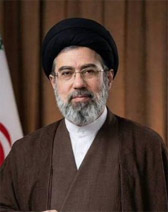
Mojtaba Khamenei
Third Supreme Leader of Iran
Born on September 8, 1969
Age: 57
Profession:
Place of Birth: Mashhad, Iran
Mojtaba Hosseini Khamenei is an Iranian Shia cleric and political figure who has served as the third Supreme Leader of Iran since March 8, 2026. Long regarded as one of the most influential figures within the inner circle of power surrounding his father, he spent decades operating largely behind the scenes in the political and security structures of the Iranian state. As the second son of Ali Khamenei, the Islamic Republic’s second Supreme Leader, Mojtaba Khamenei became widely known as a key strategist within the Supreme Leader’s office and a powerful actor in the country’s security apparatus.
Early Life and Background
Mojtaba Khamenei was born on September 8, 1969, in Mashhad, a major religious center in northeastern Iran. His full name is Mojtaba Hosseini Khamenei. He is the second of six children born to Ali Khamenei, who became the second Supreme Leader of Iran in 1989, and Mansoureh Khojasteh Bagherzadeh. Growing up in a politically and religiously prominent household during the formative years of the Islamic Republic of Iran, Mojtaba Khamenei was exposed early to both theological scholarship and the evolving structures of revolutionary governance.
He completed his secondary education in Tehran at the religiously oriented Alavi High School, an institution known for educating students within a conservative Islamic framework. After graduating from high school, Mojtaba Khamenei began formal religious studies. Among his earliest teachers were his father Ali Khamenei and the influential Shia jurist Mahmoud Hashemi Shahroudi, who later served as head of Iran's judiciary.
Religious Education
In 1999, at the age of thirty, Mojtaba Khamenei moved to the city of Qom, one of the most important centers of Shia scholarship in the world. There he continued his studies at the Qom Islamic Seminary, where he attended lectures by several prominent clerics including Mohammad-Taqi Mesbah-Yazdi, Lotfollah Safi Golpaygani, and Mohammad Bagher Kharazi. These scholars represented influential currents within the conservative theological establishment of the Islamic Republic.
Observers have frequently noted that Mojtaba Khamenei did not begin wearing traditional clerical robes until approximately the age of thirty, which was relatively late compared with many Iranian seminarians who typically adopt clerical dress earlier in their religious education. This detail has occasionally been cited by analysts examining his unconventional path within the clerical hierarchy.
Military Service and the Iran–Iraq War
During his youth, Mojtaba Khamenei reportedly served in the ground forces of the Islamic Revolutionary Guard Corps during the final phase of the Iran–Iraq War. Between 1987 and 1988 he is believed to have participated in limited frontline duties within the Seyyed al-Shuhada Division. Reports indicate that he took part in several operations during the closing stages of the conflict, although detailed records of his service remain limited.
Role Within the Supreme Leader’s Office
From 1997 until March 2026, Mojtaba Khamenei worked within the Office of the Supreme Leader as deputy chief of staff responsible for political and security affairs. In this position he collaborated closely with Vahid Haghanian, another influential official within the leadership structure. Over time he developed strong connections with both the Islamic Revolutionary Guard Corps and the paramilitary Basij], institutions central to the security architecture of the Islamic Republic.
Because of these networks, analysts frequently described Mojtaba Khamenei as a powerful figure operating behind the scenes of Iranian politics. His influence was rarely exercised through formal public office but rather through advisory roles, security coordination, and close proximity to the Supreme Leader himself.
Political Influence and Election Controversies
The name Mojtaba Khamenei first entered broader public discussion during the 2005 Iranian presidential election. Reformist candidate Mehdi Karroubi publicly alleged that Mojtaba Khamenei had intervened in the electoral process in support of Mahmoud Ahmadinejad. Journalists and political analysts later speculated that he may have helped organize networks backing Ahmadinejad during both the 2005 and 2009 Iranian presidential election.
His name resurfaced during the protests that followed the contested 2009 election results. The demonstrations, widely known as the Green Movement, were among the largest challenges to the Iranian government since the 1979 revolution. Critics alleged that Mojtaba Khamenei played a role in coordinating the state’s response through security institutions and Basij militia networks, though Iranian authorities denied such claims.
International Scrutiny and Sanctions
Mojtaba Khamenei has remained a relatively private figure rarely appearing in public or giving interviews. Nonetheless, international diplomatic sources have occasionally commented on his influence. Documents published by WikiLeaks cited U.S. diplomatic cables describing him as a “skilled and powerful leader” within the Iranian system and referring to him metaphorically as “the power behind the robes.”
Investigative reports published by Bloomberg and The Guardian have also alleged that Mojtaba Khamenei controls significant financial assets through complex networks of companies and intermediaries. These reports suggested connections to high-value real estate in cities such as London and Dubai, as well as interests linked to shipping, banking, and tourism sectors in Europe. Some investigations alleged that Iranian businessman Ali Ansari was connected to companies associated with these assets, though Ansari denied any financial relationship.
In 2019 the government of the United States imposed sanctions on Mojtaba Khamenei, despite his lack of an elected public office, arguing that he acted on behalf of the Supreme Leader. The sanctions cited alleged links to the Quds Force and claimed support for organizations including Hezbollah, Hamas, and the Taliban. Iranian officials rejected these accusations and described the sanctions as politically motivated.
Path to the Supreme Leadership
For many years Mojtaba Khamenei was viewed by observers as a possible successor to his father Ali Khamenei. Under the constitution of the Islamic Republic of Iran, the Supreme Leader is selected by the 88-member Assembly of Experts, whose members are elected by the public. Some analysts argued that Mojtaba Khamenei lacked the senior clerical rank traditionally expected for the position, though historical precedent existed: Ali Khamenei himself was elevated to the rank of Ayatollah shortly after becoming Supreme Leader in 1989.
Personal Life
In 1999 Mojtaba Khamenei married Zahra Haddad Adel. The couple had three children. His personal life has remained largely private, reflecting the limited public visibility he maintained for much of his career.
On February 28, 2026, his wife and one of their children were reportedly killed during a joint military strike carried out by United States and Israel forces targeting the Supreme Leader’s compound in Tehran. The attack also resulted in the death of Ali Khamenei.
Third Supreme Leader of Iran
Following the death of Ali Khamenei in the February 28, 2026 strike on the leadership complex in Tehran, the Assembly of Experts convened to select a new Supreme Leader. On March 8, 2026, it announced that Mojtaba Khamenei had been chosen as the third Supreme Leader of Iran.
The decision generated immediate debate both inside and outside Iran, with critics arguing that the succession appeared to resemble dynastic transfer of power. Supporters within the Iranian establishment, however, emphasized his long involvement in the country’s political and security institutions.
As Supreme Leader, Mojtaba Khamenei holds ultimate authority over the Iranian Armed Forces and exercises decisive influence over both domestic and foreign policy within the Islamic Republic. After decades spent operating largely behind the scenes, he assumed one of the most powerful positions in the Iranian political system.
Source: Biyografiler.com
News about Mojtaba Khamenei

U.S. and Iran Sign Historic Memorandum: Agreement Officially Enters Into Force
The historic memorandum reached after weeks of diplomatic talks between the United States and Iran has officially entered into force. The text, referr...
Frequently asked questions about Mojtaba Khamenei
Who is Mojtaba Khamenei?, Mojtaba Khamenei biography, Mojtaba Khamenei life story, Mojtaba Khamenei age, Mojtaba Khamenei facts, Mojtaba Khamenei birthplace, Mojtaba Khamenei photos, Mojtaba Khamenei videos, Mojtaba Khamenei career
Related Biographies

Lamine Yamal
Professional footballer

Erling Haaland
Professional footballer

Kylian Mbappe
Professional footballer

Austin Abrams
Actor

Bad Bunny
Rapper, Songwriter

Sam Altman
Entrepreneur, Investor, CEO


Hongjoong
Singer, Rapper, Songwriter, Composer

Ludacris
Rapper, Actor

Kwon Eunbi
Singer

Sarah Wayne Callies
Actress, Screenwriter, Producer, Director

LaTavia Roberson
Singer, Actress, Entrepreneur

Amber Heard
Actress, Model
Lamine Yamal
Professional footballer
Bad Bunny
Rapper, Songwriter
Erling Haaland
Professional footballer
Kylian Mbappe
Professional footballer
Austin Abrams
Actor