
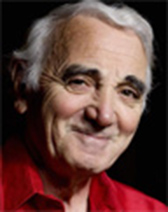
Charles Aznavour
The “French Sinatra” and one of the most iconic chanson artists of the 20th century
Born on May 22, 1924
Died on October 1, 2018
Age at death: 94
Profession: Singer, Songwriter, Diplomat
Place of Birth: Paris, France
Place of Death: Alpilles, Provence, France
Charles Aznavour was one of France’s most popular and internationally recognized artists, celebrated for his emotionally charged chansons, distinctive voice, and prolific career spanning music, cinema, and diplomacy. Often referred to as “France’s Frank Sinatra,” Aznavour became a global cultural figure whose songs—largely centered on love, loss, and human vulnerability—resonated across generations.
Early Life and Family Background
Charles Aznavour was born as Shahnur Varinag Aznavourian on May 24, 1924, in Paris, to an Armenian family. His mother, Knar Baghdasarian, was an actress who had emigrated from Adapazarı, while his father, Misha Aznavourian, was a singer who migrated from Georgia to France. Growing up in an artistically inclined household, Aznavour was immersed in music and performance from an early age.
Because of this creative environment, he began appearing in stage productions and singing professionally by the age of nine. His early exposure to theater and music laid the foundation for a lifelong dedication to performance.
Breakthrough and Édith Piaf
A decisive turning point in Charles Aznavour’s career came when he met the legendary French singer Edith Piaf. Piaf recognized his potential and became both a mentor and supporter, taking him on tour across Europe and the United States. These tours introduced Aznavour to international audiences and played a crucial role in transforming him into a world-renowned performer.
Through this association, Aznavour refined his stage presence, songwriting, and interpretive depth, eventually emerging as a leading figure in French popular music.
Music Career and International Success
Charles Aznavour built an extraordinary catalog of songs, most of which revolved around themes of love, longing, aging, and existential reflection. He wrote more than a hundred songs and recorded in six languages: French, English, Italian, Spanish, German, and Russian. While French remained his native language, he was also fluent in English and German, though he did not speak Armenian.
In the 1970s, Aznavour achieved major success in the United Kingdom with songs such as “Dance in the Old Fashioned Way” and “She,” further solidifying his international appeal. His ability to cross linguistic and cultural boundaries made him one of the rare European artists to enjoy sustained global popularity.
Film Career
In addition to music, Charles Aznavour enjoyed a substantial acting career, appearing in approximately sixty films. Among his notable works are Shoot the Piano Player (1960), Tobruk (1961), The Postman Goes to War (1966), and The Ghosts of the Hat Maker (1982). His screen performances often mirrored the emotional intensity found in his music.
In 2002, he appeared in Ararat, directed by Armenian-Canadian filmmaker Atom Egoyan, a film centered on the Armenian genocide narrative. The role marked a significant moment in his later acting career.
Political and Diplomatic Activities
Charles Aznavour maintained a complex relationship with politics and national identity. During the 1950s and 1960s, he frequently visited Turkey, expressing admiration for the country and its people and publicly supporting Turkey in international contexts. In later years, however, he adopted positions aligned with Armenian genocide claims, a shift that drew controversy.
Following the devastating 1988 earthquake in Armenia, Aznavour provided extensive humanitarian aid. In recognition of these efforts, the Armenian government awarded him the title of “National Hero of Armenia” in 2004. In 2008, by decree of President Serzh Sargsyan, he was granted Armenian citizenship, and in 2009 he was appointed Armenia’s Ambassador to Switzerland and permanent representative to UNESCO.
Personal Life
Charles Aznavour married three times. His first marriage was to Micheline Rugel in 1946, with whom he had two children, Misha and Patrick. Patrick died at the age of 26. In 1955, Aznavour married Evelyne Plessis, and they had a daughter, Katia.
His third marriage, in 1967, was to Ulla Thorsell. They had three children together, including Nicolas, born in 1977, and later Seda and Charles. Family life remained an important aspect of Aznavour’s identity throughout his career.
Death
Charles Aznavour died on October 1, 2018, at the age of 94, at his home in the Alpilles region of southern France. His death marked the end of an era in French chanson, but his music, films, and cultural legacy continue to resonate worldwide.
Charles Aznavour remains remembered as a singular artist—one who gave voice to love in all its complexity and carried French music to a truly global stage.
Source: Biyografiler.com
Frequently asked questions about Charles Aznavour
Who is Charles Aznavour?, Charles Aznavour biography, Charles Aznavour life story, Charles Aznavour age, Charles Aznavour facts, Charles Aznavour birthplace, Charles Aznavour photos, Charles Aznavour videos, Charles Aznavour career
Related Biographies


Lamine Yamal
Professional footballer

Sam Altman
Entrepreneur, Investor, CEO

Kylian Mbappe
Professional footballer

Alice Weidel
Politician, Economist

Erling Haaland
Professional footballer

Giorgia Meloni
Politician, Journalist


Hongjoong
Singer, Rapper, Songwriter, Composer

Ludacris
Rapper, Actor

Kwon Eunbi
Singer

Sarah Wayne Callies
Actress, Screenwriter, Producer, Director

LaTavia Roberson
Singer, Actress, Entrepreneur
Lamine Yamal
Professional footballer

Xi Jinping
Politician, Statesman, Head of State

Brad Pitt
Actor
Kylian Mbappe
Professional footballer

Pedro Sanchez
Politician
Erling Haaland
Professional footballer