
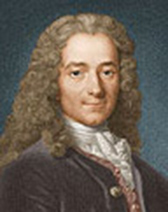
Voltaire
The Voice of Reason and Satire of the Enlightenment
Born on November 12, 1694
Died on May 30, 1778
Age at death: 84
Profession: Philosopher, Writer, Historian
Place of Birth: Paris, Kingdom of France
Place of Death: Paris, Kingdom of France
Voltaire, whose real name was François Marie Arouet, was a celebrated French thinker, writer, and philosopher who made major contributions to the Enlightenment and indirectly influenced the French Revolution. In addition to his unforgettable works in theater, he is regarded as the creator of refined irony and satire in modern literature. His work Zadig, in particular, is considered one of the earliest examples of the detective story genre.
When he was born on 21 November 1694, no one believed that this sickly and frail baby would survive. Baptized as François Marie Arouet, he never enjoyed robust health, yet by the age of three he could recite all of La Fontaine’s fables from memory. These were taught to him by his godfather Abbé de Châteauneuf, a man viewed with suspicion by church authorities. Recognizing the boy’s extraordinary talent, the abbé not only laid the foundations of his education but also instilled in him unconventional and independent ideas.
At the age of ten, François was sent to a Jesuit school. During his school years, he proved to be a brilliant student whose sharp intellect and quick comprehension astonished his teachers and priests alike. However, when his father insisted that he study law, François firmly opposed him, declaring, “I want no profession other than literature.”
With the help of his godfather Abbé de Châteauneuf, François gained access to court circles and wrote his first tragedy, Oedipus. His intelligence earned him the remark, “What a powerful mind in such a frail body.” As his writings began to attract attention, he adopted the pen name Voltaire. Hoping to rescue his son from scandalous circles, his father sent him to the brother of his godfather, the Marquis de Châteauneuf, who served as the Dutch ambassador. Yet another romantic scandal forced Voltaire to return to Paris.
With the death of Louis XIV in 1715, restrictions on freedom of expression eased. People could now speak and write more freely, but Voltaire’s pen was too sharp and satirical to go unnoticed. His writings angered the Regent Philippe II, Duke of Orléans, and Voltaire was imprisoned in the Bastille for eighteen months. There, he spent his time composing a long epic poem about Henry IV of France.
After his release, Voltaire arranged for the staging of Oedipus. The play achieved unprecedented success, not solely because of its literary merit, but because rumors circulated that it criticized the Regent and reflected Voltaire’s unjust treatment. Encouraged by this success, he attempted to publish his epic poem The Henriade, which defended Protestantism and religious tolerance. When publication was forbidden, Voltaire finally had it printed in Rouen in 1723.
In 1725, his sharp wit again brought trouble. After offending a knight named Rohan with his biting sarcasm, Voltaire was beaten by the knight’s men. Forced to challenge him to a duel, Voltaire was instead arrested once more and briefly imprisoned in the Bastille. Filled with anger at the injustices he had suffered in France, he left for England upon his release.
In England, Voltaire was introduced to Lord Bolingbroke and entered the intellectual elite of his time. He met figures such as Jonathan Swift, Alexander Pope, Edward Young, John Gay, and William Congreve, as well as prominent nobles including the Duchesses of Marlborough, Chesterfield, and Peterborough. English society, with its tolerance for freedom of thought, deeply impressed him. His Henriade, dedicated to Queen Caroline of Great Britain, was published in thousands of copies.
Returning to France in 1729, Voltaire completed The History of Charles XII and began preparing Letters on the English. Soon after, conflicts with the Church forced him to flee to Rouen, where he wrote Philosophical Letters, a work shaped by his English experiences.
By this time, Voltaire was closely watched, and nearly everything he wrote was banned by the Church, which accused him of extreme irreligion. Eventually, a woman named Émilie du Châtelet offered him refuge at her husband’s château. This marked the beginning of the greatest passion of Voltaire’s life. He was thirty-nine years old; Madame du Châtelet was eleven years younger, married, and childless. A profound love developed between them.
Fortune eventually smiled upon Voltaire in his own country. In 1745, through the influence of Madame de Pompadour, the mistress of Louis XV, he was appointed royal historiographer, and in 1746 he was elected to the Academy.
After a quarrel fueled by jealousy, Madame du Châtelet returned to her husband and died shortly thereafter. To overcome his grief, Voltaire immersed himself in writing plays and novels. In 1753, he settled in Switzerland and later in the town of Ferney. There, his genius reached perfection in Candide, a masterpiece that secured his immortality. This work offers a mature expression of his understanding of humanity and stands as one of the finest examples of his timeless satire.
In his final years, Voltaire finally received the respect and admiration he deserved. At the age of eighty-three, he returned to France to attend the Paris premiere of his play Irene. He was welcomed on stage with a laurel wreath and a standing ovation. The play was a great success, but death was near. On 30 May 1778, amid a crowd of visitors, Voltaire passed away. His final words were, “Let me die in peace.”
The traces of Voltaire’s intelligence, refined irony, satire, and sharp judgment have endured through his works to the present day. Theater was a lifelong passion for him; he wrote more than fifty plays. His most important tragedies include Zaïre (1732), Mérope, and Mahomet (1741).
Source: Biyografiler.com
Frequently asked questions about Voltaire
Who is Voltaire?, Voltaire biography, Voltaire life story, Voltaire age, Voltaire facts, Voltaire birthplace, Voltaire photos, Voltaire videos, Voltaire career

Lamine Yamal
Professional footballer

Kylian Mbappe
Professional footballer

Erling Haaland
Professional footballer

Sam Altman
Entrepreneur, Investor, CEO

Austin Abrams
Actor

Bad Bunny
Rapper, Songwriter


Hongjoong
Singer, Rapper, Songwriter, Composer

Ludacris
Rapper, Actor

Kwon Eunbi
Singer

Sarah Wayne Callies
Actress, Screenwriter, Producer, Director

LaTavia Roberson
Singer, Actress, Entrepreneur

Pedro Sanchez
Politician

Adam Sandler
Actor

Cillian Murphy
Actor
Lamine Yamal
Professional footballer
Austin Abrams
Actor

Brad Pitt
Actor