
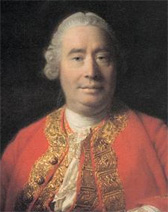
David Hume
The Leading Figure of British Empiricism
Born on May 7, 1711
Died on August 25, 1776
Age at death: 65
Profession: Philosopher, Historian, Economist
Place of Birth: Edinburgh, Scotland
Place of Death: Edinburgh, Scotland
David Hume was born on May 7, 1711, in Edinburgh, the capital of Scotland. He studied philosophy at the University of Edinburgh, where he was introduced to the intellectual foundations that would later shape his revolutionary contributions to philosophy.
In 1734, at the age of twenty-three, David Hume traveled to France, where he lived for four years. During this period, he completed his first major work, A Treatise of Human Nature, which was finished in 1738. Although the work did not initially receive the attention he expected, it later came to be regarded as one of the most important texts in modern philosophy.
Because he needed to earn a living, David Hume worked as a secretary to a general, which allowed him to travel across continental Europe. During this time, he reconsidered and refined the ideas presented in his first book. These revisions culminated in the publication of An Enquiry into Human Understanding in 1748.
After returning to Britain, he obtained a position that allowed him to work comfortably and pursue his research: librarian at the Faculty of Law in Edinburgh. While working there, he completed History of England (1755). The success of this work brought him widespread fame and recognition.
In 1763, David Hume went to France as a secretary to the embassy. There, his close friendships with Jean Jacques Rousseau and the Encyclopedists greatly enriched his intellectual life. After returning to Britain, he worked briefly at the Foreign Office before settling permanently in Edinburgh, where he chose a quiet and peaceful life until his death.
David Hume died on August 25, 1776, in Edinburgh, at the age of sixty-five.
Philosophy
David Hume is regarded as one of the most important representatives of empiricism. While grounding empiricism largely in the philosophy of George Berkeley, he was also deeply influenced by the ideas of John Locke. His philosophical inquiry begins with the fundamental question: “What is the origin of our ideas?”
According to David Hume, consciousness contains two kinds of contents: impressions and ideas. Impressions arise directly from experience and are vivid and forceful, whereas ideas are faint copies of these impressions. All thoughts and concepts ultimately derive from experience, and without experience, no idea can exist.
Impressions first enter memory and become ideas, but in doing so they lose their original vividness. Through the mechanisms of memory and association, ideas are combined, and it is in this process that true and false thoughts emerge.
David Hume argued that human knowledge is limited to human experience and questioned whether we can truly know the existence of the external world. He concluded that reason alone is insufficient to prove the existence of the external world; therefore, we can only believe in it rather than know it with certainty.
He strongly criticized the principle of causality, which had been regarded since the Renaissance as a fundamental pillar of human understanding. According to David Hume, we never perceive causality itself—only the constant succession of events. Thus, causality cannot be directly experienced or perceived.
As the theoretical foundation of the British Enlightenment and the central epistemological movement of eighteenth-century British philosophy, Hume’s empiricism profoundly influenced later thinkers. His philosophy famously awakened Immanuel Kant from his “dogmatic slumber” and contributed significantly to Kantian philosophy as well as to modern positivism.
Economic Thought
In economic theory, David Hume occupies a position between mercantilism and classical economics. His economic analyses are closely connected to his views on human nature. His most significant contribution to economic thought is the concept of the quantity theory of money.
David Hume argued that the amount of precious metals in a country does not determine its level of development; rather, economic development determines the accumulation of wealth. He also defended free trade, asserting that it enables the rational distribution of resources. His economic writings were collected in Writings on Economics (1752–1758).
Books
1739–1740 – A Treatise of Human Nature
1742 – Essays Moral, Political and Literary
1751 – An Enquiry Concerning Human Understanding
1752 – Political Discourses
1754–1762 – History of England
1757 – Natural History of Religion
Quotes by David Hume
Source: Biyografiler.com
Frequently asked questions about David Hume
Who is David Hume?, David Hume biography, David Hume life story, David Hume age, David Hume facts, David Hume birthplace, David Hume photos, David Hume videos, David Hume career
Related Biographies

Lamine Yamal
Professional footballer

Sam Altman
Entrepreneur, Investor, CEO

Kylian Mbappe
Professional footballer

Erling Haaland
Professional footballer

Alice Weidel
Politician, Economist

Giorgia Meloni
Politician, Journalist


Hongjoong
Singer, Rapper, Songwriter, Composer

Ludacris
Rapper, Actor

Kwon Eunbi
Singer

Sarah Wayne Callies
Actress, Screenwriter, Producer, Director

LaTavia Roberson
Singer, Actress, Entrepreneur
Lamine Yamal
Professional footballer

Austin Abrams
Actor

Eliezer Yudkowsky
Researcher, Writer

Charles Leclerc
Formula 1 Driver
Giorgia Meloni
Politician, Journalist

Recep Tayyip Erdogan
Politician