
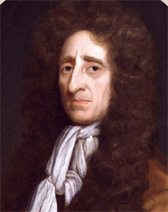
John Locke
The Founder of Enlightenment and the Age of Reason
Born on August 29, 1632
Died on October 28, 1704
Age at death: 72
Profession: Philosopher, Political Theorist, Writer
Place of Birth: Wrington, Somerset, England
Place of Death: Essex, England
John Locke was the first thinker to disseminate, on the widest scale, the idea of freedom of thought and the principle of regulating human actions according to reason. He is regarded as the true founder of the Enlightenment and the Age of Reason in Europe.
John Locke was born on August 29, 1632, in Wrington, Somerset, England. His father came from a family engaged in the cloth trade and also worked as a notary. John Locke received his university education at Oxford University, where he studied mainly natural sciences and medicine. After entering professional life, he worked both as a writer and as a statesman.
John Locke served as secretary to the English embassy in the Duchy of Brandenburg. After returning to England, he worked for eight years as a personal physician to the English aristocrat Lord Shaftesbury. When Lord Shaftesbury left England and went to the Netherlands in 1683, John Locke also left England and followed him there. After the success of the Second English Revolution in 1689, he was able to return to England; however, he later had to seek refuge in France once again.
John Locke was one of the foremost defenders of the doctrine of natural law. In all his works, he argued that humanity must free itself from every form of tradition and authority, and that only reason can guide human life. Through these ideas, he became a pioneer of Liberalism, a natural conception of religion, and Rational Pedagogy.
He went down in history as the first thinker to seriously shake absolutist regimes. As a result of the fractures he opened within absolutism, deep cracks gradually formed, laying the foundations for three major revolutions. He is remembered as the philosopher who laid the intellectual groundwork for the English, American, and French Revolutions.
According to John Locke, morality, like mathematics, is open to demonstration, because the essences of the objects to which moral judgments correspond can be known. Good and evil are nothing other than pleasure and pain, or what causes pleasure and pain in us, and whether our voluntary actions conform to ethical laws.
He distinguished three types of law: sacred law, civil law, and moral law.
The natural state of humanity is not a war of all against all, but a state of freedom; however, this state is governed by a law of nature. This law is the law of reason, which teaches human beings that they are equal and independent. The natural rights with which humans are born are the right to self-preservation and defense of life, the right to freedom, and the right to property. Because people are naturally free, no one can be subjected to another’s political power without their own consent. Yet, in order to establish a safer environment, people relinquish some of their rights and powers and transfer them to the majority of society through a contract. In this way, they leave the state of nature and bind their individual wills to the will of society to form a civil society.
The government established in this manner is obliged to protect the rights and freedoms of society and to work for its welfare. The execution of enacted laws belongs to the executive power, while the resolution of disputes belongs to the judicial power. Society entrusts the right of judgment and punishment to judges, that is, to the judiciary, and assigns the preparation and enactment of laws to another authority, the parliament. In addition, an executive power is required to enforce positive laws, conduct agreements, and decide on war and peace.
John Locke paved the way for Enlightenment philosophy and laid the foundations of empirical philosophy by taking experience as its starting point. He influenced not only major empiricist philosophers such as George Berkeley and David Hume, but also leading Enlightenment thinkers like Voltaire and Immanuel Kant.
John Locke died on October 28, 1704, in Essex, England, at the age of 72.
Books:
An Essay Concerning Human Understanding
Some Thoughts Concerning Education
A Letter Concerning Toleration
Two Treatises of Government
On the Reasonableness of Christianity
Source: Biyografiler.com
Frequently asked questions about John Locke
Who is John Locke?, John Locke biography, John Locke life story, John Locke age, John Locke facts, John Locke birthplace, John Locke photos, John Locke videos, John Locke career
Related Biographies

Lamine Yamal
Professional footballer

Kylian Mbappe
Professional footballer

Erling Haaland
Professional footballer

Sam Altman
Entrepreneur, Investor, CEO

Austin Abrams
Actor

Bad Bunny
Rapper, Songwriter


Hongjoong
Singer, Rapper, Songwriter, Composer

Ludacris
Rapper, Actor

Kwon Eunbi
Singer

Sarah Wayne Callies
Actress, Screenwriter, Producer, Director

LaTavia Roberson
Singer, Actress, Entrepreneur

Pedro Sanchez
Politician

Adam Sandler
Actor

Cillian Murphy
Actor
Lamine Yamal
Professional footballer
Austin Abrams
Actor

Brad Pitt
Actor