
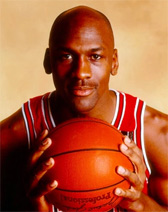
Michael Jordan
Born on February 17, 1963
Age: 63
Profession: Professional Basketball Player
Place of Birth: New York, United States
Michael Jeffrey Jordan, born in 1963, is an American legendary basketball player who is widely regarded as the greatest basketball player of all time. Throughout basketball history, Jordan achieved countless successes and broke numerous records, earning his place among the most influential and dominant athletes the sport has ever seen.
Michael Jeffrey Jordan was born on February 17, 1963, in Brooklyn, New York, as the son of Deloris and James R. Jordan. At the age of seven, he moved with his family to North Carolina, where he enrolled at Emsley A. Laney High School and took his first steps toward an athletic career. Jordan loved playing baseball, basketball, and football, initially focusing on baseball, his father’s favorite sport. At just seven years old, he won a state championship and earned his first “Most Valuable Player” (MVP) award with his baseball team. Over time, inspired by his older brother Larry, he devoted himself fully to basketball.
During high school, Jordan tried out for the school basketball team but was initially cut for being considered too short and physically weak at 1.80 meters. Determined to prove himself, he spent the entire summer training intensely and working to improve his physical condition. The following year, he made the team and went on to average 25 points per game throughout his high school career. In his senior year, he posted remarkable triple-double averages of 29.2 points, 11.6 rebounds, and 10.1 assists, leading Laney High School to a state championship. His outstanding performance earned him a spot on the prestigious McDonald's All-American Team, composed of the best high school players in the United States.
After graduating high school, Jordan attended the elite Five-Star Basketball Camp, where coaches identified him as one of the most promising young guards in the southern United States. Despite his strong performance and solid academic record, he was not accepted into UCLA or the University of Virginia. However, the University of North Carolina offered him a basketball scholarship, which he accepted.
In 1981, Jordan enrolled in the geography department at the University of North Carolina. He was named “Freshman of the Year” in his first season. Although he initially played alongside stars such as James Worthy and Sam Perkins, his defining moment came during the 1982 NCAA Finals when he hit a decisive three-point shot with 15 seconds remaining, securing the championship. Jordan later described this basket as the turning point of his career. In subsequent seasons, he took on greater leadership responsibilities and won the “College Player of the Year” award in both 1983 and 1984. Before completing his final year, he decided to turn professional, a decision he announced at a press conference in North Carolina. He later returned to complete his education and earned his diploma in 1986. That same year, he won an Olympic gold medal with the 1984 U.S. Olympic basketball team.
In the 1984 NBA Draft, Jordan was selected third overall by the Chicago Bulls, following Hakeem Olajuwon and Sam Bowie. He made an immediate impact in his rookie season, averaging 28.2 points, 6.5 rebounds, and 5.9 assists per game. He finished third in scoring behind Bernard King and Larry Bird and won the NBA Rookie of the Year award. His arrival also transformed the Bulls, leading them to 11 more wins than the previous season and a playoff appearance.
Jordan’s second season was hampered by a broken foot that limited him to just 18 games. Despite this, he returned for the playoffs and delivered a legendary performance against the Boston Celtics, scoring an NBA playoff-record 63 points in a single game. Although the Bulls were eliminated, Larry Bird famously remarked that it felt like “God disguised as Michael Jordan” was playing on the court.
In the 1987–1988 season, Jordan continued to dominate the league offensively and won the NBA Defensive Player of the Year award. The following seasons saw intense playoff battles with the Detroit Pistons, who developed the infamous “Jordan Rules” to contain him. Despite repeated playoff disappointments, the Bulls steadily improved with the emergence of Scottie Pippen, Horace Grant, and head coach Phil Jackson.
The 1990–1991 season marked a breakthrough. Jordan averaged 31.5 points, 6 rebounds, and 5.5 assists, winning his second NBA MVP award. The Bulls defeated the Pistons in the Eastern Conference Finals and went on to win the NBA Championship, with Jordan also earning his first NBA Finals MVP award. The Bulls went on to win three consecutive championships from 1991 to 1993, during which Jordan became the first player in NBA history to win three consecutive Finals MVP awards.
In 1993, Jordan announced his retirement, citing a loss of motivation and the emotional toll of his father’s murder. Shortly afterward, he pursued a professional baseball career with the Chicago White Sox organization, fulfilling his father’s dream. Although his baseball career was short-lived and less successful, Jordan returned to basketball in 1995.
The 1995–1996 season saw the Bulls add Dennis Rodman, forming one of the greatest teams in NBA history. The Bulls dominated the league and won the NBA Championship, while Jordan earned his fourth MVP award. The team repeated as champions in 1997 and 1998, giving Jordan a total of six NBA titles and five MVP awards.
Jordan retired for the second time in January 1999 but later returned to the NBA as both a player and executive with the Washington Wizards. Despite injuries limiting his playing time, he remained a major attraction, and the Wizards became one of the most-watched teams in the league. Jordan played his final NBA game on April 16, 2003.
Jordan won two Olympic gold medals, first in 1984 and later as a member of the legendary 1992 “Dream Team.” Off the court, he built a global brand, including the iconic Air Jordan shoe line, later rebranded as Jordan Brand under Nike. He also starred alongside Looney Tunes characters in the 1996 film Space Jam[]]], which became a cultural phenomenon.
Throughout his career, Jordan amassed extraordinary achievements, including five NBA MVP awards, six NBA championships, ten scoring titles, the highest scoring averages in both regular season and playoff history, and numerous other honors. Standing at 1.96 meters tall, he remains one of the most marketable and influential figures in sports history.
Today, Michael Jeffrey Jordan is remembered not only as a basketball icon but as a global symbol of excellence, competitiveness, and determination, whose impact extends far beyond the game itself.
Source: Biyografiler.com
Frequently asked questions about Michael Jordan
Who is Michael Jordan?, Michael Jordan biography, Michael Jordan life story, Michael Jordan age, Michael Jordan facts, Michael Jordan birthplace, Michael Jordan photos, Michael Jordan videos, Michael Jordan career

Lamine Yamal
Professional footballer

Kylian Mbappe
Professional footballer

Erling Haaland
Professional footballer

Sam Altman
Entrepreneur, Investor, CEO

Austin Abrams
Actor

Bad Bunny
Rapper, Songwriter


Hongjoong
Singer, Rapper, Songwriter, Composer

Ludacris
Rapper, Actor

Kwon Eunbi
Singer

Sarah Wayne Callies
Actress, Screenwriter, Producer, Director

LaTavia Roberson
Singer, Actress, Entrepreneur

Pedro Sanchez
Politician

Adam Sandler
Actor

Cillian Murphy
Actor
Lamine Yamal
Professional footballer
Austin Abrams
Actor

Brad Pitt
Actor