
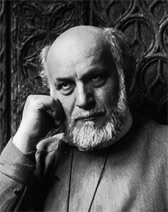
Antoine Bourdelle
Herakles the Archer, Monument to the Combatants of Tarn-et-Garonne, Monument to General Alvear, Monument to Adam Mickiewicz, and the sculptural decorations of the Théâtre des Champs-Élysées.
Born on October 31, 1861
Died on October 1, 1929
Age at death: 68
Profession: Sculptor
Place of Birth: Montauban, Tarn-et-Garonne, France
Place of Death: Le Vésinet, France
Antoine Bourdelle, full name Émile Antoine Bourdelle, was born on October 30, 1861, in Montauban, France. He was a French sculptor, painter, draftsman, and art educator whose work developed from the traditions of nineteenth-century French sculpture toward the simplified forms and monumental compositions of modern sculpture. Between 1893 and 1908, he worked in the studio of Auguste Rodin, before developing an independent approach influenced by ancient Greek sculpture, Romanesque art, and architectural construction. His works include Herakles the Archer (1909), Monument to the Combatants of Tarn-et-Garonne (1902), Monument to General Alvear in Buenos Aires, and Monument to Adam Mickiewicz in Paris. He also designed sculptures and decorative reliefs for the Théâtre des Champs-Élysées. As a teacher at the Académie de la Grande Chaumière, he trained artists from several countries, including Alberto Giacometti and Germaine Richier. He died on October 1, 1929, in Le Vésinet, near Paris, at the age of 67.
Early Life and Family Background
Antoine Bourdelle was born on October 30, 1861, in Montauban, in the Tarn-et-Garonne department of southwestern France. He was the only child of Antoine Bourdelle, a cabinetmaker and carpenter, and Émilie Reille.
His father operated a workshop producing furniture, cabinets, and carved wooden objects. As a child, Bourdelle became familiar with the tools and materials used in cabinetmaking. At approximately thirteen years old, he left school and began working in his father's workshop, learning woodcarving and other forms of specialized craftsmanship.
His early experience with wood, hand tools, and three-dimensional forms contributed to his interest in sculpture. He also attended drawing classes in Montauban, where he began developing his abilities in artistic observation and modeling.
In 1876, at the age of fourteen, he received a scholarship to study at the École des Beaux-Arts de Toulouse. There he received formal training in drawing, sculpture, and the artistic methods associated with academic education.
Art Education in Paris
In 1884, Antoine Bourdelle was admitted to the École des Beaux-Arts de Paris, ranking second in the entrance examination. He joined the studio of French sculptor Alexandre Falguière, whose work combined academic traditions with a naturalistic treatment of the human figure.
During this period, he also studied the sculptures of Jules Dalou and other French artists working in the public monuments and portrait sculpture traditions.
His academic education was relatively brief. He left Falguière's studio in 1886, preferring to develop his work outside the formal structure of the school.
In 1885, he established a studio at 16 Impasse du Maine in the Montparnasse district of Paris. His parents joined him there the following year. Bourdelle lived and worked in this artistic neighborhood for more than four decades. The studio complex would later become the Musée Bourdelle.
One of his early sculptures, The First Victory of Hannibal, was exhibited at the Salon des Artistes Français in 1885. The work depicted a historical subject and demonstrated his early interest in the relationship between physical movement, human anatomy, and dramatic expression.
Working with Auguste Rodin
In 1893, Antoine Bourdelle began working as a studio assistant to French sculptor Auguste Rodin. Their professional association continued until 1908.
Bourdelle was employed as a practitioner, a sculptor responsible for transferring forms from models into marble. This work required technical precision, knowledge of the material, and the ability to reproduce the sculptor's intended forms.
Rodin was already receiving commissions for large sculptures and monuments. Bourdelle's involvement in his workshop provided direct experience with the production of major sculptural works and the organization of a professional studio.
During their fifteen-year association, the two artists developed a professional relationship that included artistic discussions and mutual respect. Rodin supported Bourdelle's independent career and defended some of his works when they faced criticism.
In the early stages of his career, Bourdelle was influenced by Rodin's treatment of the human body, expressive surfaces, and dramatic movement. His sculptures often featured complex volumes, irregular textures, and intense physical gestures.
Gradually, however, he began seeking greater structural clarity. He became interested in the simplified forms of ancient Greek sculpture, the solidity of Romanesque art, and the relationship between sculptural masses and architectural construction.
The development of his independent style did not mean that he abandoned emotional expression. His sculptures of Ludwig van Beethoven, for example, continued to explore psychological tension and dramatic intensity while using increasingly defined structural forms.
Although Bourdelle's association with Rodin was sometimes described as a master-and-pupil relationship, he was already a trained sculptor when he joined the workshop. His principal role was as a professional assistant working on Rodin's marble sculptures.
Monument to the Combatants of Tarn-et-Garonne
One of Antoine Bourdelle's first major public commissions was the Monument to the Combatants and Defenders of Tarn-et-Garonne of 1870–1871, created to commemorate those who had fought and died during the Franco-Prussian War.
In 1895, he won the competition organized in Montauban for the monument. The project gave him an opportunity to develop a large sculptural composition independently of Rodin's workshop.
Bourdelle prepared numerous drawings, studies, and models before completing the final design. The monument combined four principal figures: France, the Great Warrior, the Dragoon, and the Dying Warrior.
The figures were represented in dramatic poses associated with combat, resistance, and death. Rather than relying on the restrained arrangements traditionally used in public memorials, Bourdelle emphasized bodily tension and emotional expression.
His initial models met with criticism from some members of the artistic establishment. Auguste Rodin defended the project, supporting Bourdelle's departure from conventional commemorative sculpture.
The full-scale plaster model was exhibited in Paris in 1902. The monument was inaugurated in Montauban on September 14, 1902.
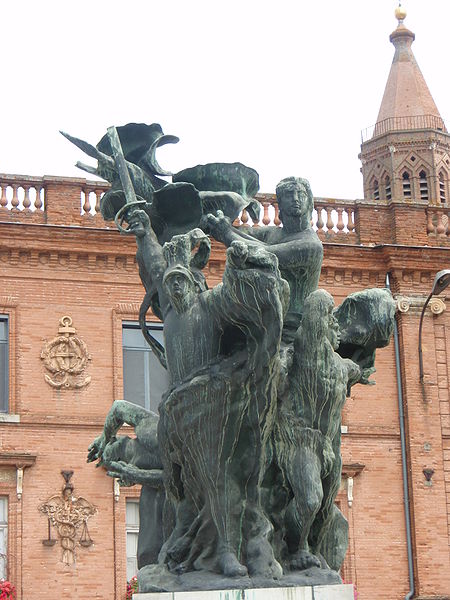
The monument contains figures with outstretched arms, tense hands, and pronounced muscular forms. These details contribute to the composition's representation of the physical and emotional consequences of war.
Its figures also demonstrate Bourdelle's interest in using individual anatomical details as part of a larger expressive structure. The spread fingers of the warriors and the sharply defined movements of their bodies became characteristic elements of his monumental sculpture.
Developing an Independent Sculptural Style
Between 1900 and 1909, Antoine Bourdelle increasingly moved away from the modeling techniques associated with Auguste Rodin. He began emphasizing simplified outlines, geometric construction, and the arrangement of sculptural masses.
Ancient Greek sculpture provided an important source of inspiration. Bourdelle studied the clarity of archaic figures, the solidity of classical forms, and the structural relationships between different parts of the body.
He also drew upon Romanesque sculpture and the architectural traditions of the Middle Ages. His work incorporated frontal arrangements, compact volumes, and forms designed to remain visually coherent when viewed from a distance.
In developing these methods, he retained an interest in emotional expression. His sculptures frequently represented physical effort, confrontation, reflection, and spiritual experience.
Works associated with this transition include Head of Apollo, Penelope, and a series of sculptures depicting Beethoven.
In 1905, he held his first solo exhibition at the Paris gallery of art founder Adrien Hébrard. The exhibition presented his independent work to collectors and a wider artistic audience.
Beethoven Sculptures and Portrait Busts
Antoine Bourdelle maintained a lifelong interest in the German composer Ludwig van Beethoven. He produced numerous busts, heads, drawings, and sculptural studies inspired by the composer's appearance and music.
His Beethoven sculptures did not represent a single fixed portrait. He repeatedly returned to the composer's features, experimenting with different expressions, head positions, and surface treatments.
Among these works were Beethoven Leaning, Beethoven in the Wind, and variations showing Beethoven with his hands or head in different positions.
The composer's prominent facial features, furrowed brow, and strongly defined chin provided Bourdelle with forms through which he explored psychological tension.
In several versions, Beethoven appears with his head lowered or turned, suggesting concentration or emotional struggle. Other compositions place the figure in a more monumental position, combining portraiture with symbolic elements.
Bourdelle's work on Beethoven continued for decades. His studies included sculptural busts and drawings that examined the relationship between facial expression and the artistic identity of the composer.
He also produced portrait sculptures of artists and intellectuals, including Jean-Auguste-Dominique Ingres, Auguste Rodin, and Anatole France. These portraits emphasized recognizable features while exploring the character of the subjects.
Herakles the Archer
In 1909, Antoine Bourdelle completed Herakles the Archer, also known by its French title Héraklès archer. The sculpture depicts the mythological Greek hero Herakles drawing a bow.
The work represents a moment of concentrated physical effort. Herakles is shown stretching his body across a rocky support, with one arm pulling the bowstring and the other extended forward.
Bourdelle developed the composition through the study of human anatomy and geometric relationships. The figure's limbs create a network of strong diagonal lines, while the tension of the body is concentrated around the action of drawing the bow.
Unlike the softer, irregular modeling associated with Rodin, the sculpture uses clearly defined masses and a more structured arrangement of the body.
Its subject is associated with the Greek myth of Herakles and the Stymphalian birds, one of the tasks included among the hero's Twelve Labors.
The bronze version was exhibited at the Salon de la Société Nationale des Beaux-Arts in 1910 and received substantial critical attention. The work brought Bourdelle wider recognition and contributed to the growing international demand for his sculptures.
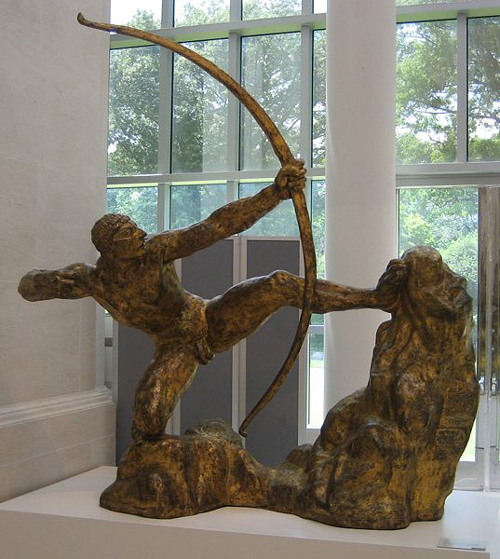
The sculpture was subsequently produced in several authorized versions and became part of museum and private collections in different countries.
Its treatment of movement, balance, and simplified anatomical forms illustrates Bourdelle's growing interest in the relationship between sculpture and architectural structure.
Teaching at the Académie de la Grande Chaumière
In 1909, after ending his professional association with Rodin, Antoine Bourdelle began teaching at the Académie de la Grande Chaumière in Paris. The private art academy had been established in 1902 and attracted students from France and abroad.
Bourdelle taught sculpture, drawing, and the study of the human figure. He also provided instruction in his own workshops.
His teaching emphasized the construction of forms, the relationship between sculpture and architecture, and the importance of drawing before beginning work in three dimensions.
He encouraged students to approach the human body through its underlying structure rather than concentrating exclusively on the external surface.
Among the artists who studied with him were Alberto Giacometti, Germaine Richier, and Maria Helena Vieira da Silva. His teaching also reached artists associated with different forms of modern sculpture and painting.
Henri Matisse, Aristide Maillol, René Iché, and Étienne Hajdu were among the artists associated with the broader artistic environment in which Bourdelle worked or with his teaching tradition, although their individual relationships with him differed.
Alberto Giacometti attended Bourdelle's classes at the Académie de la Grande Chaumière during the 1920s. Germaine Richier also studied under him before developing an independent sculptural career.
Bourdelle remained involved in art education for approximately twenty years. According to the Musée Bourdelle, he taught more than five hundred students from different parts of the world.
Drawing as the Foundation of Sculpture
For Antoine Bourdelle, drawing was an essential part of sculptural practice. He considered preliminary sketches necessary for understanding the structure, proportions, and movement of a figure before producing a sculpture.
He prepared numerous studies in pencil, charcoal, ink, watercolor, and pastel. Some were intended as independent works, while others were used to develop monuments, portraits, and architectural decorations.
His drawings included studies of Isadora Duncan, the American dancer whose movements influenced his representations of the human body.
He also produced drawings connected with the Théâtre des Champs-Élysées, sculptures of Beethoven, religious and mythological subjects, and architectural studies.
Among his subjects were representations of Reims Cathedral during the First World War, when the building suffered serious damage.
The Musée Bourdelle in Paris preserves approximately 6,350 drawings and works on paper associated with the artist. The collection includes studies made during his youth and works produced during the final years of his life.
Bourdelle frequently connected drawing with three-dimensional construction. His approach treated the outline, proportions, and internal organization of a sculpture as elements that could first be understood through drawing.
"Sculpture, in the end, is nothing other than drawing in every direction."
This principle formed part of his teaching and appeared in the methods he used to prepare large sculptures and monuments.
Théâtre des Champs-Élysées
Between 1910 and 1913, Antoine Bourdelle worked on the sculptural decoration of the Théâtre des Champs-Élysées in Paris.
The theater was designed by architect Auguste Perret, with contributions from several artists and designers. Bourdelle participated in architectural studies and created sculptural reliefs for the façade, along with frescoes for the interior.
His decorations included figures associated with dance, music, and theatrical performance. Their simplified shapes and carefully arranged movements were designed to function as part of the building's architecture.
The American dancer Isadora Duncan was among the performers whose movements interested Bourdelle. He studied her dance poses and developed drawings and sculptural forms inspired by them.
The theater's façade includes marble reliefs arranged within the architectural structure. Rather than treating the sculptures as separate objects, Bourdelle designed them in relation to the building's proportions and surfaces.
The Théâtre des Champs-Élysées opened in 1913. Bourdelle's contributions formed part of the building's decorative program, which brought together architecture, sculpture, and painting.
International Recognition and Exhibitions
During the 1910s and 1920s, Antoine Bourdelle's work was increasingly exhibited and collected outside France.
His sculptures were acquired by museums and collectors in cities including Rome, Stockholm, Bucharest, and Brussels.
He participated in the 1913 International Exhibition of Modern Art in New York, commonly known as the Armory Show. The exhibition introduced American audiences to numerous European modern artists.
In 1914, thirty of his works were exhibited at the Venice Biennale. His participation helped bring his sculptures to audiences outside France.
Writers and intellectuals including Anatole France and Andre Gide expressed interest in his artistic work.
Although some of his students later adopted experimental or avant-garde approaches, Bourdelle continued to work with forms drawn from classical antiquity, Romanesque art, and Renaissance sculpture.
His interest in historical sculpture was accompanied by attempts to simplify and reconstruct traditional forms rather than reproduce them without modification.
Monument to General Alvear
In 1913, the Argentine government commissioned Antoine Bourdelle to create the Monument to General Alvear in Buenos Aires.
The monument commemorates Carlos María de Alvear, a military and political leader associated with Argentina's independence.
Bourdelle developed the design through numerous drawings and sculptural studies. The central figure depicts General Alvear mounted on a horse, positioned above a large pedestal.
Four allegorical figures represent Victory, Strength, Eloquence, and Liberty. Each figure incorporates attributes associated with the quality it symbolizes.
The composition combines an equestrian statue with monumental standing figures. Its design draws upon the tradition of Renaissance equestrian sculpture, including works associated with Donatello and Andrea del Verrocchio.
Bourdelle prepared different versions of the allegorical figures before settling on the final arrangement. Their simplified shapes and vertical proportions were intended to remain legible within the large monument.
The monument was inaugurated in 1926 in the Recoleta district of Buenos Aires, Argentina.
Monument to Adam Mickiewicz
In 1908, Antoine Bourdelle traveled to Poland. During this period, he became involved in a project to commemorate the Polish poet Adam Mickiewicz.
The commission developed into the Monument to Adam Mickiewicz, a large sculptural work intended for Paris.
Its design incorporated the standing figure of the poet and symbolic elements associated with Polish national identity and historical struggle.
Bourdelle worked on the project over many years, preparing drawings, models, and different sculptural components.
The monument was inaugurated in Paris in 1929, during the final year of Bourdelle's life. It was originally installed at Place de l'Alma.
The project formed part of his series of public monuments in which historical individuals were represented alongside symbolic figures and architectural elements.
Other Monumental Sculptures
Antoine Bourdelle continued producing large-scale sculptures during the final decades of his career.
Among these works was The Dying Centaur, completed around 1914. The sculpture depicts a centaur in a state of physical exhaustion and death.
The work draws upon ancient Greek mythology, combining the human and animal forms of the centaur. Its compact structure and simplified surfaces differ from the more fluid modeling associated with Bourdelle's early sculptures.
Another project, The Virgin of the Offering, was created between 1919 and 1923 for Niederbruck in Alsace. The sculpture combines a religious subject with the monumental forms characteristic of his later work.
His sculpture La France, completed in the 1920s, presents an allegorical female figure associated with the French nation. The work was connected with public commissions following the First World War.
In these sculptures, Bourdelle used subjects associated with history, religion, mythology, and national identity while emphasizing simplified forms and the relationship between sculpture and architecture.
Artistic Style and Sculptural Technique
Antoine Bourdelle's artistic style changed substantially during his career. His early sculptures were influenced by the expressive modeling and irregular surfaces used by Auguste Rodin. Later works placed greater emphasis on structural clarity, geometric relationships, and monumental proportions.
He studied ancient Greek sculpture, particularly its archaic forms, and incorporated elements of Romanesque and Gothic art.
His approach to the human figure often began with the organization of the body into clearly defined masses. Limbs, torsos, and heads were arranged according to geometric relationships that helped establish balance and movement.
He encouraged his students to think about sculptural forms in a manner similar to a geometer, examining how each part related to the structure of the whole.
Small details remained significant within these compositions. The spread fingers of a warrior in the Montauban monument, for example, contribute to the figure's expression of tension. Similarly, the strongly modeled chin and brow in his Beethoven portraits reinforce the subject's psychological character.
Bourdelle drew upon different historical artistic traditions without consistently adopting a single style. The Virgin of Alsace includes elements associated with Gothic sculpture, while The Dying Centaur reflects his study of ancient Greek forms. The Monument to General Alvear incorporates features of Renaissance equestrian sculpture.
His work also included paintings and drawings. The frescoes and bas-reliefs he created for the Théâtre des Champs-Élysées demonstrate his interest in integrating figurative art into an architectural setting.
Although his forms became increasingly simplified, Bourdelle generally retained recognizable human and mythological figures rather than moving toward complete abstraction.
Salon des Tuileries and Official Recognition
Antoine Bourdelle was involved in the establishment of the Salon des Tuileries, an exhibition organization in Paris. He served as one of its founding members and vice-presidents.
The Salon provided opportunities for artists to exhibit works outside some of the established academic exhibition systems.
His growing professional recognition was also reflected in honors awarded by the French government.
He was appointed a Knight of the Legion of Honour in 1909 and promoted to Officer in 1919.
In 1924, he received the rank of Commander of the Legion of Honour, one of France's national distinctions.
During the 1920s, exhibitions devoted to his sculptures were organized in different European cities. A retrospective held in Brussels in 1928 presented more than two hundred works.
Personal Life and Family
Antoine Bourdelle's personal life was closely connected with the artists and students who worked in his Paris studios.
During the 1890s, he had a relationship with Marie Laprade, who appeared in several of his drawings, paintings, and sculptural studies.
He later formed a relationship with Stéphanie Van Parys. Their son, Pierre Bourdelle, was born in 1901. The couple married in 1904, with Auguste Rodin serving as a witness at the wedding.
Pierre Bourdelle later became a painter and sculptor and pursued part of his professional career in the United States.
In the early twentieth century, Bourdelle met Cléopâtre Sevastos, a Greek art student who came to Paris to study sculpture. She had received artistic training in Greece before joining his professional circle.
Cléopâtre became one of his models and was associated with several of his drawings and sculptures.
Their daughter, Rhodia Bourdelle, was born in Greece on April 10, 1911. Bourdelle and Cléopâtre married in 1912, following the end of his marriage to Stéphanie Van Parys.
Rhodia later married designer Michel Dufet and became known as Rhodia Dufet-Bourdelle.
After the sculptor's death, Cléopâtre and Rhodia worked to preserve his studios, sculptures, drawings, and archives. Their efforts contributed to the establishment of the Musée Bourdelle in Paris.
Final Illness and Death
In May 1929, Antoine Bourdelle visited the home of his friend Eugène Rudier, a bronze founder who lived in Le Vésinet, west of Paris.
During the visit, he became seriously ill and was confined to bed. His condition improved somewhat during the summer, but his health deteriorated again toward the end of September.
Antoine Bourdelle died on October 1, 1929, in Le Vésinet, France. He was 67 years old.
His death occurred several months after the inauguration of the Monument to Adam Mickiewicz in Paris.
He was buried in the Montparnasse Cemetery in Paris.
Musée Bourdelle
The Musée Bourdelle was established in Paris in 1949, twenty years after Antoine Bourdelle's death.
The museum occupies the studios and buildings where he worked for more than four decades, beginning in 1885.
His widow, Cléopâtre Sevastos, and daughter, Rhodia Dufet-Bourdelle, helped preserve his works and personal archives. Their contributions made it possible to establish a museum containing sculptures, models, drawings, paintings, photographs, and documents associated with his career.
The museum's collections include plaster models, bronze sculptures, marble works, and thousands of drawings. Some sections of the original studios have been preserved to document the environment in which the artist worked.
Additional museum spaces were opened in 1961 and 1992, expanding the exhibition areas and providing facilities for displaying large sculptures.
The Musée-Jardin Bourdelle in Égreville, Seine-et-Marne, was developed through the efforts of Rhodia Dufet-Bourdelle and her husband Michel Dufet. The sculpture garden contains works installed within a landscaped setting and opened to the public as a departmental museum in 2005.
Major Sculptures and Artistic Works
1885 - The First Victory of Hannibal (La Première victoire d'Hannibal)1890s–1920s - Beethoven Busts and Heads (Series of sculptures and studies)
1895–1902 - Monument to the Combatants and Defenders of Tarn-et-Garonne (Montauban, France)
1900–1909 - Head of Apollo (Tête d'Apollon)
1902–1911 - The Fruit (Le Fruit)
1903 - Beethoven Leaning (Beethoven accoudé)
1905–1912 - Penelope (Pénélope)
1909 - Herakles the Archer (Héraklès archer)
1910–1913 - Théâtre des Champs-Élysées Sculptures and Frescoes (Paris, France)
1911–1914 - The Dying Centaur (Centaure mourant)
1909–1929 - Monument to Adam Mickiewicz (Paris, France)
1913–1926 - Monument to General Alvear (Buenos Aires, Argentina)
1919–1923 - The Virgin of the Offering (Vierge à l'offrande, Niederbruck, Alsace)
1923–1925 - La France (Monumental sculpture)
Museums and Sculpture Gardens Displaying His Works
Musée Bourdelle - Paris, FranceMusée Ingres Bourdelle - Montauban, Tarn-et-Garonne, France
Musée-Jardin Bourdelle - Égreville, Seine-et-Marne, France
Aichi Prefectural Museum of Art - Nagoya, Japan
Courtauld Gallery - London, England
Legion of Honor Museum - San Francisco, California, United States
Galleria Nazionale d'Arte Moderna e Contemporanea - Rome, Italy
State Hermitage Museum - Saint Petersburg, Russia
Hirshhorn Museum and Sculpture Garden - Washington, D.C., United States
Kimbell Art Museum - Fort Worth, Texas, United States
Royal Museums of Fine Arts of Belgium - Brussels, Belgium
Kröller-Müller Museum - Otterlo, Netherlands
Minneapolis Sculpture Garden - Minneapolis, Minnesota, United States
Museo Nacional de Bellas Artes - Buenos Aires, Argentina
National Galleries of Scotland - Edinburgh, Scotland
National Gallery of Australia - Canberra, Australia
Source: Biyografiler.com
Frequently asked questions about Antoine Bourdelle
Who is Antoine Bourdelle?, Antoine Bourdelle biography, Antoine Bourdelle life story, Antoine Bourdelle age, Antoine Bourdelle facts, Antoine Bourdelle birthplace, Antoine Bourdelle photos, Antoine Bourdelle videos, Antoine Bourdelle career

Lamine Yamal
Professional footballer

Kylian Mbappe
Professional footballer

Keanu Reeves
Actor

Erling Haaland
Professional footballer

Brad Pitt
Actor

Leonardo DiCaprio
Actor

Anton Dvorak
Composer

Antoine Lavoisier
Chemist

Antoine Bourdelle
Sculptor

Anthony van Dyck
Painter

Anthony Stewart Head
Actor, Singer

Antoni Gaudi
Architect

Gadi Eisenkot
Politician, Military Commander

Susie Wiles
Political Consultant

Alberto Ascari
Formula 1 Driver

Elizabeth Taylor
Actress

Michael Jordan
Professional Basketball Player

Ann-Margret
Actress, Singer