
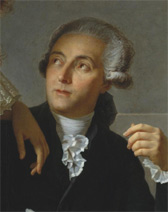
Antoine Lavoisier
The foundations of modern chemistry, the law of conservation of mass, the oxygen theory of combustion, and the reform of chemical nomenclature.
Born on August 26, 1743
Died on May 8, 1794
Age at death: 51
Profession: Chemist
Place of Birth: Paris, France
Place of Death: Paris, France
Antoine Lavoisier, full name Antoine-Laurent de Lavoisier, was born on August 26, 1743, in Paris, France. He was a French chemist widely regarded as one of the founders of modern chemistry. Through carefully measured experiments, he demonstrated the role of oxygen in combustion, helped establish the law of conservation of mass, and contributed to the development of modern chemical nomenclature. His work challenged the phlogiston theory, which had previously been used to explain combustion. In 1789, he published Traité Élémentaire de Chimie (Elements of Chemistry), one of the earliest systematic textbooks of modern chemistry. He was executed during the French Revolution on May 8, 1794, at the age of 50.
Early Life and Education
Antoine Lavoisier was born into a wealthy family in Paris. His father, Jean-Antoine Lavoisier, was a lawyer, and his mother, Émilie Punctis, died when he was five years old. He was raised with the support of his father and maternal relatives.
He studied at the Collège Mazarin, where he received an education in mathematics, astronomy, natural sciences, and the humanities. Following his father's wishes, he studied law and obtained his legal qualification in 1764. However, his principal interest was scientific research, particularly chemistry.
He attended chemistry lectures given by Guillaume-François Rouelle at the Jardin du Roi in Paris. He also studied geology and mineralogy under Jean-Étienne Guettard. Together with Guettard, he participated in geological surveys of France, collecting mineral and water samples for analysis.
Early Scientific Career
Antoine Lavoisier began publishing scientific research during the 1760s. In 1766, the French Academy of Sciences awarded him a gold medal for a study proposing improvements to street lighting in Paris.
In 1768, at the age of 25, he was elected to the French Academy of Sciences. His work included chemistry, mineralogy, public lighting, and practical scientific problems.
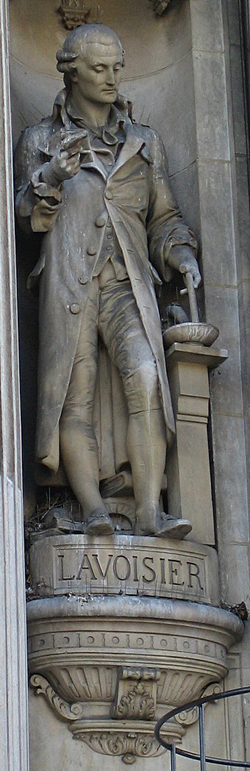
In 1775, he joined the Royal Gunpowder and Saltpeter Administration, where he helped improve gunpowder production. His work was particularly relevant during the American Revolutionary War, when France supplied military materials to the American colonies.
He also participated in government commissions concerned with agriculture, public administration, and the standardization of measurements. During the late 1780s and early 1790s, he contributed to scientific efforts that helped establish the metric system.
The Discovery of Oxygen's Role in Combustion
One of Antoine Lavoisier's principal scientific achievements was his explanation of combustion. During the eighteenth century, many chemists accepted the Phlogiston Theory, which claimed that burning materials released an invisible substance called phlogiston.
Lavoisier questioned this explanation through experiments involving metals, phosphorus, sulfur, and gases. By carefully weighing substances before and after chemical reactions, he demonstrated that combustion involved the combination of materials with a component of air.
British chemist Joseph Priestley had isolated oxygen in 1774, while Swedish chemist Carl Wilhelm Scheele had independently obtained the gas earlier. Lavoisier recognized its role in combustion and helped establish the name oxygen.
His research demonstrated that burning was not the release of phlogiston but a chemical reaction involving oxygen. He also investigated respiration and showed that it involved processes related to combustion.
The Law of Conservation of Mass
Antoine Lavoisier used accurate balances and controlled experiments to investigate chemical transformations. His measurements helped establish the principle known as the Law of Conservation of Mass.
According to this principle, matter is neither created nor destroyed during an ordinary chemical reaction. The total mass of the substances before the reaction equals the total mass afterward, provided that all reacting materials and products are accounted for.
Lavoisier demonstrated this relationship through experiments conducted in closed containers, carefully measuring both the original substances and the resulting products.
He also helped establish the chemical nature of water by demonstrating that it was composed of hydrogen and oxygen rather than being a fundamental element.
Elements and Modern Chemical Nomenclature
Antoine Lavoisier contributed to the reform of chemical terminology. In 1787, he worked with Louis-Bernard Guyton de Morveau, Claude Louis Berthollet, and Antoine François de Fourcroy to develop a systematic method of naming chemical substances.
The resulting work, Méthode de Nomenclature Chimique, introduced naming principles that influenced modern chemical terminology.
Lavoisier distinguished chemical elements from compounds and helped establish a classification based on experimental evidence. He identified oxygen and hydrogen as elements and included substances such as carbon and sulfur in his classification.
Although he contributed to the identification and classification of elements, he did not personally discover oxygen, carbon, or silicon. His principal contribution was the development of a more systematic experimental understanding of chemical substances and their reactions.
Elements of Chemistry
In 1789, Antoine Lavoisier published Traité Élémentaire de Chimie (Elements of Chemistry), a textbook presenting his experimental findings and chemical theories.
The book explained combustion, the role of gases in chemical reactions, the conservation of mass, and the classification of chemical substances. It also included a list of substances then considered elements, reflecting the scientific knowledge of the period.
The publication helped introduce the new chemical nomenclature and Lavoisier's experimental approach to a wider scientific audience.
Marriage and Scientific Collaboration
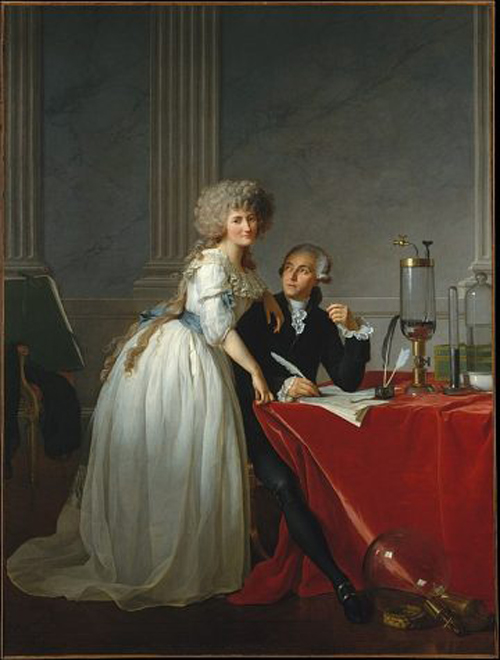
On December 16, 1771, Antoine Lavoisier married Marie-Anne Pierrette Paulze, the daughter of a prominent tax administrator. Marie-Anne was fourteen years old at the time of their marriage. The couple had no children.
Marie-Anne became an active collaborator in her husband's scientific research. She learned chemistry, recorded experimental observations, translated scientific papers from English into French, and prepared illustrations of laboratory equipment.
She also assisted in organizing scientific publications and correspondence. Her drawings were used in Lavoisier's published research, including his 1789 chemistry textbook.
The French Revolution and Execution
Alongside his scientific activities, Antoine Lavoisier had invested in the Ferme Générale, a private organization responsible for collecting certain taxes on behalf of the French monarchy.
Following the French Revolution of 1789, the organization's financial activities became the subject of political investigations. Former tax collectors were accused of financial misconduct and abuses associated with the old monarchy.
In December 1793, Lavoisier was arrested with other members of the Ferme Générale. He was later brought before the Revolutionary Tribunal in Paris.
On May 8, 1794, he was convicted and sentenced to death alongside other former tax administrators. He was executed by guillotine the same day, at the age of 50.
Following his execution, mathematician Joseph-Louis Lagrange was reported to have made the following observation:
"It took them only an instant to cut off that head, and a hundred years may not produce another like it."
The French authorities subsequently reviewed the proceedings against the former tax collectors. In 1795, Lavoisier's condemnation was repudiated, and his widow later recovered confiscated property and scientific materials.
Principal Scientific Publications
1787 - Méthode de Nomenclature Chimique (Method of Chemical Nomenclature, with other chemists)1789 - Traité Élémentaire de Chimie (Elements of Chemistry)
1805 - Mémoires de Chimie (Posthumously published scientific writings)
Source: Biyografiler.com
Frequently asked questions about Antoine Lavoisier
Who is Antoine Lavoisier?, Antoine Lavoisier biography, Antoine Lavoisier life story, Antoine Lavoisier age, Antoine Lavoisier facts, Antoine Lavoisier birthplace, Antoine Lavoisier photos, Antoine Lavoisier videos, Antoine Lavoisier career

Lamine Yamal
Professional footballer

Kylian Mbappe
Professional footballer

Keanu Reeves
Actor

Erling Haaland
Professional footballer

Brad Pitt
Actor

Leonardo DiCaprio
Actor

Anton Dvorak
Composer

Antoine Lavoisier
Chemist

Antoine Bourdelle
Sculptor

Anthony van Dyck
Painter

Anthony Stewart Head
Actor, Singer

Antoni Gaudi
Architect

Gadi Eisenkot
Politician, Military Commander

Susie Wiles
Political Consultant

Alberto Ascari
Formula 1 Driver

Elizabeth Taylor
Actress

Michael Jordan
Professional Basketball Player

Ann-Margret
Actress, Singer