
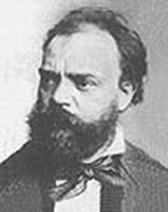
Anton Dvorak
Czech composer known for his New World Symphony, Slavonic Dances, and the opera Rusalka.
Born on September 8, 1841
Died on May 1, 1904
Age at death: 63
Profession: Composer
Place of Birth: Nelahozeves, Bohemia, Austrian Empire (present-day Czech Republic)
Place of Death: Prague, Austria-Hungary (present-day Czech Republic)
Antonín Dvořák, full name Antonín Leopold Dvořák, was born on September 8, 1841, in Nelahozeves, Bohemia, then part of the Austrian Empire. He was a Czech composer, conductor, and music educator associated with the Romantic period. His compositions incorporated elements of Czech and other Slavic folk music into symphonies, operas, chamber music, and choral works. Among his best-known compositions are Symphony No. 9, From the New World, Slavonic Dances, Stabat Mater, the Cello Concerto in B Minor, and the opera Rusalka. He taught at the Prague Conservatory and served as director of the National Conservatory of Music in New York between 1892 and 1895.
Early Life and Musical Education
Antonín Dvořák was born on September 8, 1841, in Nelahozeves, a village near Prague. His father, František Dvořák, worked as a butcher and innkeeper and played the zither. His mother was Anna Dvořáková, née Zdeňková. Antonín was the eldest of nine children.
He received his first music lessons from village teacher Josef Spitz, learning to play the violin. During childhood, he participated in local musical activities and developed an interest in traditional Bohemian melodies and dances.
In 1857, he entered the Prague Organ School, where he studied music theory, organ, and composition. He completed his education in 1859, supporting himself partly through musical performances and private lessons.
Beginning of His Professional Career
After completing his studies, Antonín Dvořák worked as a violist in the orchestra conducted by Karel Komzák. In 1862, the ensemble became part of Prague's Provisional Theatre orchestra, where Dvořák continued performing until 1871.
During these years, he gained experience with orchestral instruments and musical arrangements. He also worked under conductor and composer Bedřich Smetana and encountered works by Richard Wagner. Alongside his orchestral duties, he began composing symphonies, chamber music, songs, and operas.
In 1873, he achieved his first substantial public success with the patriotic cantata The Heirs of the White Mountain, also known as Hymnus. Its performance by a large choir brought his compositions to the attention of audiences in Prague.
Recognition and Collaboration with Johannes Brahms
During the 1870s, Antonín Dvořák received financial support through an Austrian state scholarship intended for talented artists with limited financial resources.
Composer Johannes Brahms, who served on the scholarship committee, recognized Dvořák's abilities and recommended his music to publisher Fritz Simrock. The publisher subsequently issued several of his compositions.
The Slavonic Dances, first published in 1878, helped establish Dvořák's reputation outside Bohemia. Inspired by Slavic dance rhythms, the compositions were initially written for piano four hands and later orchestrated.
He continued composing chamber music, symphonies, vocal works, and orchestral pieces, including the Slavonic Rhapsodies, Gypsy Songs, and Scherzo Capriccioso.
Stabat Mater and Success in England
Antonín Dvořák composed the religious choral work Stabat Mater between 1876 and 1877. The composition was influenced by personal tragedy, including the deaths of his young children.
The work received an enthusiastic reception when performed in London in 1883. In March 1884, Dvořák traveled to England and conducted the composition at the Royal Albert Hall.
He subsequently made several visits to Britain, conducting his own compositions and receiving commissions for new works. His British performances included Saint Ludmila, The Spectre's Bride, and Requiem.
In 1891, the University of Cambridge awarded him an honorary doctorate in music. He also received an honorary degree from the Czech University in Prague.
Prague Conservatory and American Years
In 1891, Antonín Dvořák began teaching composition at the Prague Conservatory. The following year, he accepted an invitation from Jeannette Thurber to become director of the National Conservatory of Music of America in New York.
He moved to the United States in 1892 and remained there until 1895. During his American years, he studied African American spirituals and became interested in Indigenous American musical traditions.
In 1893, he composed Symphony No. 9 in E Minor, From the New World. The work was influenced by his experiences in America and his interest in American musical traditions. It premiered at Carnegie Hall in New York on December 16, 1893, conducted by Anton Seidl.
Dvořák also composed the American String Quartet and the String Quintet in E-flat Major during his stay. His interest in the American poet Henry Wadsworth Longfellow and the poem The Song of Hiawatha influenced aspects of his musical imagination during this period.
He returned to Bohemia in 1895, partly because of homesickness and financial difficulties affecting the American conservatory.
Final Years in Prague
After returning from America, Antonín Dvořák resumed teaching at the Prague Conservatory. In 1901, he became its director.
During his later years, he concentrated increasingly on symphonic poems and operas. His compositions from this period included The Water Goblin, The Noon Witch, The Golden Spinning Wheel, and The Wild Dove.
He also composed the operas The Devil and Kate (1899), Rusalka (1900), and Armida (1903). Rusalka, which premiered in Prague in 1901, became one of his most frequently performed operas.
Dvořák received several honors during his lifetime, including the Austrian Order of the Iron Crown and the honorary distinction Litteris et Artibus. In 1896, he conducted the inaugural concert of the Czech Philharmonic.
Personal Life and Death
Antonín Dvořák married singer Anna Čermáková on November 17, 1873. Anna played the piano and occasionally performed her husband's compositions. The couple had nine children, three of whom died during childhood.
In 1904, Dvořák experienced serious health problems following the premiere of his opera Armida. He suffered from kidney-related illness and influenza, which required an extended period of bed rest.
Antonín Dvořák died on May 1, 1904, at his home in Prague, at the age of 62. He was buried in the Vyšehrad Cemetery in Prague.
Major Musical Works
1873 - The Heirs of the White Mountain (Hymnus, Cantata)1874 - The King and the Charcoal Burner (Opera)
1874 - The Stubborn Lovers (Opera)
1875 - Vanda (Opera)
1876 - Moravian Duets (Vocal Duets)
1876–1877 - Stabat Mater (Sacred Cantata)
1877 - The Cunning Peasant (Opera)
1878 - Slavonic Dances, Op. 46 (Orchestral Dances)
1878 - Slavonic Rhapsodies (Orchestral Works)
1879 - Violin Concerto in A Minor (Concerto)
1880 - Gypsy Songs (Song Cycle)
1882 - Dimitrij (Opera)
1883 - Scherzo Capriccioso (Orchestral Work)
1885 - Saint Ludmila (Oratorio)
1886 - Slavonic Dances, Op. 72 (Orchestral Dances)
1888 - The Jacobin (Opera)
1890 - Requiem (Sacred Work)
1891 - Othello Overture (Concert Overture)
1893 - Symphony No. 9, From the New World (Symphony)
1893 - String Quartet No. 12, American (Chamber Music)
1894 - Humoresques (Piano Pieces)
1895 - Cello Concerto in B Minor (Concerto)
1899 - The Devil and Kate (Opera)
1900 - Rusalka (Opera)
1903 - Armida (Opera)
Source: Biyografiler.com
Frequently asked questions about Anton Dvorak
Who is Anton Dvorak?, Anton Dvorak biography, Anton Dvorak life story, Anton Dvorak age, Anton Dvorak facts, Anton Dvorak birthplace, Anton Dvorak photos, Anton Dvorak videos, Anton Dvorak career

Lamine Yamal
Professional footballer

Kylian Mbappe
Professional footballer

Keanu Reeves
Actor

Erling Haaland
Professional footballer

Brad Pitt
Actor

Leonardo DiCaprio
Actor

Anton Dvorak
Composer

Antoine Lavoisier
Chemist

Antoine Bourdelle
Sculptor

Anthony van Dyck
Painter

Anthony Stewart Head
Actor, Singer

Antoni Gaudi
Architect

Gadi Eisenkot
Politician, Military Commander

Susie Wiles
Political Consultant

Alberto Ascari
Formula 1 Driver

Elizabeth Taylor
Actress

Michael Jordan
Professional Basketball Player

Ann-Margret
Actress, Singer