
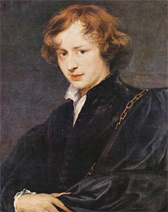
Anthony van Dyck
Court painter to King Charles I of England, Flemish Baroque portraiture, and the development of English aristocratic portrait painting.
Born on March 22, 1599
Died on December 9, 1641
Age at death: 42
Profession: Painter
Place of Birth: Antwerp, Spanish Netherlands (present-day Belgium)
Place of Death: London, England
Anthony van Dyck, also known as Sir Anthony van Dyck, was born on March 22, 1599, in Antwerp, then part of the Spanish Netherlands and now located in Belgium. He was a Flemish Baroque painter who worked in Antwerp, Italy, and England. Trained in the artistic environment of Peter Paul Rubens, he developed a portrait style characterized by elongated figures, fluid brushwork, carefully rendered fabrics, and restrained facial expressions. In 1632, he became court painter to King Charles I of England and received a knighthood. His portraits of the English royal family and aristocracy influenced later British painters, including Joshua Reynolds and Thomas Gainsborough. He also produced religious and mythological paintings, drawings, and prints. A dark brown pigment known as Van Dyck brown bears his name.
Early Life and Family Background
Anthony van Dyck was born on March 22, 1599, in Antwerp, one of the principal commercial and artistic centers of the Spanish Netherlands. The city is now part of Belgium. His father, Frans van Dyck, was a prosperous merchant involved in the silk and textile trade, while his mother was Maria Cuypers.
He grew up in a large merchant family and demonstrated an interest in drawing and painting during childhood. Antwerp had an established tradition of painting, printmaking, and decorative arts, and its churches and wealthy merchants provided commissions for artists.
In 1609, at approximately ten years old, he entered the workshop of Hendrick van Balen, a painter known for religious, mythological, and historical subjects. He studied with Van Balen during the early years of his artistic development.
Van Dyck's training included drawing, preparing materials, composing figures, and learning the methods used in Flemish painting workshops. His early education provided a foundation for both religious compositions and portrait painting.
Artistic Training and Collaboration with Peter Paul Rubens
By his teenage years, Anthony van Dyck had begun producing independent paintings. One of his earliest dated works, Portrait of an Old Man, dates from 1613. His early portraits already demonstrated careful observation of facial features and the effects of light on skin and clothing.
He subsequently became associated with the Antwerp workshop of Peter Paul Rubens, who was then working on major religious, mythological, and aristocratic commissions.
Rubens employed a workshop system in which assistants participated in preparing large paintings, transferring compositions, and completing different sections of commissioned works. Van Dyck worked within this environment while developing his own projects.
In 1618, he was registered as an independent master in Antwerp's Guild of Saint Luke. His admission recognized his professional standing as a painter while he was still a young man.
During this period, Van Dyck adopted elements of Rubens's painting technique, including broad brushstrokes, energetic compositions, and strong contrasts between light and shadow. He also studied the representation of human anatomy, movement, and richly colored fabrics.
Like Rubens, he painted religious and mythological subjects drawn from Christian scripture and classical literature. Among his early works were The Crowning with Thorns and The Taking of Christ, both associated with the development of his religious painting.
Van Dyck worked in the same artistic circles as Jacob Jordaens, another Flemish painter associated with the Baroque tradition in Antwerp. Their careers developed within the city's network of artists, workshops, collectors, and church patrons.
Although Rubens remained an important influence, Van Dyck gradually developed a different approach to portraiture. His figures became more slender, his compositions less crowded, and his treatment of clothing and gestures increasingly restrained.
First Visit to England
In 1620, Anthony van Dyck traveled to England, where he entered the service of King James I of England. His journey brought him into contact with English court patrons and collectors.
Among the figures associated with his introduction to English artistic circles was Thomas Howard, 14th Earl of Arundel, a collector with an extensive interest in European painting and classical art.
Through these court connections, Van Dyck encountered works from Italian painting traditions, particularly Venetian art. His interest in Titian and other Venetian painters would become increasingly important during his subsequent travels.
His first stay in England lasted only a few months. He returned to the Spanish Netherlands before undertaking a longer journey to Italy.
Although King Charles I had not yet succeeded to the English throne during this first visit, the contacts Van Dyck established helped prepare the way for his later appointment as a royal court painter.
Travels in Italy and the Influence of Venetian Painting
In 1621, Anthony van Dyck traveled to Italy, where he remained until 1627. He visited several artistic centers, including Genoa, Rome, Venice, and Florence.
Italian painting provided new sources for his study of portrait composition, color, and the representation of aristocratic status. He was particularly interested in the work of Titian, whose portraits combined individual likeness with formal presentation.
Van Dyck studied Venetian color techniques and developed a broader range of warm and cool tones. His paintings increasingly featured luminous fabrics, carefully controlled shadows, and figures placed within architectural or landscape settings.
During his time in Rome, he became acquainted with church officials, diplomats, and collectors. One of his patrons was Guido Bentivoglio, a cardinal and papal diplomat whose portrait Van Dyck painted in 1623.
The painting, Portrait of Cardinal Guido Bentivoglio, presents the cardinal seated in scarlet ecclesiastical robes. The folds of the fabric and the contrast between red tones create a detailed representation of the sitter's clothing and position.
The portrait is held by the Palazzo Pitti in Florence.
Portraits of the Genoese Aristocracy
Anthony van Dyck spent a substantial part of his Italian period in Genoa. The city's wealthy merchant and aristocratic families commissioned portraits to display their social position and family identity.
His patrons included members of the Spinola, Durazzo, Balbi, Cattaneo, and Brignole-Sale families. Van Dyck produced full-length portraits of men, women, and children belonging to these households.
In these paintings, figures were often shown standing or seated in spacious interiors, near architectural columns, curtains, or imposing furnishings. The compositions emphasized the subjects' rank through their clothing, posture, and surroundings.
Van Dyck frequently placed the horizon line relatively low, creating the impression that viewers were looking upward toward the figures. This arrangement made the subjects appear taller and gave additional visual weight to long garments and flowing fabrics.
His portraits of Genoese women often featured elaborate silk dresses, lace, jewelry, and carefully arranged drapery. The clothing was rendered with enough detail to distinguish different types of material while remaining integrated into the overall composition.
Works from this period include Marchesa Balbi, Marchesa Elena Grimaldi Cattaneo, Paolina Adorno, and portraits associated with the Brignole-Sale and Cattaneo families.
The portrait of Marchesa Elena Grimaldi Cattaneo presents its subject standing beneath a parasol held by a servant. The arrangement of the figures, architectural background, and costume establishes the Marchesa's position within Genoese society.
These commissions allowed Van Dyck to develop an approach to aristocratic portraiture that he later adapted for the English royal court.
Return to Antwerp
In 1627, Anthony van Dyck returned to Antwerp after approximately six years in Italy. He continued producing portraits while accepting religious commissions from churches and other institutions.
Between 1627 and 1632, he painted members of the Flemish aristocracy, merchants, fellow artists, and religious figures. His clientele included both established families and individuals connected with Antwerp's artistic community.
During this period, he returned to portrait formats associated with Flemish painting, including half-length figures against relatively simple backgrounds. His portraits often emphasized facial expression, the position of the hands, and carefully observed personal details.
He continued to use elements learned in Italy, particularly in the treatment of color and fabric, but adapted these methods to the preferences of Flemish patrons.
Van Dyck also produced large religious paintings for churches. His compositions included biblical scenes, representations of saints, and subjects associated with the Passion of Christ.
His religious paintings generally used softer emotional expressions and less crowded compositions than many works by Rubens. He employed light and gesture to direct attention toward the principal figures.
Printmaking and the Iconography Series
Alongside painting, Anthony van Dyck worked as a draftsman and etcher. He developed a project commonly known as Iconography, consisting of portraits of notable individuals from European political, intellectual, and artistic life.
The series included rulers, military commanders, scholars, collectors, and artists. Many of its subjects were people Van Dyck knew personally or encountered through his professional connections.
He prepared portrait drawings and etched some of the plates himself. Other prints were completed by professional engravers working from his designs.
The project circulated his portrait compositions beyond the original paintings and made images of his sitters available to a wider European audience.
Van Dyck traveled to Paris during his later career, seeking commissions and artistic opportunities. His work as a printmaker and his involvement in portrait engravings formed a separate part of his professional activity from his large-scale paintings.
Appointment as Court Painter to Charles I
In 1632, Anthony van Dyck returned to England at the invitation of King Charles I of England. The king was an art collector who commissioned portraits of himself, his family, and members of the royal court.
Van Dyck was appointed principal painter to the king and received a knighthood in 1632. He was also granted financial support and accommodation associated with his royal appointment.
He established a studio in the Blackfriars district of London and maintained access to the court. He also spent time at Eltham, where he was able to work away from the city.
The royal appointment provided regular commissions and brought Van Dyck into contact with English nobles, diplomats, and officials.
He painted numerous portraits of Charles I, Queen Henrietta Maria, their children, and members of the Stuart court. His work included full-length portraits, equestrian compositions, family groups, and more intimate studies.
Contemporary inventories and later catalogues record numerous royal portraits and versions produced by Van Dyck and his workshop. The precise number of autograph paintings remains a matter of attribution and catalogue research.
Portraits of King Charles I
The portraits of King Charles I of England occupy a substantial part of Anthony van Dyck's English career. The king commissioned both official representations and paintings intended for private or diplomatic use.
Van Dyck often portrayed Charles I in elongated proportions, with carefully arranged clothing and restrained gestures. Rather than relying exclusively on crowns, thrones, or other royal symbols, some compositions represented the king through his posture and surroundings.
One example is Charles I at the Hunt, also known as Le Roi à la chasse, now in the Louvre Museum in Paris. The painting depicts the king standing outdoors beside a white horse, dressed in an elegant hunting costume.
Charles I wears a broad-brimmed dark hat, a light-colored satin garment, and red breeches. His relaxed pose contrasts with the presence of attendants and the horse beside him.
The landscape, the relatively low viewpoint, and the carefully arranged figure contribute to the presentation of royal authority without the conventional setting of a throne room.
Van Dyck also painted Equestrian Portrait of Charles I, in which the king appears mounted on a horse and wearing armor. The painting presents the monarch within a composition associated with military command and royal power.
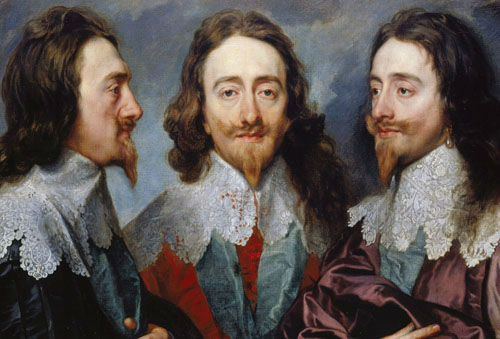
Another work, Charles I in Three Positions, depicts the king's head from three different angles. The painting was prepared for the Italian sculptor Gian Lorenzo Bernini, who was commissioned to create a portrait bust of Charles I.
These paintings formed part of the royal court's use of portraiture for political representation, personal display, and diplomatic gifts.
Portrait Technique and the Representation of the Aristocracy
During his English period, Anthony van Dyck produced a large number of portraits of nobles, court officials, military figures, and members of wealthy families.
His portrait technique combined accurate observation with carefully controlled idealization. He emphasized features that distinguished individual sitters while adjusting posture, proportions, and costume to suit their social position.
His figures often appear tall and slender, with relaxed hands, calm facial expressions, and clothing arranged in broad folds. The poses convey social confidence without relying entirely on rigid or symmetrical arrangements.
Earlier portraits sometimes used relatively plain backgrounds. In later works, he increasingly introduced architectural columns, curtains, vases, landscapes, and other elements associated with the portrait traditions of Peter Paul Rubens and Titian.
Silk, velvet, satin, lace, and other expensive fabrics were rendered through variations in color and light. Van Dyck used warm tones within shadowed areas and cooler highlights to describe the textures of garments.
His treatment of blue, purple, white, gold, and silver fabrics allowed him to represent subtle changes in surface and reflected light. At the same time, he frequently simplified less important details to direct the viewer's attention toward the sitter's face and hands.
His portraits of aristocratic women often presented long dresses spreading across the lower portions of the canvas. By placing the figures against a relatively low horizon, he increased the apparent height of the subjects and created a monumental composition.
Portraits associated with this period include Mary Ruthven, members of the Villiers family, the Countess of Bedford, and numerous members of the English court.
Portrait of Mary Ruthven, Lady van Dyck
One of Anthony van Dyck's personal portraits depicts his wife, Mary Ruthven, a Scottish woman connected with the household of Queen Henrietta Maria.
The painting, Portrait of Mary Ruthven, Lady van Dyck, dates from approximately 1640 and is held by the Museo Nacional del Prado in Madrid.
The portrait presents Mary Ruthven in an elegant dress, with attention given to the texture of her clothing and the expression of her face. Unlike the more formal court portraits, the painting places greater emphasis on the individual sitter.
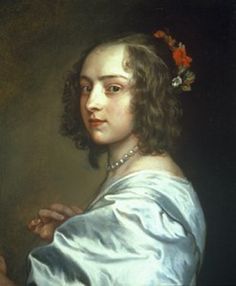
Mary Ruthven came from a Scottish family of aristocratic background. She served as a maid of honor to Queen Henrietta Maria before marrying Van Dyck.
The marriage took place in 1640. Through his connection with the royal court, Van Dyck had already obtained a position within English aristocratic society.
Mary Ruthven later gave birth to their daughter, Justina, shortly before the painter's death in December 1641.
Queen Henrietta Maria with Sir Jeffrey Hudson
Among Anthony van Dyck's paintings of the English royal family is Queen Henrietta Maria with Sir Jeffrey Hudson, completed in 1633.
The work depicts Queen Henrietta Maria, wife of King Charles I, standing beside Jeffrey Hudson, a member of the royal household. Hudson was known for his short stature and served at the queen's court.
The queen wears a blue satin dress decorated with gold details and lace. Her broad-brimmed black hat is adorned with feathers, while Hudson appears beside her in red clothing.
The architectural setting includes a column, heavy curtains, and objects associated with royal status. The arrangement also contains a small orange tree, a detail connected with the queen's Medici ancestry.
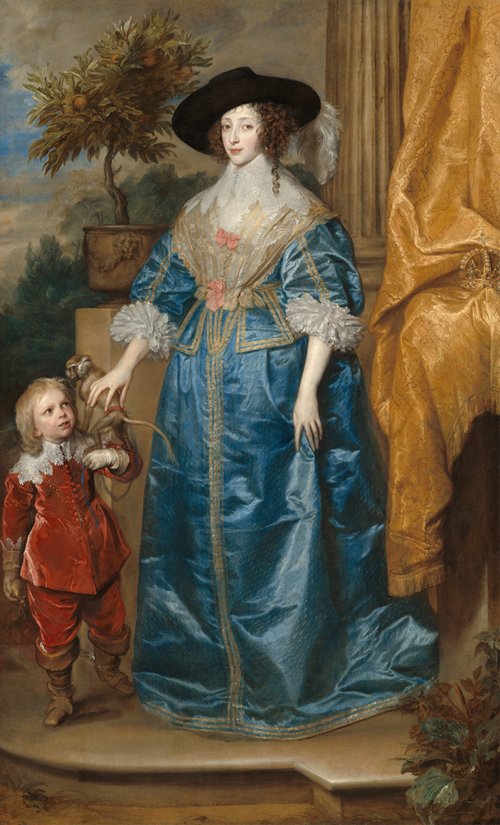
Van Dyck presents the queen with elongated proportions, making her appear taller than her actual height. The positioning of Jeffrey Hudson beside her reinforces this visual effect.
Warm and cool colors are placed alongside one another to distinguish the fabrics and figures. The luminous blue satin, gold ornamentation, and red costume create contrasts within the composition.
The painting is part of the collection of the National Gallery of Art in Washington, D.C.
Influence on English Portrait Painting
The portrait style developed by Anthony van Dyck at the English court influenced subsequent generations of British portrait painters.
Earlier English court portraiture frequently emphasized formal poses, decorative patterns, and clearly defined symbols of social status. Van Dyck introduced a more fluid approach, using relaxed gestures, softer transitions of light, and carefully constructed relationships between figures and their surroundings.
His full-length portraits became models for the representation of aristocratic identity in later British painting. Artists working in the eighteenth century studied his arrangements of figures, fabrics, and architectural backgrounds.
Among the painters influenced by his work were Joshua Reynolds and Thomas Gainsborough. Both developed portrait practices in which the sitter's social position, costume, and surrounding landscape formed part of the overall composition.
Van Dyck's paintings also influenced portrait engraving and the wider circulation of images of European rulers, nobles, and artists.
Van Dyck Brown
The name Anthony van Dyck is also associated with a dark brown pigment known as Van Dyck Brown, sometimes spelled Van Dyke Brown.
The traditional pigment is a naturally occurring brown earth containing organic material, including humus, peat, or coal-derived substances, mixed with mineral components.
Historically, related pigments were obtained from regions around Cologne and Kassel in Germany. They were also known as Cassel brown or Cologne earth.
The pigment was used in European painting and became associated with Van Dyck's name. However, products sold under this name have not always contained the same materials. Some later versions were manufactured from carbon black and iron oxide mixtures.
Its dark brown tone has been used in painting to create shadows, muted backgrounds, and tonal transitions.
Personal Life and Marriage
Anthony van Dyck lived for much of his professional career among wealthy patrons, artists, and members of European aristocratic society.
During his Italian years, he became familiar with the customs and clothing of Genoese noble families. His personal manner and appearance were described in historical accounts as reflecting the social circles in which he worked.
In England, his appointment as court painter brought financial rewards and access to the royal household. He maintained a residence and studio at Blackfriars in London and spent time at Eltham.
In 1640, he married Mary Ruthven, a Scottish aristocrat who served in Queen Henrietta Maria's household. Their daughter, Justina, was born in December 1641.
Van Dyck continued accepting commissions during the final years of his life, although illness increasingly affected his health.
Final Years and Death
During the final years of his career, Anthony van Dyck continued working for the English court while also exploring new artistic commissions on the European continent.
He traveled to Antwerp and Paris during the early 1640s, when important decorative projects were being discussed at the French court. He sought opportunities associated with King Louis XIII of France and Cardinal Armand Jean du Plessis, Duke of Richelieu.
By 1641, his health had deteriorated. He returned to London and became seriously ill.
His wife, Mary Ruthven, gave birth to their daughter, Justina, shortly before his death.
Anthony van Dyck died on December 9, 1641, in London, England. He was 42 years old.
He was buried in Old St Paul's Cathedral in London. The cathedral was later destroyed during the Great Fire of London in 1666.
At the time of his death, Van Dyck had produced portraits, religious compositions, mythological paintings, drawings, and prints during a career that extended from his early training in Antwerp to his appointment at the English royal court.
Selected Paintings
1613 - Portrait of an Old Man1618–1620 - The Crowning with Thorns
1618–1620 - The Taking of Christ
1621 - Portrait of Cornelis van der Geest
1623 - Portrait of Cardinal Guido Bentivoglio (Palazzo Pitti, Florence)
c. 1623 - Marchesa Balbi
c. 1623 - Marchesa Elena Grimaldi Cattaneo
c. 1626 - The Lomellini Family
1627 - Portrait of Ambrogio Spinola
c. 1632–1635 - Charles I at the Hunt (Louvre Museum, Paris)
1633 - Queen Henrietta Maria with Sir Jeffrey Hudson (National Gallery of Art, Washington, D.C.)
c. 1633 - Equestrian Portrait of Charles I (National Gallery, London)
1635 - Charles I in Three Positions (Royal Collection)
c. 1637 - Portrait of George Villiers and Lord Francis Villiers
c. 1638 - Lord John Stuart and His Brother, Lord Bernard Stuart
c. 1640 - Portrait of Mary Ruthven, Lady van Dyck (Museo Nacional del Prado, Madrid)
c. 1640 - Self-Portrait (National Portrait Gallery, London)
Major Artistic Activities
1609–1612 - Apprenticeship with Hendrick van Balen in Antwerp1610s - Association with the workshop of Peter Paul Rubens
1618 - Registered as an independent master in the Guild of Saint Luke, Antwerp
1620–1621 - First visit to England and service at the court of King James I
1621–1627 - Travel and artistic work in Italy
1627–1632 - Painting and portrait commissions in Antwerp
Late 1620s–1630s - Development of the Iconography portrait print series
1632 - Appointment as principal painter to King Charles I of England
1632 - Received a knighthood from King Charles I
1632–1641 - Portrait commissions for the English royal family and aristocracy
Source: Biyografiler.com
Frequently asked questions about Anthony van Dyck
Who is Anthony van Dyck?, Anthony van Dyck biography, Anthony van Dyck life story, Anthony van Dyck age, Anthony van Dyck facts, Anthony van Dyck birthplace, Anthony van Dyck photos, Anthony van Dyck videos, Anthony van Dyck career

Lamine Yamal
Professional footballer

Kylian Mbappe
Professional footballer

Keanu Reeves
Actor

Erling Haaland
Professional footballer

Brad Pitt
Actor

Leonardo DiCaprio
Actor

Anton Dvorak
Composer

Antoine Lavoisier
Chemist

Antoine Bourdelle
Sculptor

Anthony van Dyck
Painter

Anthony Stewart Head
Actor, Singer

Antoni Gaudi
Architect

Gadi Eisenkot
Politician, Military Commander

Susie Wiles
Political Consultant

Alberto Ascari
Formula 1 Driver

Elizabeth Taylor
Actress

Michael Jordan
Professional Basketball Player

Ann-Margret
Actress, Singer