
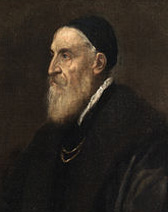
Titian
Master of Venetian Color and Light
Born on ?? ??, 1488
Died on August 27, 1576
Age at death: 88
Profession: Painter
Place of Birth: Pieve di Cadore, Republic of Venice (Italy)
Place of Death: Venice, Italy
Titian, born Tiziano Vecellio, was an Italian Renaissance painter and the greatest master of the Venetian school, celebrated for his revolutionary approach to color, composition, and emotional expression.
Titian was born in 1488 in Pieve di Cadore, Italy, into a wealthy family. His full name was Tiziano Vecellio. At the age of nine, his father brought him and his brother Francesco to Venice. There, Titian began his artistic training under the painter and mosaic artist Sebastiano Zuccato, before continuing his education in the workshops of Gentile Bellini and Giovanni Bellini. During this period, he met the painter Giorgione, who was ten years his senior and whose influence would profoundly shape Titian’s early artistic style. In 1508, Titian and Giorgione collaborated on decorating the façade of the Fondaco dei Tedeschi, the center of German trade in Venice. Due to Venice’s humid climate, these works have not survived.
After the death of his close friend Giorgione on October 25, 1510, Titian left Venice and traveled to Padua. In 1511, he painted fresco cycles for the Scuola del Santo and the Scuola del Carmine. Giorgione’s influence on Titian was so strong that, after his mentor’s death, Titian completed several of Giorgione’s unfinished paintings. During this period, Titian’s reputation grew rapidly.
In 1513, Titian returned to Venice and established his own workshop. He was commissioned to work on the decoration of the Great Council Hall in the Palazzo Ducale, the residence of the Venetian doges. Unfortunately, these monumental paintings were destroyed in the great fire of 1577.
On November 29, 1516, following the death of his master Giovanni Bellini, Titian was appointed the official chief painter of the Republic of Venice. From that point onward, he entered a long and brilliant professional period, receiving commissions from popes, princes, cardinals, and rulers, and producing numerous religious paintings and portraits.
Titian married a woman named Cecilia in 1525. They had two sons and two daughters, one of whom died in infancy. After Cecilia’s death in 1530, Titian never remarried. His younger son, Orazio, later became a painter and served as Titian’s chief assistant.
Around 1530, Titian attracted the attention of Emperor Charles V, Holy Roman Emperor, who invited him to Bologna to depict his coronation. Titian was granted the title of Count Palatine and, in 1533, was appointed official painter to the imperial court. In 1540, at the invitation of Pope Paul III, Titian traveled to Rome, where he was received with great honor. In recognition of his services to the papacy, he was granted Roman citizenship and painted the pope’s official portrait.
In 1548, Titian was invited to Augsburg, Germany, where he painted portraits of members of the imperial court. Later, Philip II of Spain, who succeeded Charles V, acquired numerous works by Titian. The paintings held in the Prado Museum are considered among the most significant examples of his art, both in number and artistic quality.
Between 1519 and 1526, Titian painted Madonna di Ca’ Pesaro, also known as the Pesaro Madonna, commissioned by Jacopo Pesaro to commemorate Venice’s victory in Cyprus. This work is regarded as one of Titian’s most famous masterpieces and is preserved in the Frari Basilica (Santa Maria Gloriosa dei Frari) in Venice.
After 1550, Titian no longer left Venice. He died of the plague on August 27, 1576, at the age of 88.
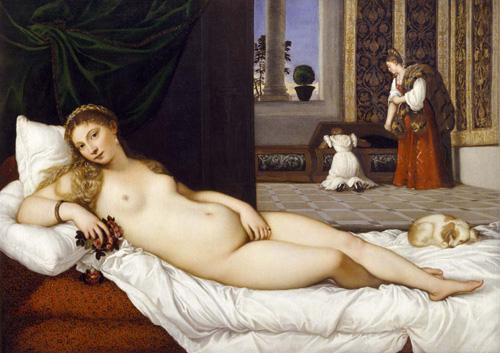
One of Titian’s most celebrated paintings, Urbino Venus, was completed in 1538. The painting depicts a nude young woman, believed to represent Venus, reclining on a couch or bed within the luxurious interior of a Renaissance palace. The work is exhibited at the Uffizi Gallery in Florence.
The pose of the female figure is based on Sleeping Venus (1510) by Giorgione. However, Titian replaced Giorgione’s sense of distance with a more sensual and intimate composition. The figure lacks traditional classical or allegorical attributes, enhancing the painting’s erotic character. Venus gazes directly at the viewer with confidence; her right hand holds flowers, while her left hand is placed provocatively over her genital area. The sleeping dog behind her symbolizes fidelity, and its slumber has often been interpreted as a sign of implied infidelity.
The painting was commissioned by Guidobaldo II della Rovere, Duke of Urbino. It was originally intended to decorate a cassone, a traditional Italian wedding chest. The servants depicted in the background are shown searching through such a chest for Venus’s garments, reinforcing the painting’s association with marriage. The painting’s overt eroticism has led scholars to suggest it was intended as an instructive model for the duke’s young bride.
Urbino Venus later inspired Olympia by Edouard Manet, now exhibited at the Musée d’Orsay.
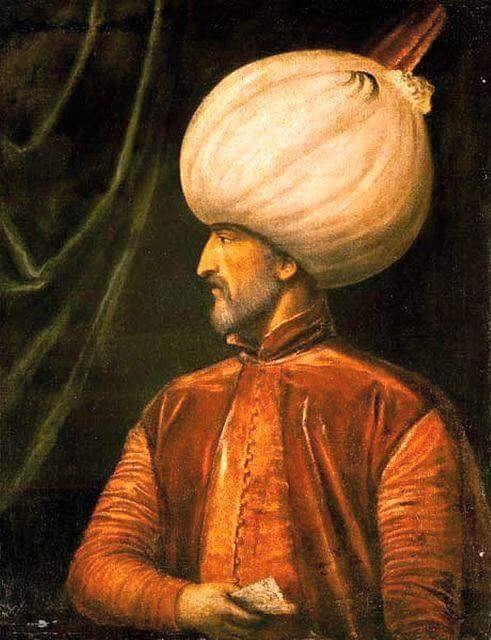
Around 1539, Titian also painted a portrait of Suleiman the Magnificent, the tenth Ottoman sultan.
Titian’s artistic development is traditionally divided into three periods. His apprenticeship period was dominated by the influence of Giorgione, so strong that scholars often struggle to distinguish Giorgione’s late works from Titian’s early paintings. In his second period, roughly between 1520 and 1545, Titian refined his style: the spiritual intensity of his religious works deepened, while the sensuality of his mythological subjects became more pronounced.
In his mature period, Titian developed a freer and more expressive approach to painting. Although he sometimes relied on variations of a single dominant color, this did not prevent him from achieving an extraordinarily rich and powerful use of color. His late style emphasized emotional depth and spiritual intensity. During his lifetime, his artistic language was fully understood by almost no other painter, with the notable exception of Tintoretto.
Major Works:
The Miracles of Saint Anthony of Padua (1511)
Salome (1512)
Sacred and Profane Love (1515–1516)
Flora (1515)
The Worship of Venus (1518–1519)
Resurrection of Christ Altarpiece (1522)
Saint Christopher (1523)
Bacchus and Ariadne (1523)
The Entombment of Christ (1525)
The Martyrdom of Saint Peter (1528–1530)
Madonna of the Rabbit (1530)
Urbino Venus (1538)
Portrait of Suleiman the Magnificent (1539)
Portrait of a Young Girl of the Strozzis (1543)
The Crowning with Thorns (1543)
Ecce Homo (1543)
Venus with Cupid (1545)
Danaë (1545)
Portrait of Pietro Aretino (1545)
Portrait of Charles V Seated (1548)
Equestrian Portrait of Charles V (1548)
Portrait of Johann Friedrich of Saxony (1550)
Portrait of Philip II (1550–1551)
Portrait of Lavinia (1550)
Nymph and Shepherd (1570)
Self-Portrait (1565–1570)
The Fall of Man (1570)
Pietà (1573)
Pietà with Saint Mary Magdalene and Saint Jerome (1573–1576)
Source: Biyografiler.com
Frequently asked questions about Titian
Who is Titian?, Titian biography, Titian life story, Titian age, Titian facts, Titian birthplace, Titian photos, Titian videos, Titian career
Related Biographies

Lamine Yamal
Professional footballer

Erling Haaland
Professional footballer

Kylian Mbappe
Professional footballer

Keanu Reeves
Actor

Austin Abrams
Actor

Bad Bunny
Rapper, Songwriter


Hongjoong
Singer, Rapper, Songwriter, Composer

Ludacris
Rapper, Actor

Kwon Eunbi
Singer

Sarah Wayne Callies
Actress, Screenwriter, Producer, Director

LaTavia Roberson
Singer, Actress, Entrepreneur

Pedro Sanchez
Politician
Lamine Yamal
Professional footballer

Claudia Sheinbaum
President, Politician, Scientist, Academic
Erling Haaland
Professional footballer

Leonardo DiCaprio
Actor
Austin Abrams
Actor