
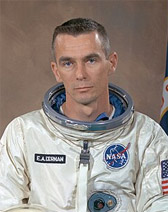
Eugene Cernan
The last human being to walk on the Moon.
Born on March 14, 1934
Died on January 16, 2017
Age at death: 83
Profession: Astronaut, Military Officer, Engineer
Place of Birth: Chicago, Illinois, United States
Place of Death: Houston, Texas, United States
Eugene Andrew Cernan was an American naval officer, aviator, engineer, and NASA astronaut who became the twelfth man to walk on the Moon and, to this day, the last human being to set foot on its surface. A veteran of three space missions—Gemini 9A, Apollo 10, and Apollo 17—Eugene Andrew Cernan played a central role in the United States’ lunar exploration program during the height of the Space Race. His final footsteps on the Moon in December 1972 marked the end of the Apollo era, placing him alongside historic figures such as Neil Armstrong and Buzz Aldrin in the pantheon of space exploration.
Early Life and Education
Eugene Andrew Cernan was born on March 14, 1934, in Chicago, Illinois, and grew up in Bellwood. After graduating from Proviso Township High School in Maywood, Illinois, he pursued engineering studies at Purdue University, earning a Bachelor of Science degree in Electrical Engineering in 1956. Purdue would later become renowned as the alma mater of several astronauts, including Neil Armstrong.
Through the Naval ROTC program at Purdue in West Lafayette, Indiana, Eugene Andrew Cernan was commissioned as a naval officer. He later obtained a Master of Science degree in Aeronautical Engineering from the U.S. Naval Postgraduate School in Monterey, California, in 1963. Over the course of his career, he received honorary doctorates from multiple institutions, including Purdue University, Drexel University, Gonzaga University, Comenius University in Slovakia, Northwestern University, and Western State University College of Law.
Naval Aviation Career
Following his commissioning, Eugene Andrew Cernan began flight training and went on to serve in Attack Squadrons 26 and 112 at Naval Air Station Miramar in California. His distinguished naval career included more than 5,000 hours of flight time, with over 4,800 hours in jet aircraft and more than 200 aircraft carrier landings. These credentials positioned him among the elite test pilots and aviators from which NASA frequently recruited its astronaut corps.
He retired from the United States Navy on July 1, 1976, with the rank of Captain, concluding a military career that had seamlessly merged engineering precision with operational excellence.
NASA Selection and Gemini 9A
In October 1963, Eugene Andrew Cernan was selected by NASA as one of fourteen new astronauts. His first mission came in June 1966 as pilot of Gemini 9A, alongside commander Thomas P. Stafford. During the three-day mission, the spacecraft achieved a circular orbit of approximately 161 miles and conducted rendezvous maneuvers with a target vehicle.
During Gemini 9A, Eugene Andrew Cernan became the second American to perform a spacewalk (EVA), spending two hours and ten minutes outside the spacecraft. The mission concluded with a successful splashdown near the USS Wasp. The demanding EVA highlighted both the challenges of extravehicular activity and the physical endurance required of early astronauts.
Apollo 10: The Lunar Dress Rehearsal
Eugene Andrew Cernan later served as backup pilot for Gemini 12 and backup Lunar Module Pilot for Apollo 7. His second spaceflight came in May 1969 as Lunar Module Pilot of Apollo 10, again under the command of Thomas P. Stafford, with John W. Young serving as Command Module Pilot.
Apollo 10 functioned as a full dress rehearsal for the first lunar landing. The Lunar Module descended to within approximately eight nautical miles of the Moon’s surface, testing all systems short of landing. The mission confirmed the reliability of the lunar landing architecture that would soon enable Neil Armstrong and Buzz Aldrin to make history on Apollo 11.
Apollo 17: The Final Lunar Mission
The defining chapter of Eugene Andrew Cernan’s career came with his appointment as commander of Apollo 17, the final planned crewed lunar mission of the Apollo program. Launched on December 6, 1972, the crew included Command Module Pilot Ronald Evans and Lunar Module Pilot Harrison H. Schmitt. The Command Module “America” and Lunar Module “Challenger” carried the crew to the Taurus–Littrow Valley.
Over three days on the lunar surface, Eugene Andrew Cernan and Schmitt conducted three extended extravehicular explorations, collecting approximately 115 kilograms of lunar samples. The mission set records for the longest crewed lunar landing, the longest cumulative time spent on the lunar surface, and the largest amount of lunar material returned to Earth.
In total, Eugene Andrew Cernan logged 566 hours and 15 minutes in space. Of that time, more than 73 hours were spent on the Moon, and across four spacewalks he accumulated 24 hours and 11 minutes of EVA time.
Before departing the lunar surface on December 14, 1972, he delivered words that would echo through history:
“We leave as we came and, God willing, as we shall return, with peace and hope for all mankind.”With the cancellation of Apollo 18, Apollo 19, and Apollo 20, his footprints—and those of his fellow astronauts—remained humanity’s last marks on the Moon. He often expressed hope that he would not remain the last person to walk there.
Post-NASA Career and Public Life
After his space missions, Eugene Andrew Cernan served at Johnson Space Center as Special Assistant to the Apollo Program Director and played a significant role in planning the Apollo–Soyuz Test Project, collaborating in high-level negotiations between the United States and the Soviet Union during a pivotal moment in Cold War détente.
Following his retirement from NASA and the Navy, he worked as Vice President for International Affairs at Coral Petroleum, Inc., in Houston. In 1981, he founded the Cernan Corporation, providing management and consulting services in energy and aerospace. He also served as a commentator for ABC-TV during Space Shuttle broadcasts and chaired the board of Johnson Engineering Corporation.
Awards and Honors
Eugene Andrew Cernan received numerous distinctions, including two NASA Distinguished Service Medals, the NASA Exceptional Service Medal, two Navy Distinguished Service Medals, the Navy Astronaut Wings, the Navy Distinguished Flying Cross, and the Fédération Aéronautique Internationale Gold Space Medal. He was inducted into the U.S. Astronaut Hall of Fame, affirming his place among America’s most accomplished spacefarers.
He was also a member of professional and honorary organizations such as the American Astronautical Society, the Society of Experimental Test Pilots, Tau Beta Pi, Sigma Xi, Phi Gamma Delta, and the Explorers Club.
Personal Life
Eugene Andrew Cernan married Barbara Jean Atchley in 1961, and the couple had a daughter, Tracy Cernan Woolie (Marion). They divorced in 1981. In 1987, he married Janis Ellen Jones, and through his blended family he had two additional daughters, Danielle Ellis and Kelly Nanna Taff (Michael). He was the father of three daughters and grandfather to nine grandchildren.
Outside his professional life, he enjoyed horseback riding, hunting, fishing, flying, and competitive sports—interests that reflected the adventurous spirit defining his career.
Death
Eugene Andrew Cernan passed away on January 16, 2017, in Houston, Texas, at the age of 83. His life embodied the ambition and courage of the Apollo era, a time when humanity first extended its reach beyond Earth. As the last man to walk on the Moon, his legacy remains inseparable from the history of space exploration and the enduring aspiration to return.
Source: Biyografiler.com
Frequently asked questions about Eugene Cernan
Who is Eugene Cernan?, Eugene Cernan biography, Eugene Cernan life story, Eugene Cernan age, Eugene Cernan facts, Eugene Cernan birthplace, Eugene Cernan photos, Eugene Cernan videos, Eugene Cernan career
Related Biographies

Lamine Yamal
Professional footballer

Erling Haaland
Professional footballer

Kylian Mbappe
Professional footballer

Austin Abrams
Actor

Bad Bunny
Rapper, Songwriter

Brad Pitt
Actor


Hongjoong
Singer, Rapper, Songwriter, Composer

Ludacris
Rapper, Actor

Kwon Eunbi
Singer

Sarah Wayne Callies
Actress, Screenwriter, Producer, Director

LaTavia Roberson
Singer, Actress, Entrepreneur

Vladimir Potanin
Businessperson, Investor

Andrej Babis
Businessperson, Politician, Economist

Geoffrey Hinton
Psychologist, Computer Scientist

Andrew Garfield
Actor
Bad Bunny
Rapper, Songwriter
Austin Abrams
Actor