
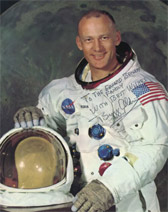
Buzz Aldrin
Apollo 11 Lunar Module Pilot – Second Human to Walk on the Moon
Born on January 20, 1930
Age: 96
Profession: Astronaut
Place of Birth: Glen Ridge, New Jersey, United States
American astronauts Neil Armstrong and Buzz Aldrin became the first humans to land on the surface of the Moon on July 20, 1969, at 20:18 UTC, during the historic Apollo 11 mission.
Buzz Aldrin was born on January 20, 1930, in Glen Ridge, New Jersey, United States, as the son of Marion Moon and Edwin Eugene Aldrin Sr. His father was an aviation engineer, which played a significant role in Aldrin’s early interest in flight and aerospace. His full name is Edwin Eugene Aldrin, Jr. The nickname “Buzz” originated from his younger sister Faye, who was unable to pronounce the word “brother” and instead said “Buzzer.” Over time, this nickname was shortened to “Buzz” and remained with him for life.
During his school years, Buzz Aldrin was a talented athlete who competed in pole vaulting and track and field events. He graduated from Montclair High School in 1946. In 1951, he graduated from the United States Military Academy at West Point and became a pilot in the United States Air Force.
During the Korean War in 1952, Buzz Aldrin flew 66 combat missions. As part of the 51st Fighter-Interceptor Wing based near Seoul, he piloted the F-86 “Sabre” jet and successfully shot down two MiG-15 aircraft. After the Korean War, he was stationed in West Germany before returning to the United States.
In 1963, Buzz Aldrin completed his doctorate at the Massachusetts Institute of Technology with a dissertation on orbital mechanics. At that time, he held the rank of Major in the United States Air Force and had not yet been selected as an astronaut. Later that same year, he was chosen by NASA to join the astronaut corps and began intensive training for spaceflight.
Buzz Aldrin flew in space twice, serving on the Gemini 12 mission in 1966 and the Apollo 11 mission in 1969. He first traveled into space on November 11, 1966, aboard Gemini 12. During this four-day mission, he performed three spacewalks, demonstrating techniques that would later be crucial for lunar exploration.
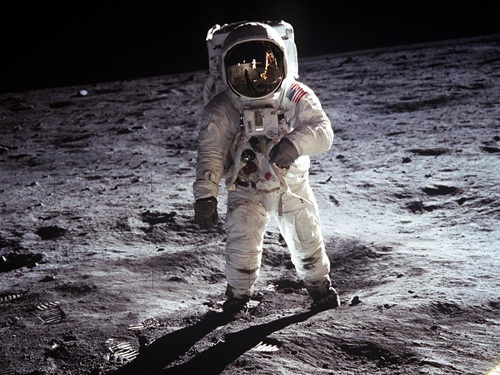
Buzz Aldrin on the Moon. One of the most widely reproduced images released by NASA, this photograph taken on the Moon shows the Apollo 11 astronaut Buzz Aldrin. Neil Armstrong served as the photographer; his reflection can be seen in Aldrin’s visor. Aldrin recalled that Armstrong told him, “Stop and turn.” In this spontaneous photograph, Aldrin’s arm is raised, possibly to read the checklist sewn onto his left glove.
American astronauts Neil Armstrong and Buzz Aldrin became the first humans to land on the surface of the Moon on July 20, 1969, at 20:18 UTC. Six hours after the landing, on July 21 at 01:56 UTC, Neil Armstrong stepped onto the lunar surface, achieving another historic first. Among the Apollo 11 crew, Neil Armstrong was the first person to walk on the Moon, while Buzz Aldrin became the second.
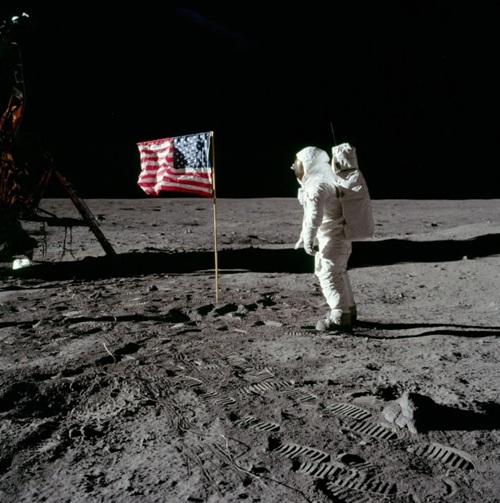
After walking on the Moon, collecting lunar rock samples, and planting the American flag, it was time to return to Earth. The mission ended on July 24 with a splashdown in the Pacific Ocean. The total mission duration was 195 hours, 18 minutes, and 35 seconds.
After returning to Earth, Buzz Aldrin remained in quarantine for 21 days. Following this period, he participated in a convoy parade before attending a state dinner held in their honor and received the Presidential Medal of Freedom from Richard Nixon.
In the years that followed, the United States sent five additional crewed missions to the Moon, and a total of 12 astronauts walked on the lunar surface. Between 1968 and 1972, 24 Apollo astronauts traveled to the Moon, and 12 of them walked on its surface.
Marriages:
1st wife: Joan Archer (m. 1954–1974). They had three children: Janice Aldrin, Andrew Aldrin, and James Aldrin.
2nd wife: Beverly Van Zile (m. 1975–1978).
3rd wife: Lois Driggs Cannon (m. 1988–2012).
4th wife: Anca Faur (m. 2023).
Buzz Aldrin began his career at NASA in 1963 as part of the Gemini program and later joined the Apollo program in 1967. He left NASA in 1971 and became the commandant of the Aerospace Research Pilot School at Edwards Air Force Base in California later that same year. In March 1972, he retired from the United States Air Force (USAF). Afterward, he worked as a technical consultant in the private sector.
After playing a pioneering role at NASA and in the military, Buzz Aldrin struggled to adjust to what he described as “normal” life. He attempted to work as a car salesman but was not successful in this role. During this period, he also continued to battle depression.
In 1988, he legally changed his name to Buzz Aldrin. “Buzz” had been his lifelong nickname, but this marked its official adoption as his legal name.
In 1998, Buzz Aldrin founded the nonprofit organization ShareSpace Foundation to promote the expansion of crewed space exploration.
In 1998, Buzz Aldrin participated in an expedition to the North Pole. In 2016, at the age of 86, he became the oldest person to reach the South Pole.
Buzz Aldrin wrote two autobiographies describing his experiences with depression following the Apollo 11 mission: Return to Earth (1973) and Magnificent Desolation: The Long Journey Home from the Moon (2009), co-written with Ken Abraham. He also authored a history of the Apollo program, Men from Earth (1989), co-written with Malcolm McConnell; two children’s books, Reaching for the Moon (2005) and Look to the Stars (2009); and two forward-looking works, Mission to Mars: My Vision for Space Exploration (2013) and No Dream Is Too High: Life Lessons from a Man Who Walked on the Moon (2016).
In 2023, at the age of 93, Buzz Aldrin entered his fourth marriage with Dr. Anca Faur, born in 1960, whom he had known since 2018.
A lunar crater and asteroid number 6470 were named in honor of Buzz Aldrin.
In the legendary Disney Pixar animated film series Toy Story, one of the main characters is named Buzz Lightyear. Pixar paid tribute by naming this fictional space hero after a real-life space hero, Buzz Aldrin.
Books:
1973 – Return to Earth
1989 – Men from Earth (with Malcolm McConnell)
2005 – Reaching for the Moon
2009 – Magnificent Desolation: The Long Journey Home from the Moon (with Ken Abraham)
2009 – Look to the Stars
2013 – Mission to Mars: My Vision for Space Exploration
2016 – No Dream Is Too High: Life Lessons from a Man Who Walked on the Moon
Source: Biyografiler.com
Frequently asked questions about Buzz Aldrin
Who is Buzz Aldrin?, Buzz Aldrin biography, Buzz Aldrin life story, Buzz Aldrin age, Buzz Aldrin facts, Buzz Aldrin birthplace, Buzz Aldrin photos, Buzz Aldrin videos, Buzz Aldrin career
Related Biographies

Lamine Yamal
Professional footballer

Erling Haaland
Professional footballer

Kylian Mbappe
Professional footballer

Austin Abrams
Actor

Bad Bunny
Rapper, Songwriter

Brad Pitt
Actor


Hongjoong
Singer, Rapper, Songwriter, Composer

Ludacris
Rapper, Actor

Kwon Eunbi
Singer

Sarah Wayne Callies
Actress, Screenwriter, Producer, Director

LaTavia Roberson
Singer, Actress, Entrepreneur

Vladimir Potanin
Businessperson, Investor

Michael Keaton
Actor

Andrej Babis
Businessperson, Politician, Economist
Bad Bunny
Rapper, Songwriter

Geoffrey Hinton
Psychologist, Computer Scientist

Andrew Garfield
Actor