
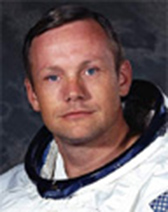
Neil Armstrong
The first human to walk on the Moon
Born on June 5, 1930
Died on August 25, 2012
Age at death: 82
Profession: Astronaut, Professor
Place of Birth: Ohio, United States
Place of Death: Ohio, United States
Neil Alden Armstrong was an American astronaut, pilot, and professor, best known as the first human being to walk on the Moon. He was born on June 5, 1930, in a farmhouse in Ohio, United States, as the eldest son of Stephen and Viola Engel Armstrong. At the age of six, he experienced his first airplane flight, an event that sparked a lifelong fascination with aviation. Growing up, he worked various jobs in his hometown and began taking flying lessons at the age of fifteen. Remarkably, he obtained his pilot’s license at sixteen, before he was even eligible for a driver’s license.
![Apollo 11 astronauts Neil Armstrong, Michael Collins]], and Buzz Aldrin](https://biyografiler.com/externalpicture/buzz-aldrin-ayda2.jpg)
Deeply captivated by aircraft, Neil Armstrong built a wind tunnel in the basement of his home, where he tested the performance of model airplanes he constructed himself. After graduating from Blume High School in 1947, he entered Purdue University with a scholarship from the United States Navy to study aeronautical engineering. In 1949, however, he was called to active duty by the Navy.
At the age of twenty, Armstrong became the youngest jet pilot in his squadron at the Pensacola Naval Air Station. In 1950, he was deployed to South Korea, where he served as a naval combat pilot during the Korean War. He flew 78 combat missions and received two gold stars, the Air Medal for combat, and several other military honors. After the war, he continued serving as a naval pilot for a total of eight years and officially left the military on October 21, 1960. He then returned to Purdue University to complete his aeronautical engineering degree.
After graduating from Purdue, Neil Armstrong became an experimental research test pilot for NACA (the National Advisory Committee for Aeronautics). He worked at the Lewis Research Laboratory in Cleveland before transferring to the High-Speed Flight Station in California. There, he served as a test pilot on several groundbreaking high-speed aircraft, contributing significantly to the advancement of flight technology.
In 1962, Armstrong achieved astronaut status. On March 16, 1968, he served as command pilot on the Gemini 8 mission, during which the first successful docking of two spacecraft in orbit was accomplished. This mission marked a major milestone in human spaceflight.
On July 20, 1969, Neil Armstrong traveled to the Moon aboard the Apollo 11 spacecraft. Alongside Buzz Aldrin, he spent approximately two and a half hours exploring the lunar surface, while Michael Collins piloted the command module in lunar orbit. At 20:18 UTC, Armstrong and Aldrin became the first humans to land on the Moon.
Six hours after landing, at 01:56 UTC on July 21, 1969, Neil Armstrong stepped onto the Moon’s surface, becoming the first human to do so. His historic words upon touching the lunar soil were: “That’s one small step for man, one giant leap for mankind.” Armstrong was followed by Buzz Aldrin as the second human to walk on the Moon. After walking on the surface, collecting lunar rock samples, and planting the American flag, the crew prepared for their return to Earth. The mission concluded with a splashdown in the Pacific Ocean on July 24, 1969, after a total mission duration of 195 hours, 18 minutes, and 35 seconds.
Following their return, Armstrong and his crewmates spent 21 days in quarantine. Neil Armstrong later participated in a celebratory parade and attended a state dinner, where he was awarded the Presidential Medal of Freedom by President Richard Nixon. In 1978, President Jimmy Carter honored him with the Congressional Space Medal of Honor. He was inducted into the National Aviation Hall of Fame in 1979 and, together with his former crewmates, received the Congressional Gold Medal in 2009.
Between 1968 and 1972, the United States sent six crewed missions to the Moon. A total of 24 Apollo astronauts traveled to lunar orbit, and 12 of them walked on the Moon’s surface.
After leaving NASA in 1971, Neil Armstrong became a professor of aerospace engineering at the University of Cincinnati. In 1986, he served on the commission that investigated the Space Shuttle Challenger disaster. Married and the father of two children, Armstrong spent his later years living quietly in Ohio.
Neil Armstrong, known worldwide as the first person to walk on the Moon, died on August 25, 2012, at the age of 82, due to complications resulting from coronary bypass surgery.
Source: Biyografiler.com
Frequently asked questions about Neil Armstrong
Who is Neil Armstrong?, Neil Armstrong biography, Neil Armstrong life story, Neil Armstrong age, Neil Armstrong facts, Neil Armstrong birthplace, Neil Armstrong photos, Neil Armstrong videos, Neil Armstrong career
Related Biographies

Lamine Yamal
Professional footballer

Erling Haaland
Professional footballer

Kylian Mbappe
Professional footballer

Austin Abrams
Actor

Bad Bunny
Rapper, Songwriter

Brad Pitt
Actor


Hongjoong
Singer, Rapper, Songwriter, Composer

Ludacris
Rapper, Actor

Kwon Eunbi
Singer

Sarah Wayne Callies
Actress, Screenwriter, Producer, Director

LaTavia Roberson
Singer, Actress, Entrepreneur

Vladimir Potanin
Businessperson, Investor

Michael Keaton
Actor

Andrej Babis
Businessperson, Politician, Economist
Bad Bunny
Rapper, Songwriter

Geoffrey Hinton
Psychologist, Computer Scientist

Andrew Garfield
Actor