
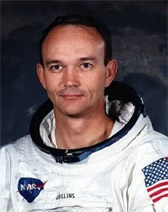
Michael Collins
Command Module pilot of Apollo 11 and the solitary guardian of lunar orbit
Born on October 31, 1930
Died on April 28, 2021
Age at death: 91
Profession: Astronaut
Place of Birth: Rome, Italy
Place of Death: Naples, Florida, United States
Michael Collins was an American astronaut, test pilot, and United States Air Force major general whose career is inseparable from one of humanity’s most consequential moments. As the Command Module Pilot of the historic Apollo 11 mission, he became the essential yet often understated third member of the crew that achieved the first human landing on the Moon.
Apollo 11 and the First Moon Landing
The Apollo 11 mission marked a defining moment in human history. On July 20, 1969, astronauts Neil Armstrong and Buzz Aldrin became the first humans to land on the surface of the Moon, touching down at 20:18 UTC. While they descended to the lunar surface, Michael Collins remained alone in lunar orbit aboard the Command Module Columbia, maintaining the mission’s most critical lifeline.
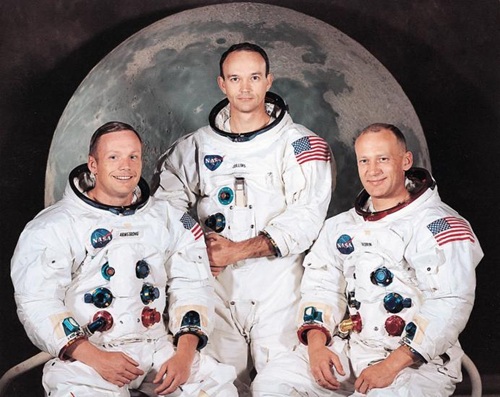
During the period when the lunar module was on the Moon, Michael Collins orbited the Moon repeatedly, including approximately 48 minutes on each orbit when he passed behind the Moon’s far side, completely cut off from radio communication with both Earth and his crewmates. This isolation earned him the enduring description of “the loneliest man in the universe,” a phrase that would follow him throughout his life.
Despite the solitude, his role was indispensable. He was responsible for navigation, systems management, and executing the precise rendezvous that allowed Neil Armstrong and Buzz Aldrin to safely return from the lunar surface. Without the flawless performance of the Command Module, the mission could not have succeeded.
Early Life and Military Formation
Michael Collins was born on October 31, 1930, in Rome, Italy, to an American family serving abroad. He was educated at Saint Albans School in Washington, D.C., before enrolling at the United States Military Academy at West Point, where he graduated in 1952.
Following graduation, he entered the United States Air Force, embarking on a career that combined operational flying with advanced aeronautical testing. He trained as both a fighter pilot and an experimental test pilot, roles that demanded technical precision and composure under extreme conditions.
Between 1959 and 1963, he served at Edwards Air Force Base in California, one of the world’s premier centers for experimental flight testing. During this period, he logged more than 3,800 flight hours, an experience base that later proved decisive for his selection as an astronaut.
NASA Selection and Gemini Program
In 1963, Michael Collins was selected as part of NASA’s third astronaut group, entering the space program at a time when the United States was racing to achieve President Kennedy’s lunar objective. His first spaceflight assignment came with Gemini 10, launched on July 18, 1966.
During the three-day Gemini 10 mission, he conducted complex orbital maneuvers, successfully docked with another spacecraft, and performed two extravehicular activities (spacewalks). He also reached an altitude of 476 miles, setting a world altitude record at the time and becoming the third American astronaut to perform a spacewalk.
This mission firmly established Michael Collins as one of NASA’s most capable and technically adept astronauts, paving the way for his later assignment to Apollo 11.
The Apollo 11 Mission Role
For Apollo 11 in 1969, Michael Collins was assigned the role of Command Module Pilot, a position demanding exceptional technical mastery and emotional resilience. While the mission’s historic imagery focused on the Moon’s surface, the success of the mission rested equally on his performance in orbit.
Operating alone aboard Columbia, he monitored spacecraft systems, executed course corrections, and prepared contingency plans should Neil Armstrong and Buzz Aldrin be unable to return from the lunar surface. His calm precision ensured that when the lunar module ascended, the rendezvous was executed without error.
Following the successful completion of the mission, Michael Collins returned to Earth alongside his crewmates, having spent over 11 days in space across two missions, including approximately 1.5 hours of spacewalking.
Honors and Recognition
After Apollo 11, Michael Collins, Neil Armstrong, and Buzz Aldrin were awarded the Presidential Medal of Freedom by U.S. President Richard Nixon, the nation’s highest civilian honor. The award recognized not only their bravery but their role in advancing scientific knowledge and national achievement.
Life After NASA
Michael Collins retired from NASA in 1970, transitioning into leadership roles in both public institutions and private enterprise. In 1971, he became Director of the National Air and Space Museum of the Smithsonian Institution, playing a central role in planning and developing its new facility on the National Mall.
He later served as Under Secretary of the Smithsonian Institution and, in 1985, founded his own consulting company, continuing to influence aerospace policy and organizational leadership.
Author and Intellectual Legacy
Beyond his operational achievements, Michael Collins was widely respected as a writer and thinker. His memoir Carrying the Fire is considered one of the most insightful and eloquent astronaut autobiographies ever written, offering a reflective and deeply human account of space exploration.
He went on to publish several other works that explored spaceflight, exploration, and America’s technological future, reinforcing his role as both participant and chronicler of the space age.
Personal Life and Death
Michael Collins was married and the father of three children. Known for his wit, humility, and intellectual curiosity, he remained an influential voice in space policy discussions long after leaving active service.
He died on April 28, 2021, in Naples, Florida, at the age of 90, following a battle with cancer. His death marked the passing of a key figure from the Apollo era, whose quiet competence was essential to humanity’s first steps on another world.
Books
1974 – Carrying the Fire
1976 – Flying to the Moon and Other Strange Places
1988 – Liftoff: The Story of America’s Adventure in Space
1990 – Mission to Mars
Source: Biyografiler.com
Frequently asked questions about Michael Collins
Who is Michael Collins?, Michael Collins biography, Michael Collins life story, Michael Collins age, Michael Collins facts, Michael Collins birthplace, Michael Collins photos, Michael Collins videos, Michael Collins career
Related Biographies

Lamine Yamal
Professional footballer

Erling Haaland
Professional footballer

Kylian Mbappe
Professional footballer

Austin Abrams
Actor

Bad Bunny
Rapper, Songwriter

Brad Pitt
Actor


Hongjoong
Singer, Rapper, Songwriter, Composer

Ludacris
Rapper, Actor

Kwon Eunbi
Singer

Sarah Wayne Callies
Actress, Screenwriter, Producer, Director

LaTavia Roberson
Singer, Actress, Entrepreneur

Jodie Foster
Actress

Vladimir Potanin
Businessperson, Investor
Bad Bunny
Rapper, Songwriter

Michael Keaton
Actor

Andrej Babis
Businessperson, Politician, Economist
Austin Abrams
Actor