
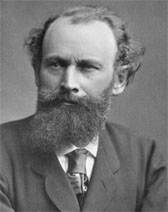
Edouard Manet
The Painter Who Bridged Realism and Impressionism
Born on January 23, 1832
Died on April 30, 1883
Age at death: 51
Profession: Painter
Place of Birth: Paris, France
Place of Death: Paris, France
Édouard Manet was one of the first painters of the 19th century to depict modern life as it was lived. He played a decisive role in the transition from Realism to Impressionism and became a central figure in the transformation of modern painting through his bold subjects, unconventional compositions, and rejection of academic conventions.
Édouard Manet was born on January 23, 1832, in Paris. His father, Auguste Manet, was a wealthy and well-known lawyer and served as a French magistrate. His mother, Eugénie-Désirée Fournier, was the granddaughter of Swedish Prince Charles Bernadotte. Growing up in a privileged environment, Manet enjoyed a comfortable and cultured childhood.
At the age of twelve, Manet entered the Collège Rollin, where he met his lifelong friend Antonin Proust. During his school years, he developed a strong interest in art and frequently visited museums and exhibitions. His artistic ambitions, however, met with resistance from his father, who insisted that he choose a respectable profession—either law or a naval career.
After completing secondary education, Manet wished to enroll in the Academy of Fine Arts, but under family pressure he attempted to enter a naval academy. After failing the entrance examinations twice, he boarded a merchant ship in 1848 and traveled to Brazil, spending three months in Rio de Janeiro. Upon his return to France, he brought back sketchbooks filled with drawings inspired by the landscapes and life he had encountered.
Realizing that resistance was futile, Manet’s father allowed him to pursue art, and in 1850 he entered the studio of the celebrated academic painter Thomas Couture. Manet studied there for six years but never confined himself solely to his teacher’s methods. He also took lessons elsewhere and devoted extensive time to studying the works of old masters, especially Venetian painters, at the Louvre. Through this self-directed study, he refined both his technique and compositional skills.
Unlike many academic painters of his time, Manet did not seek inspiration in mythology or religious themes painted in isolation within the studio. Instead, nature and contemporary life became his primary sources of inspiration. He traveled to Italy in 1853 and again in 1856, and also visited the Netherlands, Germany, and Austria. After leaving Couture’s studio in 1856, Manet’s independent artistic career truly began.
During his friendship with Claude Monet, Manet began painting outdoors, further distancing himself from academic tradition. Between 1856 and 1867, each exhibition he participated in revealed clear artistic progress. In 1865, he traveled to Spain, where he studied the works of Francisco Goya, whose influence would later be evident in his use of contrast and subject matter.
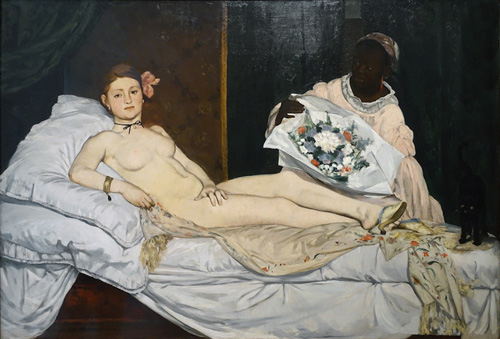
In 1863, Manet submitted his painting Luncheon on the Grass to the official Salon, where it was rejected. He exhibited it instead at the Salon des Refusés, causing a major scandal. Critics and audiences denounced the work as immoral, particularly because it depicted a nude woman seated casually beside two fully clothed men—an affront to contemporary moral and artistic norms. The controversy intensified when Manet exhibited Olympia in 1865, a work inspired by Venus of Urbino by Titian. Displayed today at the Orsay Museum in Paris, *Olympia* provoked even greater outrage but firmly established Manet as a revolutionary force in modern art.
Although Manet never formally joined any artistic movement, he became a vital source of inspiration for painters who would later be known as Impressionists, including Claude Monet, Pierre-Auguste Renoir, and Alfred Sisley. While his work laid the groundwork for Impressionism, Manet himself did not fully adopt its principles. He rejected the systematic analysis of light and color favored by Impressionists and Neo-Impressionists, maintaining a firm commitment to structure and form.
In 1870, Édouard Manet served in the Franco-Prussian War. During the subsequent civil conflict, he withdrew from Paris with his family to the countryside. Throughout his life, Manet maintained complex personal relationships. He lived for many years with the pianist Suzanne Leenhoff, whom he married in 1863 after his father’s death. Before their marriage, they had been together for a decade and had an illegitimate son, Léon Koëlla Leenhoff, born in 1852. Manet also had romantic relationships with his model Victorine Meurent and the painter Berthe Morisot.
Manet’s official recognition came late in life. In 1881, he received a gold medal at the Salon, and in 1882 he was awarded the Légion d’Honneur. By then, his works were already being collected and exhibited in major museums across Europe and the United States, including the Louvre and the National Gallery in London.
Following an accident that led to gangrene, Manet’s left leg was amputated. Weakened by illness, he died in Paris on April 30, 1883, at the age of fifty-one, from complications related to syphilis and rheumatism.
Édouard Manet left behind a body of work that profoundly influenced younger generations of artists. Masterpieces such as Luncheon on the Grass and Olympia became foundational references for modern art and solidified his role as a pivotal figure in the history of painting.
Notable Works:
Luncheon on the Grass (1863, Paris, Louvre)
Olympia (1865, Paris, Orsay Museum)
The Fifer (1866, Paris, Louvre)
The Execution of Emperor Maximilian (1867, Mannheim, Kunsthalle)
Luncheon in the Studio (1868, Munich, Neue Pinakothek)
Manet Painting in His Studio Boat (1874)
Nana (1877, Hamburg, Kunsthalle)
A Bar at the Folies-Bergère (1882, London, Courtauld Institute)
Source: Biyografiler.com
Frequently asked questions about Edouard Manet
Who is Edouard Manet?, Edouard Manet biography, Edouard Manet life story, Edouard Manet age, Edouard Manet facts, Edouard Manet birthplace, Edouard Manet photos, Edouard Manet videos, Edouard Manet career
Related Biographies

Lamine Yamal
Professional footballer

Erling Haaland
Professional footballer

Kylian Mbappe
Professional footballer

Keanu Reeves
Actor

Austin Abrams
Actor

Bad Bunny
Rapper, Songwriter


Hongjoong
Singer, Rapper, Songwriter, Composer

Ludacris
Rapper, Actor

Kwon Eunbi
Singer

Sarah Wayne Callies
Actress, Screenwriter, Producer, Director

LaTavia Roberson
Singer, Actress, Entrepreneur

Pedro Sanchez
Politician
Lamine Yamal
Professional footballer

Claudia Sheinbaum
President, Politician, Scientist, Academic
Erling Haaland
Professional footballer

Leonardo DiCaprio
Actor
Keanu Reeves
Actor