
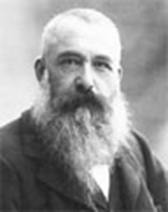
Claude Monet
The Founder of Impressionism
Born on November 18, 1840
Died on December 5, 1926
Age at death: 86
Profession: Painter
Place of Birth: Paris, France
Place of Death: Giverny, France
Claude Monet was born on November 14, 1840, in Paris, France, as the son of Adolphe Monet and Louise-Justine Monet. When his father’s grocery business began to fail, the family moved to Le Havre when Monet was five years old. He began secondary school in 1851 and quickly gained local recognition by selling caricatures he drew for 10 to 12 francs, demonstrating an early artistic talent and independent spirit.
After beginning formal art lessons, Claude Monet met Eugène Boudin, who introduced him to oil painting and the practice of painting outdoors. This encounter proved decisive, shaping Monet’s lifelong devotion to plein air painting. At the age of sixteen, following the death of his mother, Monet left school and went to live with his aunt, Madame Lecadre. In 1859, he moved to Paris to pursue artistic training, spending his days visiting exhibitions and studios rather than enrolling in official academic programs.
Rejecting the rigid methods of academic instruction, Monet occasionally attended the studio of Charles Jacque and the free Swiss Academy, where he developed independently. There, he met Camille Pissarro. Exposure to the works of Eugène Delacroix and intense artistic debates at the Martyrs café enriched his cultural and artistic understanding far beyond formal schooling.
In the autumn of 1860, Monet was drafted into the army and sent to Algeria under a seven-year contract. His aunt secured his release during his second year on the condition that he pursue formal art education. In early 1862, he returned to Le Havre and spent time in Normandy, painting coastal and rural landscapes that further refined his sensitivity to light and atmosphere.
Later in 1862, while studying in Paris under Charles Gleyre, Monet grew increasingly disillusioned with traditional academic painting. During this period, he formed close friendships with Pierre-Auguste Renoir, Frédéric Bazille, and Alfred Sisley. Together, they explored new approaches to painting, capturing the effects of natural light through broken color and rapid brushstrokes. These shared experiments would later be known as Impressionism.
In 1863, Monet met Edouard Manet at an exhibition, an encounter that further strengthened his artistic resolve. His major breakthrough came in 1866 when he exhibited a painting featuring his future wife, Camille Doncieux, at the official Salon, achieving significant success. Shortly thereafter, Monet gradually abandoned figure painting, concentrating instead on landscapes, where his artistic vision flourished most fully.
During the Franco-Prussian War of 1870–1871, Monet lived in England. After returning to France in May 1871, he visited Le Havre, where he painted Impression, Sunrise. This work, now housed at the Musée Marmottan-Monet in Paris, later gave its name to the entire Impressionist movement.
In 1873, Monet settled in Argenteuil, near Paris along the Seine River, where he lived for six years and produced many of his most celebrated works. Despite severe financial hardship, his artistic output intensified. In 1876, he received commissions from collector and businessman Ernest Hoschedé to create decorative panels. Monet and his wife moved into the Hoschedé household. After Hoschedé’s bankruptcy in 1877 and flight to Belgium, Monet remained closely connected to the family.
Following the birth of his second son, Michel, on March 17, 1878, Monet suffered a devastating loss when his wife Camille died of tuberculosis on September 5, 1879. Monet subsequently lived in Vétheuil with his two children and Alice Hoschedé and her six children. After Ernest Hoschedé’s death in 1891, Monet and Alice married in July 1892.
The family relocated several times—first to Poissy in 1881, then to Vernon in 1883—before finally settling in Giverny in May 1883, approximately 80 kilometers from Paris. Monet spent the remainder of his life there, painting extensively in his garden. He frequently traveled, sometimes alone and sometimes with Pierre-Auguste Renoir, painting along the Mediterranean coast and in southern France.
By the late 1880s, public and commercial interest in Impressionism began to grow. In 1888, Monet painted numerous landscapes in Antibes and began working on series depicting the same subject under different lighting conditions. His series of the Rouen Cathedral façade, painted nearly forty times between 1892 and 1894, marked a turning point in his career. Financial stability followed, enabling him to purchase his home in Giverny in 1890.
Determined never to experience poverty again, Monet devoted himself fully to his most ambitious works. Between 1883 and 1908, he traveled extensively around the Mediterranean, producing countless landscape paintings. In 1915, he built a massive studio measuring 276 square meters, where between 1916 and 1926 he created monumental water-lily compositions.
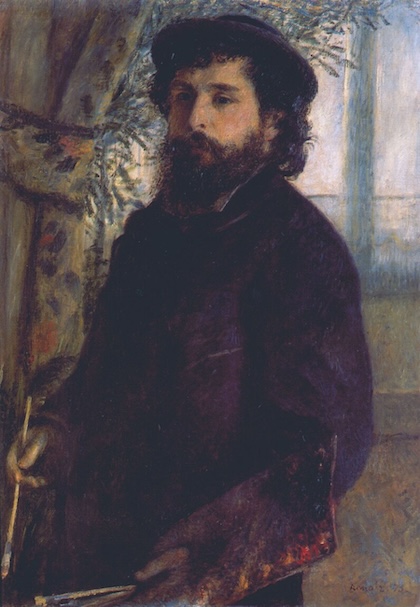
In 1923, Monet underwent two cataract surgeries that temporarily affected his vision. Despite these challenges, he continued working with remarkable determination. On December 5, 1926, Claude Monet died in Giverny at the age of eighty-six from lung cancer.
One of his works, London, the Parliament, Effects of Sun in the Fog (1904), was sold in 2004 for 20.1 million dollars, reflecting his enduring market value. The largest collection of Monet’s paintings is held at the Musée d’Orsay in Paris. His monumental Water Lilies series (1915–1924), consisting of eight mural panels, is permanently displayed at the Orangerie Museum in the Tuileries Garden. His works are also among the greatest treasures of institutions such as the Metropolitan Museum of Art, the Museum of Modern Art, the British Museum, the National Gallery, and the Louvre.
Marriages:
First wife: Camille Doncieux, whom he met in 1866 and married in 1870. She died of tuberculosis on September 5, 1879. They had two sons, Jean Monet (1867–1914) and Michel Monet (1878–1966).
Second wife: Alice Hoschedé, whom he married in July 1892. She died in 1911.
Source: Biyografiler.com
Frequently asked questions about Claude Monet
Who is Claude Monet?, Claude Monet biography, Claude Monet life story, Claude Monet age, Claude Monet facts, Claude Monet birthplace, Claude Monet photos, Claude Monet videos, Claude Monet career
Related Biographies

Lamine Yamal
Professional footballer

Erling Haaland
Professional footballer

Kylian Mbappe
Professional footballer

Keanu Reeves
Actor

Austin Abrams
Actor

Bad Bunny
Rapper, Songwriter


Hongjoong
Singer, Rapper, Songwriter, Composer

Ludacris
Rapper, Actor

Kwon Eunbi
Singer

Sarah Wayne Callies
Actress, Screenwriter, Producer, Director

LaTavia Roberson
Singer, Actress, Entrepreneur

Pedro Sanchez
Politician
Lamine Yamal
Professional footballer

Claudia Sheinbaum
President, Politician, Scientist, Academic
Erling Haaland
Professional footballer

Leonardo DiCaprio
Actor
Keanu Reeves
Actor