
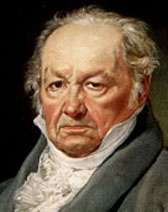
Francisco Goya
The Dark Visionary of Romanticism
Born on March 30, 1746
Died on April 16, 1828
Age at death: 82
Profession: Painter
Place of Birth: Fuendetodos, Zaragoza, Spain
Place of Death: Bordeaux, France
Francisco José de Goya y Lucientes was a Spanish painter and printmaker, regarded as one of the leading figures of the Romantic movement and one of the most important precursors of modern art. Renowned for his powerful portraits, psychological depth, and unflinching portrayal of violence, madness, and human cruelty, Goya profoundly influenced later artists such as Edouard Manet, Pablo Picasso, and Francis Bacon.
Francisco Goya was born on March 30, 1746, in the village of Fuendetodos near Zaragoza, Spain. His father, José Goya, was a farmer. Goya made his earliest attempts at painting in Zaragoza. At the age of thirteen, he entered the workshop of José Luzán in Zaragoza, where he received four years of formal training.
In 1763, Goya moved to Madrid to work with the painter Francisco Bayeu, whom he would later become related to by marriage. Following the artistic tradition of the time, which encouraged promising painters to study in Italy, Goya traveled extensively for nearly five years through Naples, Rome, and Parma. Rather than focusing on the grandeur of Italian art, he closely studied technique. In 1771, he won first prize at a painting competition in Parma. Upon returning to Spain, he was already a recognized artist.
After his return, Francisco Goya painted decorative works for Zaragoza Cathedral, including frescoes for the smaller choir. In 1774, he was summoned to Madrid and commissioned to design tapestry cartoons for the Royal Tapestry Factory of Santa Bárbara. During this period, his work shows the influence of the great Spanish master Diego Velazquez. In 1779, he painted a portrait of King Charles III of Spain. In 1780, he was appointed royal painter and admitted to the Royal Academy of San Fernando.
Goya’s career advanced rapidly. In 1785, he became deputy director of the Academy’s painting department. In 1788, he was appointed one of the court painters to King Charles IV of Spain, and in 1799 he rose to the prestigious position of First Court Painter. He painted numerous royal portraits, gained widespread fame, and lived in considerable prosperity during these years.
In 1792, while traveling through southern Spain, Goya fell gravely ill in Seville. The illness left him permanently deaf at the age of forty-six. This physical isolation marked a decisive turning point in his art and personality. He spent a year in Andalusia with the Duchess of Alba, to whom he was passionately attached. After returning to Madrid in 1793, he began working on his famous series of eighty-four etchings titled Los Caprichos (1795–1798), a biting critique of superstition, ignorance, and social hypocrisy.
In 1795, having largely recovered, Goya resigned from his official duties and decorated the dome of the Church of San Antonio de la Florida with frescoes. Closely following the French Revolution, he was deeply influenced by the ideas of Jean Jacques Rousseau. Around 1800, he completed the monumental group portrait The Family of Charles IV, now in the Prado Museum, representing the peak of his achievement in portraiture.
In 1808, Spain entered a period of profound tragedy when Napoleon Bonaparte invaded the country. The brutal conflict that followed until 1814 left Goya deeply shaken. As a committed patriot, he witnessed atrocities committed by French troops against Spanish civilians. These experiences profoundly darkened his artistic vision, as seen in works such as The Third of May 1808. His palette became dominated by blacks, grays, and muted tones, and his art increasingly reflected despair, violence, and human suffering.
By 1815, Francisco Goya had largely withdrawn from public life, painting mainly for himself and close friends. In 1819, seeking isolation from society, he moved with his long-term companion Leocadia Weiss to a modest house outside Madrid known as *Quinta del Sordo* (“House of the Deaf Man”). There, Goya covered the plaster walls with a series of deeply disturbing paintings later known as the Black Paintings. Executed directly on the walls without commercial intent, these works—dominated by dark colors and nightmarish imagery—represent the culmination of his artistic vision. Titles were assigned only later by art historians.
In the late 19th century, long after Goya’s death, the walls of *Quinta del Sordo* were removed and transferred to the Prado Museum in Madrid, where the paintings were carefully transferred onto canvas using a specialized technique.
Due to the controversial nature of some of his works, Francisco Goya was summoned before the Spanish Inquisition. This experience deeply disillusioned him with Spain. Fearing further persecution, and widowed for over twelve years, he left Spain in 1824 under the pretext of seeking medical treatment and settled in France. His only surviving son, Javier Goya, and his daughter-in-law visited him in Bordeaux in 1828.
Francisco Goya married Josefa Bayeu in 1774, the sister of Francisco Bayeu. The couple had five children, though only one survived into adulthood. After Josefa’s death in 1812, Goya never remarried.
He died on April 16, 1828, in Bordeaux, France, at the age of eighty-two. He left behind nearly five hundred oil paintings and frescoes, around three hundred lithographs, and hundreds of drawings.
Regarded as one of the pioneers of modern art, Francisco Goya bridged the gap between the Old Masters and modern expression. A large portion of his work is housed in Madrid’s Museo del Prado.
Notable Works:
The Milkmaid of Bordeaux, 1827–1828 (Madrid, Prado)
Tapestry Cartoons, 1776–1792 (Madrid, Prado)
The Parasol, 1777
The Duchess of Alba, 1796 (New York, Hispanic Society)
The Nude Maja, c. 1797–1800 (Madrid, Prado)
Charles IV and María Luisa on Horseback, 1799
Woman with a Fan, 1807 (Paris, Louvre)
The Majas on the Balcony, 1810–1815 (New York, Metropolitan Museum of Art)
The Colossus, 1810–1812 (Madrid, Prado)
The Third of May 1808, 1814
Saturn Devouring His Son, c. 1820
Witches’ Sabbath, 1820–1822
Print Series:
Tauromaquia, 1815
Proverbs, 1815
Disparates, published posthumously in 1850
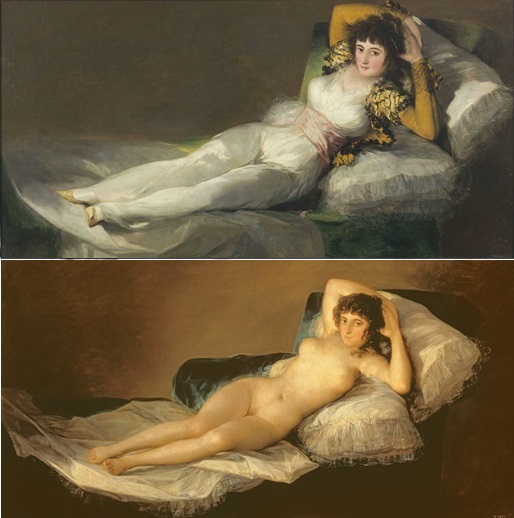
The painting The Nude Maja exists in two versions, the first being the nude figure, followed later by The Clothed Maja. Despite being among the earliest nude works in Western art, the painting is not mythological. Goya was accused of immorality by the Spanish Inquisition in 1808 because of this work. The nude was commissioned by Spanish Prime Minister Manuel de Godoy and entered his collection on November 12, 1800. At Godoy’s request, Goya later painted its companion piece between 1802 and 1805.
Source: Biyografiler.com
Frequently asked questions about Francisco Goya
Who is Francisco Goya?, Francisco Goya biography, Francisco Goya life story, Francisco Goya age, Francisco Goya facts, Francisco Goya birthplace, Francisco Goya photos, Francisco Goya videos, Francisco Goya career
Related Biographies

Lamine Yamal
Professional footballer

Erling Haaland
Professional footballer

Kylian Mbappe
Professional footballer

Keanu Reeves
Actor

Austin Abrams
Actor

Bad Bunny
Rapper, Songwriter


Hongjoong
Singer, Rapper, Songwriter, Composer

Ludacris
Rapper, Actor

Kwon Eunbi
Singer

Sarah Wayne Callies
Actress, Screenwriter, Producer, Director

LaTavia Roberson
Singer, Actress, Entrepreneur

Pedro Sanchez
Politician
Lamine Yamal
Professional footballer

Claudia Sheinbaum
President, Politician, Scientist, Academic
Erling Haaland
Professional footballer

Leonardo DiCaprio
Actor
Austin Abrams
Actor